What is a Token Factory?

Written by Arnon Shimoni
✓ Expert
Last updated on:
What is a token factory?
A token factory is GPU infrastructure operated to sell token-metered AI inference: instead of renting hardware by the hour, the operator hosts models, exposes them through APIs, and bills customers per token of model input and output. The term comes from the orchestration layer (For example, Rafay markets Token Factory capabilities for turning GPU providers into operators of token-metered AI services) and it names the neocloud category's move up the value chain.
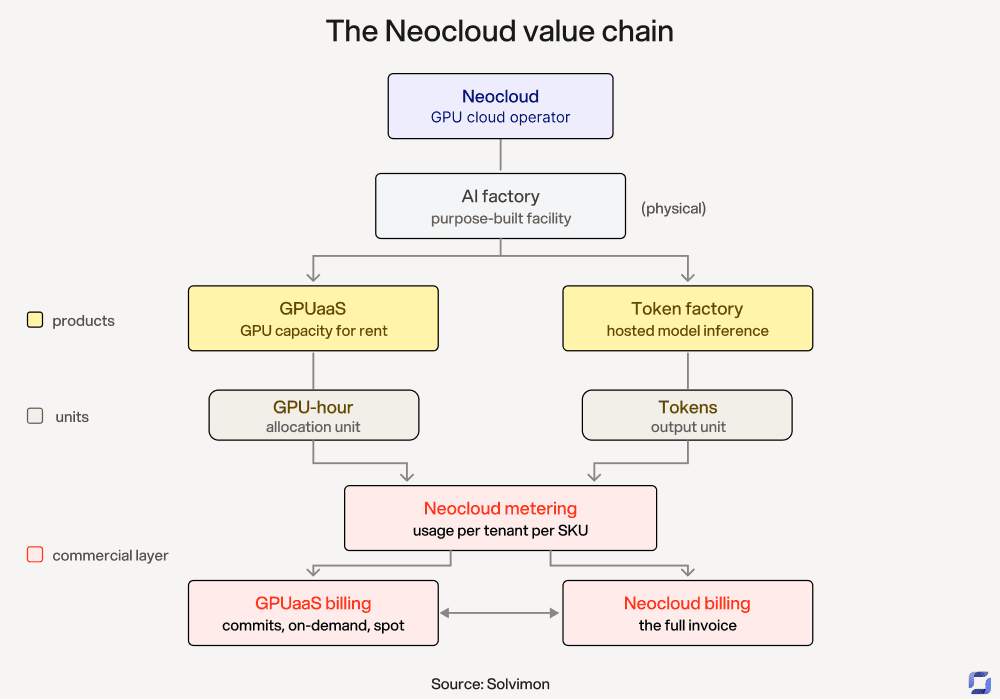
The facility converts energy into tokens, and tokens are the product. See AI factory for the physical side; this glossary entry covers the commercial one.
How does the token factory stack work?
Operators describe the same 3 layers, whatever they call them:
Layer | What the customer gets | What they pay for |
|---|---|---|
Bare metal / reserved clusters | Raw GPU capacity, their own stack on top | Committed capacity per SKU |
Virtualized compute | VMs, managed Kubernetes or SLURM, per-GPU rental | GPU-hours, on demand |
AI-as-a-service | Hosted models behind an API, log in and consume | Tokens in, tokens out |
At the bottom layer, the customer chooses the hardware. At the top, as one European neocloud founder puts it, nobody wants a GPU: customers want AI in operation, and the provider decides what silicon serves the request. That inversion is the whole point. Once the unit is the token, the hardware becomes the operator's optimization problem, and the operator captures the utilization upside instead of handing it to the renter.
Why are neoclouds becoming token factories?
Margin and defensibility. A GPU-hour is a commodity input priced against every other provider's GPU-hour. A token is an output, priced in the same market as AI token pricing generally, where the reference prices are set by model providers rather than by hardware arbitrage. Open-source models make the move practical: the operator hosts capable open-weight models, fine-tuned where needed, without owning a frontier lab.
For the sovereign tier the motive is sharper still. European operators host open-source models on EU infrastructure so that companies get competitive AI without shipping data into foreign-jurisdiction platforms. The token factory is how sovereignty becomes a product rather than a compliance statement (see sovereign AI billing).
What's the billing problem inside a token factory?
Two meters, one margin. The infrastructure meter counts allocation (neocloud metering: tenant, SKU, instance, hours, state). The inference meter counts tokens per tenant per model. The same GPUs serve both products, so knowing the token product's margin requires allocating hardware cost to token revenue continuously. Providers that can't compute that allocation are pricing their flagship product on instinct.
Then the surrounding structures arrive: prepaid credits for customers who want budgetable spend, volume tiers on token rates, commit-and-drawdown contracts that span both layers, and deferred revenue treatment for everything prepaid. Hours, tokens, credits: three units on one invoice, which is a single-ledger problem. Solvimon runs token rating, credit balances, and infrastructure metering as one price configuration on one ledger: Solvimon for AI.
FAQ
Is "token factory" a product or a category term?
Both, currently. Companies ship it as a product capability; the category is adopting it as shorthand for token-metered infrastructure operations, the way "AI factory" outgrew any single vendor.
How is a token factory different from a model provider like OpenAI?
The model provider trains frontier models and sells them. A token factory operates infrastructure and typically serves open-source or customer-supplied models. Same billing unit, different position in the stack.
Do token factories replace GPU rental?
No. Operators run both layers at once, often for the same customer: reserved clusters for the customer's own workloads, token APIs for everything else.
What do token factories charge?
Per-token rates benchmarked against the model market, frequently wrapped in credit packs or committed-spend deals. The pricing dynamics track token economics downstream.
Related
AI factory: the physical plant
AI token pricing: the market the output prices into
Neocloud: the operators making the move
GPUaaS billing: the layer below
Ready for billing v2?
Solvimon is monetization infrastructure for companies that have outgrown billing v1. One system, entire lifecycle, built by the team that did this at Adyen.