
What is a Minimum Commit?

Written by Arnon Shimoni
✓ Expert
Last updated on:
A minimum commit is a contractual guarantee that a customer will spend at least a specified amount over a defined period, typically 12 to 36 months. If the customer’s actual usage falls below that threshold, they still pay the committed amount. The vendor gets revenue predictability, and the customer gets a lower unit price in exchange for the commitment.
This structure is foundational to how cloud infrastructure and increasingly SaaS and AI companies monetize enterprise customers. AWS, Google Cloud, Snowflake, Databricks, and most large consumption-based platforms run on minimum commits. The structure has migrated into SaaS as usage-based and hybrid pricing models became the norm, because usage-based pricing without a commit floor creates revenue volatility that makes forecasting painful for both vendor and customer.
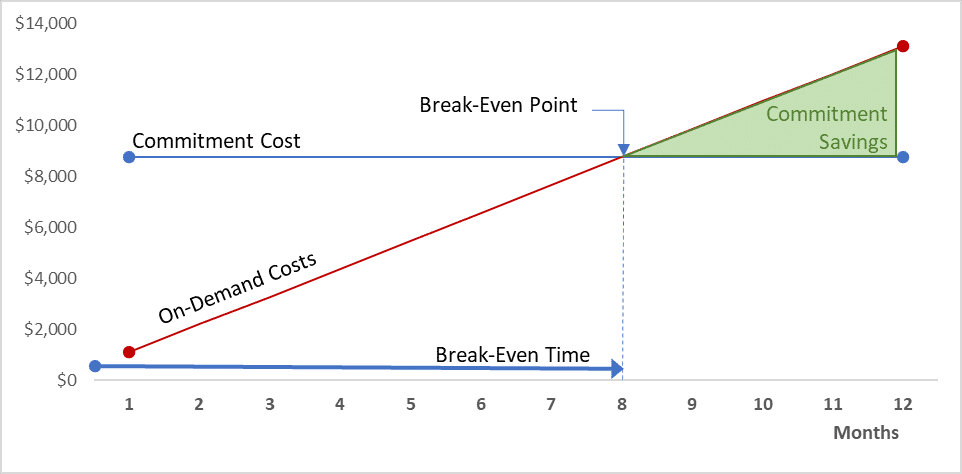
A minimum commitment guarantees revenue for a while. Illustration and more information at FinOps.
How minimum commits work
The basic structure is straightforward: the customer agrees to spend $X over Y months. In return, they get better pricing, priority support, or access to features reserved for committed customers. If they spend more than $X, they pay the overage at the agreed rate. If they spend less, they still owe $X.
Term | What it means | Example |
|---|---|---|
Committed spend | The dollar amount the customer guarantees to spend | “$120K annual commit” means the customer pays at least $120K/year regardless of usage |
Commit period | The timeframe over which the commitment applies | 12 months (annual), 24 months, 36 months. Longer periods typically unlock better rates |
Drawdown | How the committed spend gets consumed | Customer uses product throughout the period. Usage charges draw down against the committed balance |
Overage | Usage beyond the committed amount | Customer committed $120K but used $150K worth. The $30K overage is billed at the contracted rate (or a different overage rate) |
Shortfall | Unused committed spend at period end | Customer committed $120K but only used $80K. They still pay $120K. The $40K is lost |
Rollover | Whether unused commit carries to the next period | Some contracts allow partial rollover (e.g., 50% of unused balance rolls to next year). Most don’t |
The Snowflake model is the canonical example. Customers commit to an annual spend amount and draw down credits against it as they consume compute, storage, and AI services. The commit unlocks tiered pricing that drops as the commitment increases. Snowflake’s entire revenue model is built on this structure: predictable committed ARR with usage-based consumption underneath.
Why minimum commits exist
Three forces drive the adoption of minimum commits.
Vendor-side: revenue predictability. Usage-based pricing aligns price with value, but it creates forecasting problems. A customer might use $50K one quarter and $20K the next. Minimum commits establish a revenue floor that vendors can plan against, hire against, and report to investors. For public companies or late-stage startups, this is the difference between predictable revenue growth and quarterly surprises.
Customer-side: budget certainty. Procurement teams in large organizations need to know what they’re going to spend. An open-ended usage-based contract with no ceiling or floor is hard to get approved through enterprise procurement. Minimum commits give the CFO a number to budget against, and the discount on unit pricing sweetens the deal.
Mutual: relationship alignment. A minimum commit is a bet on the relationship continuing. Both sides have skin in the game. The customer is incentivized to consolidate usage onto the platform (to avoid waste), and the vendor is incentivized to deliver enough value that the customer actually consumes their commitment. As one pricing framework puts it: commitment pricing creates shared interest between vendor and customer. That alignment separates it from just being a discount.
Minimum commit structures
Not all commits are structured the same way. The three most common patterns serve different purposes.
Structure | How it works | Best for |
|---|---|---|
Spend commit | Customer commits to a total dollar amount. Usage draws down against it. Most flexible for the customer since they can consume any mix of products or services | Multi-product platforms, cloud infrastructure. Snowflake, AWS, and Databricks use this model |
Volume commit | Customer commits to a specific volume of usage (e.g., 10M API calls/year, 500K credits). Unit price is set based on the volume tier | Single-product companies with clear usage metrics. Works well for API businesses and metering-heavy products |
Tiered commit | Customer commits at a tier level. If usage drops below the tier, pricing reverts to a higher per-unit rate. Different from a spend commit because it’s tied to volume thresholds rather than dollars | Products where usage naturally fluctuates and the vendor wants to incentivize sustained volume without guaranteeing a specific dollar floor |
The risks of minimum commits
Minimum commits aren’t free money. They create obligations on both sides that can go wrong.
For vendors:
Customers who commit but don’t consume become churn risks at renewal. If a customer paid $120K but only used $60K worth of product, that renewal conversation is adversarial. The customer feels they overpaid. The vendor’s usage data confirms it. Unless there’s a clear path to increasing consumption, the customer either downsizes the commit or leaves entirely.
For customers:
Commits lock in budget that might be needed elsewhere. If business priorities shift or the product doesn’t deliver expected value, the committed spend becomes stranded. Enterprise procurement teams increasingly push for shorter commit periods (12 months vs. 36) and partial rollover provisions for this reason.
For both:
The shortfall/waste dynamic creates trust issues. Vendors who rely on breakage (customers not consuming their full commit) as a revenue strategy are building on friction, not value. As AI costs rise and customers scrutinize utilization more aggressively, products that rely on unused commits risk accelerated churn.
Minimum commits and billing infrastructure
Modeling a minimum commit sounds simple. In practice, it requires your billing system to track cumulative spend against a commitment threshold across a multi-month period, apply different rates for within-commit vs. overage usage, handle mid-period adjustments (customer wants to increase their commit), manage rollover logic if applicable, and reconcile committed vs. actual spend at period end.
Most subscription billing systems (Stripe, Chargebee, Recurly) were built for fixed recurring charges, not drawdown-against-commit logic. This is why companies running minimum commit models often end up with custom billing code, spreadsheet reconciliation, or dedicated commit management tools layered on top of their billing platform.
Capability | Why it matters for commits |
|---|---|
Running balance tracking | System must show how much of the commit has been consumed at any point in time |
Multi-rate rating | Within-commit usage might be rated differently than overage usage |
Period-aware billing | Invoices need to reflect drawdown against an annual or multi-year pool, not just monthly usage |
Rollover logic | If unused commit rolls over, the system needs to carry balances across billing periods |
Contract amendments | Mid-period commit increases (customer wants to bump from $120K to $180K) need to adjust rates and thresholds without manual intervention |
Shortfall invoicing | At period end, if usage falls short, the system needs to generate a true-up invoice for the difference |
Related
Volume commitments. Committed usage levels in exchange for better rates.
Solvimon flexible pricing. Run any pricing model without engineering sprints.
Volume discounts. Lower unit prices at higher purchase volumes.
Reserved GPU capacity billing. Commit structures at data-center scale.
Ready for billing v2?
Solvimon is monetization infrastructure for companies that have outgrown billing v1. One system, entire lifecycle, built by the team that did this at Adyen.