What is Yield Optimization?

Written by Arnon Shimoni
✓ Expert
Last updated on:
Yield optimization is the practice of adjusting prices dynamically to extract the maximum revenue from a finite set of customers or capacity. It originated in airlines and hotels, where a fixed number of seats or rooms needed to generate the most revenue possible before departure or checkout. A seat that flies empty is revenue that's gone forever.
In software, the concept translates differently. SaaS companies don't have perishable inventory in the traditional sense, but they do have constrained resources: compute capacity, support bandwidth, onboarding slots, and the attention of their sales team. Yield optimization in SaaS means pricing each customer segment, contract, or usage tier to capture the most value from the resources you allocate to serving them.
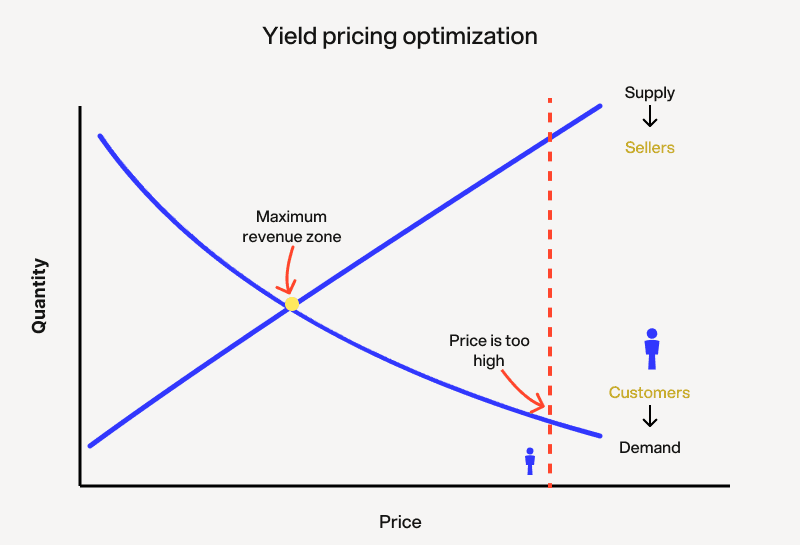
Yield optimization is about charging the right amount for the right customer at the right time, which is different from just charging more. A customer who signs an annual contract at $50K might generate more lifetime value than one who pays $70K month-to-month and churns in four months. The yield on the first deal is higher even though the sticker price is lower.
How yield optimization works in SaaS
In traditional industries, yield optimization runs on algorithms that adjust prices in real time based on demand signals. Airlines change seat prices hundreds of times a day. Hotels adjust room rates based on occupancy forecasts.
SaaS yield optimization is slower and more structural. It operates through four mechanisms.
Mechanism | What it does | Example |
|---|---|---|
Segment-based pricing | Different prices for different customer profiles based on willingness to pay and cost to serve | Startups get self-serve at $49/month. Enterprise gets custom pricing at $5K/month. Same product, different yield per segment |
Contract structure | Annual commits, multi-year deals, and volume tiers that trade discount for predictability | Snowflake offers lower per-credit rates for higher annual commitments. The discount reduces unit price but increases total contract value and retention |
Usage-based scaling | Price increases as usage increases, capturing more value from customers who get more value | Twilio charges per API call. Customers who send more messages pay more, naturally aligning price with value received |
Packaging and bundling | Grouping features into tiers so that customers self-select into higher-value plans | HubSpot bundles CRM, marketing, sales, and service into packages at increasing price points. Each tier captures customers with higher willingness to pay |
None of these require real-time algorithmic pricing. They're structural decisions that optimize yield across your customer base by ensuring you're not charging your most valuable customers the same price as your smallest ones.
Yield optimization vs. dynamic pricing
These terms get used interchangeably, but they're different.
Yield optimization | Dynamic pricing | |
|---|---|---|
Timeframe | Structural. Set quarterly or annually | Real-time. Changes hourly or daily |
Where it applies | Contract structure, packaging, segment pricing | Transaction-level pricing based on demand signals |
Common in | SaaS, enterprise software, B2B | E-commerce, travel, ride-sharing, retail |
Customer expectation | Prices are stable within a tier or contract | Prices fluctuate and customers expect variability |
Risk | Leaving money on the table if segments are too broad | Customer backlash if price changes feel arbitrary |
Most SaaS companies practice yield optimization without calling it that. Every time you create a pricing tier, negotiate an enterprise contract, or offer volume discounts, you're optimizing yield.
Dynamic pricing in SaaS is rare for a reason. B2B customers budget annually. A price that changes weekly makes forecasting impossible for procurement teams. The few SaaS companies that have tried real-time dynamic pricing for core subscriptions have generally retreated to stable pricing with usage-based variable components instead.
Where SaaS companies lose yield
Yield leaks are places where you're systematically undercharging relative to the value delivered. They're common and often invisible until someone looks.
Flat pricing across segments. If a 10-person startup and a 500-person enterprise both pay $99/month for the same plan, you're leaving yield on the table from the enterprise customer. The enterprise gets far more value (more users, more data, more integrations) but pays the same price.
Unlimited usage on fixed plans. Plans that include "unlimited" anything (API calls, storage, seats) cap your yield at the plan price regardless of how much value the customer extracts. Your heaviest users become your least profitable customers.
Manual discounting without guardrails. When sales reps negotiate individually without discount floors or margin minimums, yield erodes deal by deal. A 2025 SaaS pricing benchmark study found that enterprise deals with unstructured discounting averaged 18% lower ACV than deals with defined discount tiers.
Ignoring cost to serve. Two customers paying the same price but consuming vastly different amounts of support, compute, or onboarding resources have different yields. If you don't measure cost to serve at the customer level, you can't optimize for it.
Yield optimization and AI products
AI products make yield optimization harder because the cost to serve varies dramatically by customer. A customer running complex multi-step agent workflows might consume 50x more compute than one running simple text queries, but if they're on the same plan, your yield on the first customer is negative.
This is why hybrid pricing (base fee + usage) is the dominant model for AI products. The base fee establishes a revenue floor, and usage charges ensure that yield scales with actual cost and value delivered.
Pricing model | Yield optimization potential | Why |
|---|---|---|
Flat rate | Low | Heavy users subsidized by light users. No mechanism to capture additional value |
Per-seat | Medium | Scales with team size but doesn't account for usage intensity. Power users still subsidized |
Usage-based (pure) | High on yield per unit, low on predictability | Captures value precisely but creates revenue volatility. Customers may limit usage to control costs |
Hybrid (base + usage) | Highest | Base fee provides floor. Usage charges capture value from heavy users. Credits or committed spend add predictability |
Outcome-based | Highest alignment, hardest to implement | Price tied directly to value. But requires clear attribution and confidence in AI performance |
The shift to hybrid isn't just a pricing trend. It's a yield optimization strategy. Companies that can't differentiate pricing by usage intensity leave yield on the table from their best customers while potentially overcharging their smallest ones.
What yield optimization requires from billing
Optimizing yield across segments, contract types, usage tiers, and customer profiles requires a billing system that can actually model this complexity. If changing a price tier requires an engineering sprint, you can't iterate on yield. If you can't see margin per customer, you can't identify yield leaks. If your quoting system can't model volume commits with usage overage, your sales team can't structure deals that optimize yield.
This is the architectural problem. Yield optimization is a strategy, but billing infrastructure is what makes it executable.
Frequently Asked Questions
What is yield optimization?
Yield optimization is maximising the revenue extracted per customer or per unit of capacity, through segmentation, contract structure and pricing rather than through acquiring more customers.
How is yield optimization different from dynamic pricing?
Dynamic pricing changes the list price in response to demand or conditions. Yield optimization works mainly through structure: which segment gets which rate, how contracts are shaped, and where commitments and tiers sit. In B2B software the structural levers matter far more.
Where do SaaS companies lose yield?
Undifferentiated pricing across segments with very different willingness to pay, discounts that never expire, commitments sized too low, and expansion that requires a sales conversation rather than happening automatically.
Does yield optimization apply to usage-based pricing?
More so than to subscriptions. With consumption, revenue per account is determined continuously, so meter selection, tier placement and commitment sizing compound over the life of the contract.
What does yield optimization require from billing?
The ability to run different rate cards per segment, enforce expiry on concessions, model the effect of tier changes before making them, and report effective rate per account rather than list price.
Is yield optimization the same as revenue optimization?
They overlap heavily. Revenue optimization is the broader practice including retention and collection. Yield optimization focuses specifically on extracting more from each customer or unit of capacity.
Related
Revenue optimization. The broader practice yield sits inside.
Customer profitability. Whether higher yield is actually higher profit.
Tiered usage-based pricing. Where tier placement decides yield.
Minimum commit. Commitment sizing as a yield lever.
Price benchmarking. Knowing what the market will bear.
Ready for billing v2?
Solvimon is monetization infrastructure for companies that have outgrown billing v1. One system, entire lifecycle, built by the team that did this at Adyen.