
What is margin leakage? Where profit disappears between signature and cash

Written by Arnon Shimoni
✓ Expert
Last updated on:
Margin leakage is the gap between the profit a deal was supposed to produce and the profit it actually produces. It happens after signature, quietly, through a hundred small mechanisms rather than one visible event.
It is distinct from revenue leakage, which is revenue you were entitled to and did not collect. Margin leakage includes that, and adds everything on the cost side: usage you served and never billed, infrastructure cost you never attributed, and discounts that outlived their reason.
Field | Detail |
|---|---|
What it is | Profit lost between the deal as modelled and the deal as delivered |
Typical scale | Commonly 1-5% of revenue, higher on consumption products with real cost of goods |
Where it starts | At signature, not at the invoice |
Main causes | Unexpired discounts, unbilled or under-metered usage, unattributed infrastructure cost, manual billing |
Hardest part | Detection. Nothing fails visibly, so no alert fires |
Related |
Where margin actually leaks
Source | Mechanism | Typical detection |
|---|---|---|
Unexpired discounts | A time-boxed rate with no enforced end date becomes permanent | Never, until someone audits effective rates |
Under-metered usage | Events dropped, deduplicated too aggressively, or arriving after the invoice run | Only if usage is reconciled against product telemetry |
Unmetered features | A capability ships without a meter and is served for free indefinitely | When someone asks why COGS grew |
Cost of goods drift | Inference or infrastructure cost rises, price does not | At the quarterly margin review, too late |
Manual billing | Accounts invoiced by hand, with the errors that implies | Customer complaints, in one direction only |
Granted credits | Free usage issued as goodwill, never expired, drawn down at full cost | Rarely |
Support and overage absorption | Overages waived deal by deal to keep a customer happy | Only in aggregate, if anyone looks |
FX exposure | Priced in one currency, cost incurred in another | When the rate moves against you |
Notice that almost every detection column says the same thing. Margin leakage does not throw an error. Invoices go out, customers pay them, and the number is simply smaller than it should have been.
The spreadsheet in the middle
The structural cause in most companies is that the four numbers you need to compute margin live in four different systems, and nothing joins them continuously.
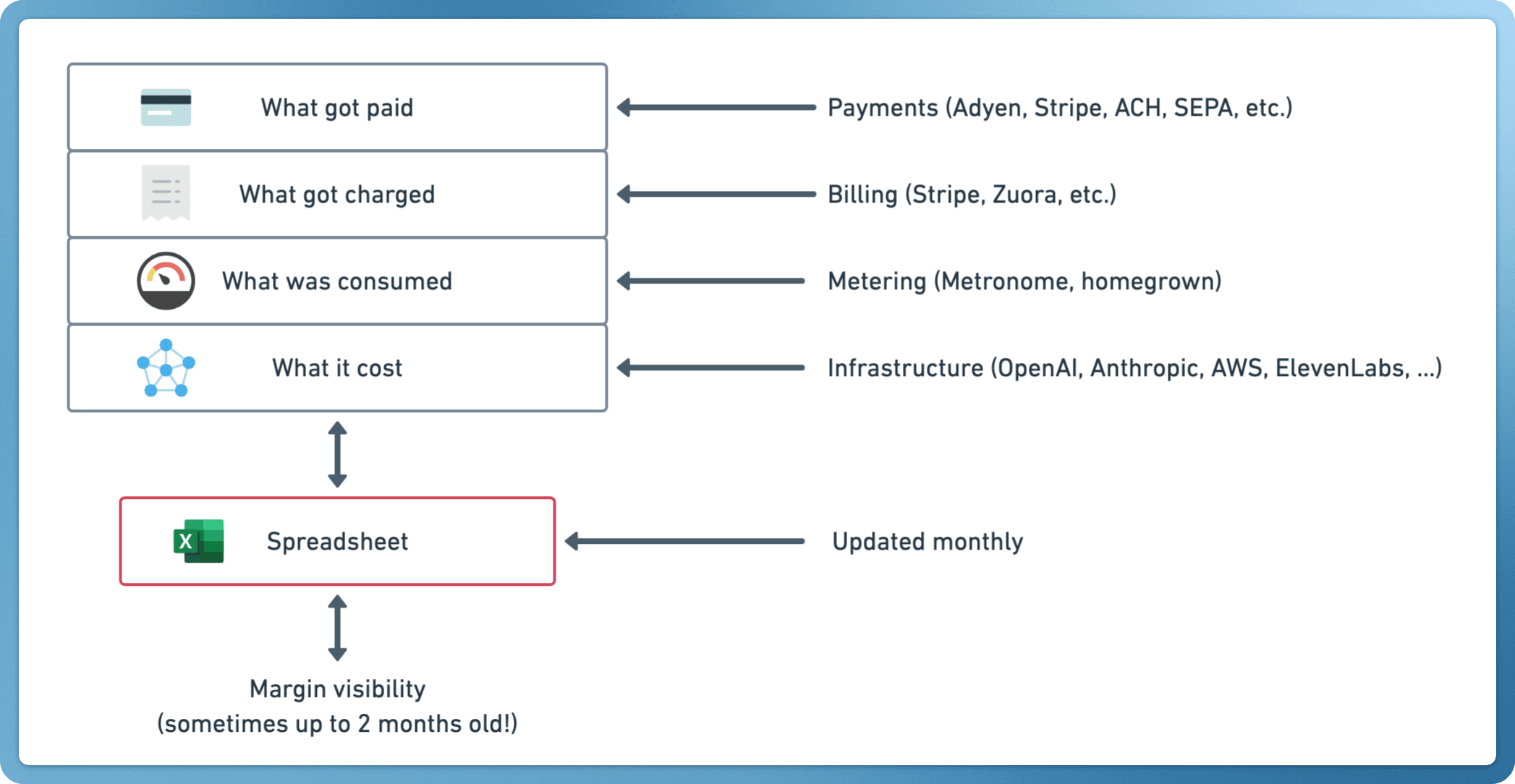
What got paid sits with the payment processor. What got charged sits in billing. What was consumed sits in metering or a data warehouse. What it cost sits with your infrastructure and model providers. A spreadsheet joins them monthly, and margin visibility is therefore always somewhere between two weeks and two months stale.
On a consumption product with real cost of goods, that latency is the whole problem. By the time a margin issue is visible in the spreadsheet, it has been running for a full period and has already been priced into a renewal.
Why AI products leak more
Traditional SaaS has near-zero marginal cost, which makes margin leakage a rounding error for most accounts. AI products do not have that cushion.
Real marginal cost. Every inference call costs money. A meter that under-counts by three percent is a direct three percent margin loss, not a forgone opportunity.
Volatile unit economics. Model prices change, context lengths grow, and a workload that was profitable at launch may not be six months later.
Multi-model routing. The same customer action may hit different models at very different costs, and the invoice usually does not distinguish them.
Credit wallets. Granted or discounted credits are consumed at full infrastructure cost, so the margin impact lands later than the concession.
Retry amplification. Agent retries multiply cost while the billable action count stays flat.
How to find and stop it
Reconcile metered usage against product telemetry. If the two disagree, the difference is unbilled usage. Do this continuously, not annually.
Report effective rate per account. Not list price with a discount note. What the account actually pays per unit, ranked.
Put an expiry date on every concession. Enforced by the system that calculates charges, not recorded in a contract PDF.
Attribute cost of goods per meter. You cannot defend margin on a meter whose cost you have never measured.
Alert on margin, not just revenue. A per-account gross margin threshold catches what a revenue report never will.
Eliminate manually billed accounts. Every account billed by hand is a permanent leak with a human maintaining it.
Where Solvimon fits
Solvimon calculates charges from metered events continuously, so usage, charges and contract terms live in one system rather than being joined in a spreadsheet after the fact. Discounts, ramps and credit grants carry enforced expiry dates, which removes the largest single category of leakage.
Because cost inputs can be attributed alongside the meters that generate them, gross margin per account and per meter is observable while the period is open rather than two months after it closed.
Frequently Asked Questions
What is margin leakage?
Margin leakage is the difference between the profit a deal was expected to generate and what it actually generates. It accumulates after signature through unexpired discounts, unbilled usage, untracked cost of goods and manual billing errors.
How is margin leakage different from revenue leakage?
Revenue leakage is revenue you were contractually entitled to and did not collect. Margin leakage includes that and adds the cost side: usage served but never billed, infrastructure cost never attributed, and concessions that outlived their purpose.
How much revenue is typically lost to leakage?
Industry estimates commonly put it at one to five percent of revenue across the quote-to-cash lifecycle. On consumption products with genuine cost of goods, the margin impact can be considerably larger than the revenue impact.
What is the biggest single cause?
Discounts without enforced expiry dates. A rate granted as a temporary concession becomes the permanent rate because the end date lived in a contract document rather than in the billing system.
Why do AI products leak more margin?
Because marginal cost is real. In traditional SaaS an under-counting meter forgoes revenue on a near-zero-cost service. On an AI product, the usage was still served and still cost money, so the loss is direct.
How do you detect margin leakage?
Reconcile metered usage against product telemetry, report effective rate per account rather than list price, attribute cost of goods per meter, and alert on per-account gross margin rather than revenue alone.
Related
Revenue leakage. The revenue-side half of the same problem.
Margin management. The practice of defending margin deliberately.
Revenue assurance. The controls that catch leakage.
Discount management. Stopping the largest single cause.
The spreadsheet in the middle. Why margin visibility is always stale.
Ready for billing v2?
Solvimon is monetization infrastructure for companies that have outgrown billing v1. One system, entire lifecycle, built by the team that did this at Adyen.