What is guided selling? Putting pricing policy inside the rep's workflow

Written by Arnon Shimoni
✓ Expert
Last updated on:
Guided selling is the practice of embedding the company's product and pricing logic into the workflow a sales rep uses, so that the right configuration and the right price are the path of least resistance rather than something the rep has to know.
It is the human-facing half of CPQ. CPQ enforces what is valid. Guided selling makes the valid thing easy to find and easy to explain.
Field | Detail |
|---|---|
What it is | Product and pricing logic embedded in the rep workflow |
Delivered through | CRM, CPQ tooling, in-quote modelling, playbooks that execute rather than describe |
Goal | Correct configurations and defensible prices without requiring rep expertise |
Measured by | Quote accuracy, cycle time, discount depth, ramp time for new reps |
Necessary when | Pricing is consumption-based and the rep cannot compute the customer's bill in their head |
Fails as | A wiki page nobody opens during a live call |
The problem it solves
A rep on a call is asked what the customer will pay. With a seat model the rep can answer. With a consumption model the honest answer depends on volume, tier boundaries, commit level, overage rates and which meters the customer will actually trigger.
Without guidance the rep does one of three things, and all of them are bad. They quote a number they made up. They defer to finance and lose the momentum of the call. Or they discount to compensate for their own uncertainty, which is the most expensive of the three.
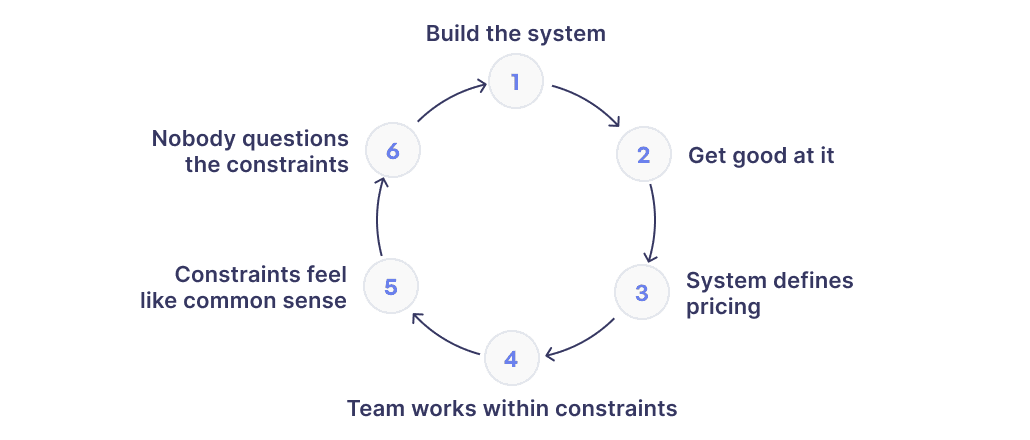
There is a second-order effect worth naming. When pricing lives in tooling reps cannot reach, the tooling starts defining what gets sold. Reps quote what is easy to quote, the product roadmap follows what is selling, and eventually nobody remembers that the constraint was technical rather than commercial.
What guided selling includes
Catalog navigation. The rep selects an outcome or a customer profile and the system proposes valid configurations rather than presenting a raw product list.
Rule enforcement. Incompatible options are unavailable, not merely discouraged.
Live price modelling. The rep can show projected spend at different volume assumptions inside the call. See price estimation.
Inline approval routing. When the rep goes past a threshold, the approval request happens in the same tool rather than in email.
Contextual objection handling. The competitive comparison and the justification for the price appear where the rep is working.
Structure suggestions. When a discount request comes in, the system proposes the alternative shape: a longer term, a higher commit, a tier change.
Guided selling for consumption pricing
This is where guided selling stops being a productivity feature and becomes a requirement.
A rep selling usage-based pricing has to be able to do three things live: define what the meter counts in plain language, model the customer's likely bill at their stated volume, and explain what happens if they exceed their commitment. None of those are memorisable across a catalog of any size.
The modelling piece matters most. A customer who cannot picture their bill will either not buy or will push for a cap that transfers all the volume risk to you. Showing a credible projection at low, expected and high volume converts an open-ended consumption contract into something procurement can approve. See quoting for how that reaches the document.
Why playbooks fail and systems work
Most guided selling initiatives start as documentation. A pricing playbook, a discount policy page, a battlecard library. These decay for a predictable reason: they require the rep to stop, leave the workflow, find the right document, and trust that it is current.
The version that works is not a better document. It is the same logic expressed as behaviour in the tool the rep is already inside. The test is simple. If following the policy is slower than ignoring it, the policy loses, every time, regardless of how well it is written.
Where Solvimon fits
Because Solvimon holds the catalog, meters, rate cards and commitment structures in one model, the pricing a rep quotes and the pricing that gets billed come from the same source. Modelled spend at a given volume is computed from the real rate card rather than a spreadsheet approximation.
That means guided selling does not require maintaining a second copy of pricing inside the CRM, which is the usual reason these systems drift out of date within a quarter.
Frequently Asked Questions
What is guided selling?
Guided selling embeds product and pricing logic into the rep's workflow so that valid configurations and approved prices are the easiest path, rather than something the rep has to remember or look up.
How is guided selling different from CPQ?
CPQ is the engine that enforces valid configurations and prices. Guided selling is the experience layer that makes the right choice discoverable and explainable during a live conversation.
Why does usage-based pricing need guided selling?
A rep cannot compute a consumption bill mentally. Without live modelling they either invent a number, defer to finance and lose momentum, or discount to cover their own uncertainty.
Do sales playbooks count as guided selling?
Only loosely. A document requires the rep to leave their workflow to consult it, so it decays. Guided selling works when the logic is expressed as behaviour in the tool rather than as text elsewhere.
What should guided selling measure?
Quote accuracy against the eventual invoice, sales cycle time, discount depth distribution, and how long a new rep takes to quote independently.
Does guided selling reduce discounting?
Usually, because a large share of discounting is reps compensating for uncertainty. Giving them a defensible price and a credible projection removes the reason to concede.
Related
CPQ. The engine underneath guided selling.
Sales enablement. The broader practice of equipping reps.
Price estimation. Modelling a consumption bill before signature.
Quote to cash. Where selling sits in the revenue process.
Deal management. The approval logic guided selling routes into.
Ready for billing v2?
Solvimon is monetization infrastructure for companies that have outgrown billing v1. One system, entire lifecycle, built by the team that did this at Adyen.