
What is Grandfathering?

Written by Arnon Shimoni
✓ Expert
Last updated on:
In pricing, grandfathering is the practice of letting existing customers keep their current pricing when you change prices for new customers. For example: A customer who signed up at $49/month stays at $49/month even after you raise the price to $79/month. New customers pay $79 while old customers keep the original price.
Almost every SaaS company does this at some point. Research shows that it's the most common price change methodology, used by 46% of SaaS companies. It feels like the right thing to do.
The mechanism is that early customers supported you when you were unproven, so honoring their original price shows loyalty.
The problem however is that grandfathering creates operational debt that compounds over time and most companies don't realize how expensive that debt becomes until it's already embedded in their billing, their contracts, their finance workflows, and their product architecture.
This article covers when grandfathering makes sense, when it doesn't, the five strategies for executing it, and the operational traps that catch companies off guard.
Why companies grandfather
The instinct to grandfather comes from three places.
Retention math - acquiring a new customer costs 5-7x more than retaining an existing one. If a price increase triggers even 10-15% churn, the math often doesn't favor the short-term revenue gain. ProfitWell data shows pricing changes without protection for legacy customers trigger 10-15% churn spikes. Grandfathering eliminates that spike entirely.
Contractual obligation - annual and multi-year contracts legally lock in pricing for the contract term. You can't raise prices mid-contract without renegotiation. This isn't optional grandfathering; it's contractual compliance.
Relationship preservation - your first 50 customers took a bet on you. They gave feedback, found bugs, and referred others. Raising their price feels like punishing loyalty. Many founders have a personal relationship with early customers that makes price increases emotionally difficult.
All three reasons are valid. The question isn't whether to grandfather. It's how to do it without creating problems that are harder to fix than the price increase itself.
Five grandfathering strategies
There isn't one way to grandfather. The right approach depends on the size of the price change, the maturity of your customer base, and how long you can afford to maintain legacy pricing.
Strategy | How it works | Best for | Risk |
|---|---|---|---|
Permanent grandfather | Existing customers keep original pricing forever | Beta users, founding customers, small cohorts you can afford to subsidize indefinitely | Creates a growing gap between old and new pricing. Hardest to unwind later |
Time-limited grandfather | Original pricing holds for a defined period (6-24 months), then migrates to new pricing | Most price increases. Gives customers time to adjust while ensuring eventual alignment | Requires billing infrastructure that can schedule future price changes per customer |
Renewal-based | Monthly customers keep pricing month-to-month. Annual customers keep pricing until renewal, then migrate | Companies with mixed billing cycles | Simpler to implement. Monthly customers migrate faster. Annual customers get natural transition points |
Feature-gated | Existing features stay at old price. New features require new pricing | Product-led companies adding significant new capabilities | Customers feel the price increase is justified by new value rather than arbitrary |
Loyalty discount | All customers move to new pricing, but legacy customers get a permanent or time-limited discount (10-20% off) | Companies that need pricing alignment but want to acknowledge tenure | Still captures most of the revenue uplift while softening the impact |
The dominant pattern in 2026 is time-limited grandfathering (12-24 months) combined with feature-gating for new capabilities. This gives existing customers a clear runway, ties any price increase to visible new value, and ensures pricing eventually converges.
The revenue math
Grandfathering feels like it costs nothing because no customer complains and no one churns. The cost is invisible: it's the revenue you don't collect from customers who would have accepted the new price.
Here's how the math works for a typical scenario:
Scenario | Revenue |
|---|---|
Current state: 1,000 customers at $49/month | $588,000/year |
New pricing: $79/month for everyone | $948,000/year (if zero churn) |
Forced migration with 15% churn: 850 customers at $79/month | $805,800/year |
Permanent grandfather (existing) + new pricing (new customers only): 1,000 at $49 + 200 new at $79 | $777,600/year |
Time-limited grandfather (12 months) then migrate with 8% churn: 920 at $79 after year 1 | $872,160/year |
The time-limited approach typically wins. It avoids the churn spike of forced migration while capturing most of the revenue within 12-18 months. Permanent grandfathering leaves the most money on the table and creates the longest operational tail.
What to watch out for: the operational debt
This is where most grandfathering guidance stops: pick a strategy, communicate well, move on. But the real problems show up later, in your billing system, your finance workflows, and your product architecture. Grandfathering creates operational debt, and like technical debt, it compounds.
1. Legacy plan proliferation
Every pricing change with grandfathering creates a new cohort of customers on a distinct plan. Three pricing changes over two years means you're maintaining four active pricing structures simultaneously. Your billing system needs to track which customer is on which plan, your sales team needs to know which prices to quote, and your finance team reconciles revenue across plan versions.
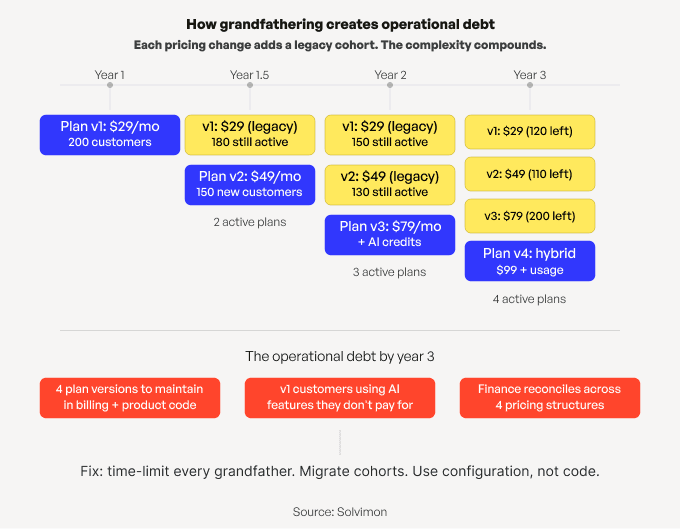
Companies that change pricing every 6 months (as Bessemer recommends) and grandfather each time can accumulate 6-8 legacy plans within three years. Each one is a support burden, a billing edge case, and a source of invoicing errors.
2. Billing system constraints
Most billing systems handle grandfathering poorly. The standard approach is to create a new plan for the new price and leave existing customers on the old plan. Simple in theory. In practice, it means you can't easily report on "how much revenue comes from which pricing era," you can't model the impact of migrating a legacy cohort, and every plan-level change (adding a feature, changing a limit) needs to be applied across every active plan version.
If your pricing logic is hardcoded in application code, grandfathering means maintaining conditional logic for every plan version. This is the "deploy code, not configuration" trap applied to migration. Every legacy plan is a branch in your codebase that engineers maintain indefinitely.
3. The entitlement drift problem
Grandfathered customers on old pricing often expect access to new features. If your new $79 plan includes AI credits that didn't exist when the $49 plan was created, does the grandfathered customer get them? If yes, you're giving away value at old prices. If no, you're creating a two-tier experience that frustrates loyal customers.
This gets worse with usage-based and credit-based pricing. A customer grandfathered on a flat $49/month plan might be consuming AI features that cost you $15/month to serve, features that didn't exist when they signed up. Without usage visibility at the customer level, you don't even know which grandfathered customers are underwater.
4. The "can't cancel" trap
Some grandfathering policies lock customers into legacy pricing only as long as their subscription remains active. Cancel and re-subscribe, and you lose the grandfather rate. This creates a perverse incentive: customers stay subscribed to a plan they barely use because the price is too good to lose. You carry the support and infrastructure cost for low-engagement customers who are only staying because of price, not value.
Decide upfront: if a grandfathered customer cancels, can they come back at the old rate? Document this clearly. The worst outcome is inconsistent enforcement where some customers get the old rate back and others don't.
5. Finance and rev rec complexity
Grandfathered customers on old plans with different pricing structures create revenue recognition complexity. If old plans were simple subscriptions but new plans include usage components, you're running two different recognition models simultaneously. Prepaid credits on new plans are liabilities; flat fees on old plans are recognized ratably. Your finance team needs to handle both.
At audit time, the question "how many pricing structures are active and how is revenue allocated across them?" needs a clean answer. If that answer lives in spreadsheets rather than your billing system, you have a problem.
How to execute grandfathering well
The difference between grandfathering that works and grandfathering that creates years of operational pain comes down to a few decisions made early.
Decision | Get this right | Get this wrong |
|---|---|---|
Set an end date | Time-limited grandfather with a specific migration date communicated upfront | "We'll keep you at this price indefinitely" becomes permanent, unwindable |
Track cohorts in your billing system | Every plan version is a tagged cohort you can report on, model, and migrate | Legacy plans are invisible. Finance can't tell you how much revenue is on old pricing |
Decide on feature access upfront | Clear policy: grandfathered customers get features available at their plan level, or a defined subset of new features | Ad-hoc decisions per customer. Some get new features, some don't. Support can't keep track |
Build migration tooling before you need it | Automated path to move customers from old plan to new plan with prorated credits | Manual migration requires engineering tickets per customer |
Communicate the timeline once, clearly | One email, 60-90 days before changes. Options: accept new pricing, downgrade, or lock in annual at old rate | Drip of confusing messages. Customers surprised at migration date |
Use configuration, not code | Pricing changes and plan versions managed in your billing system's configuration layer | Every plan version is a code branch that lives forever |
Grandfathering and hybrid pricing
Grandfathering gets harder as pricing models get more complex. When your pricing was purely per-seat, grandfathering meant keeping the old seat price. When your pricing is seats + usage + credits + committed spend, grandfathering means deciding what to freeze and what to update.
Component | Grandfather it? | Why |
|---|---|---|
Base platform fee | Usually yes, for a defined period | This is the number customers anchored on. Changing it feels like a price increase |
Per-seat rate | Sometimes. Depends on magnitude of change | If seat prices doubled, grandfather. If they went up 10%, migrate at renewal |
Usage rates | Rarely | Usage rates reflect cost of delivery. If inference costs change, rates should follow |
Credit conversion rates | Rarely | Credits abstract underlying costs. Conversion rates need to reflect current economics |
Included usage allowance | Usually yes, for a defined period | Reducing included allowances feels like a takeaway, not a price increase |
Enterprise contract terms | Always, until contract renewal | Contractual obligation. Non-negotiable |
The pattern: grandfather the fixed components that customers budgeted around. Let variable components (usage rates, credit conversion) float with market conditions. This preserves the customer's sense of pricing stability while protecting your margins on the parts that have real cost variability.
Your billing infrastructure needs to support this granularity. Grandfathering the base fee while updating usage rates for the same customer, on the same invoice, is a configuration challenge that most billing systems handle poorly without custom code.
Frequently Asked Questions
What is grandfathering in pricing?
Grandfathering is allowing existing customers to remain on their original pricing or terms after those terms change for new customers. It protects the base from churn during a repricing at the cost of operating multiple price books.
Should you grandfather existing customers?
It depends on the size of the increase and the switching cost. For a modest increase on a product with high switching costs, migrating everyone is usually survivable. For a large increase or a low-friction product, grandfathering some cohort is often cheaper than the churn.
How long should grandfathered pricing last?
Set an explicit end date rather than leaving it open. Indefinite grandfathering accumulates legacy plans that constrain every future pricing decision, and the cost compounds silently.
What is the operational cost of grandfathering?
Every grandfathered cohort is a price book your billing system, your support team and your entitlement logic have to carry indefinitely. The cost shows up as slower pricing changes rather than as a line item.
What is entitlement drift?
When a grandfathered plan's feature set diverges from what the product actually does. New capabilities ship without a decision about whether legacy plans get them, and eventually nobody knows what a legacy customer is entitled to.
Can you grandfather part of a contract?
Yes, and it is often the right structure. Holding the base fee while updating usage rates, or the reverse, gives a middle path between full protection and full migration. It requires a billing system that can version parts of a contract independently.
Related
Discount management. The related problem of concessions that never expire.
Entitlements. What each legacy plan actually grants.
Flat rate pricing. The model most often being migrated away from.
Revenue leakage. What unmanaged legacy pricing becomes.
Margin management. Why legacy pricing eventually has to be addressed.
Ready for billing v2?
Solvimon is monetization infrastructure for companies that have outgrown billing v1. One system, entire lifecycle, built by the team that did this at Adyen.