
What is Odd-Even Pricing?

Written by Arnon Shimoni
✓ Expert
Last updated on:
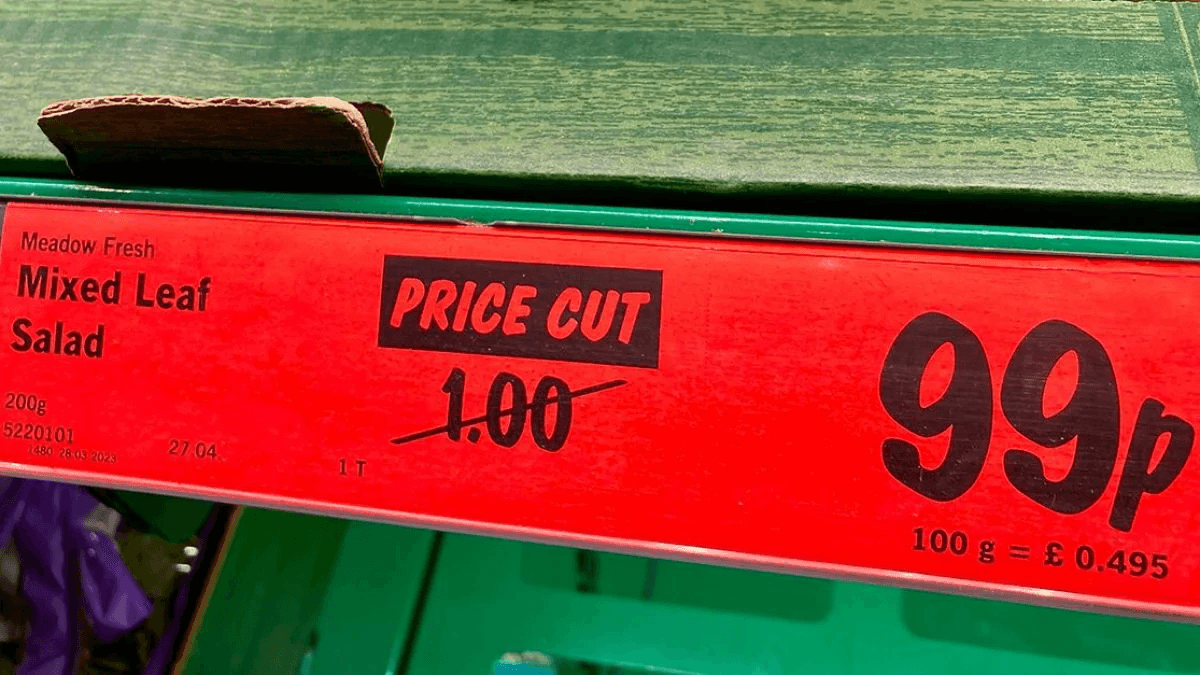
Odd-even pricing is a psychological pricing strategy where prices are set just below round numbers like $9.99 instead of $10, $99 instead of $100, $499 instead of $500.
The logic is that buyers perceive $9.99 as meaningfully cheaper than $10, even though the actual difference is one cent. The effect is well-documented in consumer psychology and retail. Its application in B2B and SaaS contexts is more limited, but the underlying mechanism (how buyers anchor to the leftmost digit of a price) appears across markets.
Field | Detail |
|---|---|
Also known as | Charm pricing, psychological pricing, just-below pricing |
Mechanism | Left-digit anchoring: buyers process $9.99 as "nine dollars and change," not "approximately $10" |
Best evidence | Retail, e-commerce, consumer subscriptions |
Weakest evidence | B2B enterprise, annual contracts, professional services |
Common variants | $X.99 (strongest effect), $X.95, $X9 (e.g., $29, $49, $99) |
Related concepts | Price anchoring, reference pricing, odd-even pricing, decoy pricing |
Why does odd-even pricing work?
The mechanism is left-digit anchoring, a well-documented finding in consumer psychology. When a buyer reads $9.99, they encode the leftmost digit first. The mental representation is "nine dollars" with a small modifier, rather than "approximately ten dollars." This is not rational as the difference is 1% but it's consistent. Studies across retail, e-commerce, and restaurant menus show that charm prices outperform round prices in controlled conditions.
A frequently cited study by Schindler and Kirby (1997) found that prices ending in 9 appeared in roughly 30-35% of prices in mass-market catalogs, well above chance. More recent work on e-commerce pricing consistently finds that $X.99 prices convert at higher rates than $X.00 prices for equivalent products, particularly at psychological threshold points like $9.99 vs $10, $99 vs $100, $999 vs $1,000.
There's also a signaling dimension: round prices ($10, $100) read as estimates or list prices. Odd prices ($9.99, $97) read as precise or calculated, implying that the seller worked to find the lowest number. In consumer contexts, this reinforces the perception of value. In B2B contexts, where buyers are sophisticated and procurement processes are formal, the effect largely disappears.
How odd-even pricing is applied in practice
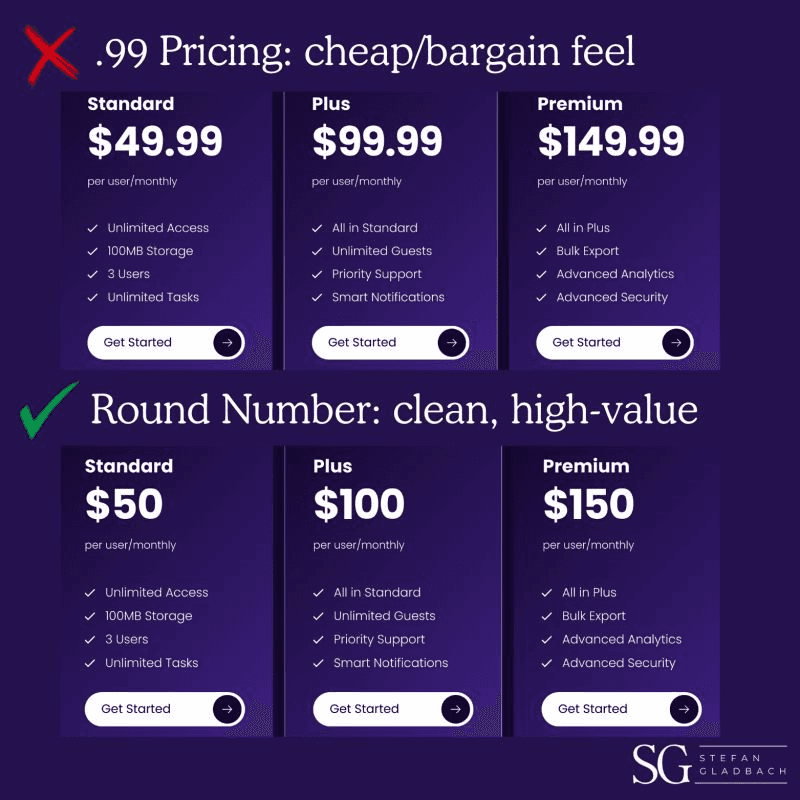
Consumer and SMB SaaS. The most direct application. Tiers priced at $9, $19, $49, $99 per month consistently outperform $10, $20, $50, $100 in consumer-oriented subscription products. The $99 vs $100 threshold is a well-known example: $99 sits below the "three digits" threshold, while $100 crosses into a psychologically different range.
Retail and e-commerce. The original domain. Amazon, consumer goods, and grocery pricing universally use charm pricing. The effect is strong enough that even products with no true price sensitivity show higher conversion at X.99 vs X.00.
Freemium to paid upsells. Apps that display the first paid tier at $0.99 or $1.99 instead of $1 or $2 see higher conversion. The psychological barrier of crossing "zero to paid" is easier at 99 cents than at $1.
What odd-even pricing doesn't change. Enterprise pricing. Consulting fees. Annual contract values. Professional services. In a B2B contract where the CFO reviews the number and procurement negotiates against it, whether the number ends in 9 or 0 is irrelevant. The threshold effects that drive charm pricing require emotional, fast processing. Procurement is the opposite of fast emotional processing.
What are the limits of odd-even pricing?
Sophistication cancels the effect. When buyers are experienced, the left-digit anchoring effect shrinks. B2B buyers comparing two proposals priced at $49,999 and $50,000 are not meaningfully influenced by the $1 difference. They're analyzing total cost of ownership, vendor risk, implementation timeline, and contract terms. Charm pricing in a $500K ACV deal is cosmetic.
Brand positioning trade-offs. Premium brands sometimes use round prices deliberately, because round prices read as confident and premium while odd prices read as discounted. Luxury goods are almost universally priced at round numbers (or at non-standard odd numbers that don't signal "discount," like $1,475 rather than $1,499). If you're positioning as premium, charm pricing can undermine the brand signal.
Currency and localization. The $9.99 convention is US-centric. In markets with different currency conventions, different digit structures, or different psychological anchors, the effect varies. Pricing that worked in USD doesn't automatically translate to EUR or GBP or JPY.
Fatigue. When every price in a market ends in 9, the effect diminishes. Buyers adjust. The strongest application of charm pricing is in categories where it's not ubiquitous.
Odd-even pricing and billing infrastructure
Charm pricing is a pricing decision, not a billing complexity. The billing system just needs to handle non-round numbers correctly — invoicing $9.99, calculating tax correctly on fractional amounts, and handling international currency display without rounding errors.
Where billing systems do create problems: inconsistent rounding. A product priced at $9.99/month with usage charges billed at fractional cents can produce invoices where the displayed total doesn't match the sum of line items due to rounding inconsistencies. This is a billing engine problem, not a pricing philosophy problem.
Where Solvimon fits
Solvimon's invoicing engine handles fractional pricing and consistent rounding at the line-item level. Charm prices, fractional usage rates, and multi-currency invoicing work without manual reconciliation.
Related terms
Frequently Asked Questions
Does $9.99 actually work better than $10?
In controlled experiments on consumer products and e-commerce, yes. The left-digit anchoring effect is robust in consumer contexts. The effect weakens significantly for B2B buyers, sophisticated purchasers, and high-consideration purchases.
However, I've run experiments on this and found no statistical significance.
What is left-digit anchoring?
Left-digit anchoring is a cognitive bias where buyers disproportionately weight the leftmost digit of a price. $9.99 anchors on the "9," leading to a perception closer to "nine dollars" than "approximately ten dollars."
It's not rational but it's consistent across many studies.
Should B2B SaaS companies use charm pricing?
For SMB-oriented products and self-service tiers, it's worth testing. For enterprise or mid-market pricing where procurement is involved, it's irrelevant. The right framing for B2B: use odd pricing on self-serve tiers, round pricing (or negotiated pricing) on enterprise contracts.
Is there a difference between $9.99 and $9.95?
Surprisingly, yes. Research by Schindler and Kibarian (1996) found that prices ending in 9 outperform prices ending in 5 in most categories. The effect is strongest at 9, though both benefit from left-digit anchoring relative to round numbers.
What is even pricing, and when should I use it?
Even pricing (round numbers: $10, $100, $500) is used when brands want to signal premium quality, confidence, or simplicity. Some premium SaaS products use round pricing deliberately to avoid the "discount" connotation of charm prices. It's a valid alternative when brand positioning is a priority.
Does charm pricing work internationally?
The effect is documented across cultures but varies by market. Currency structure matters: in markets where prices are naturally expressed in whole units (e.g., JPY, KRW), the $X.99 convention doesn't apply. Localization research is necessary for non-US markets.
Educational reference. Solvimon's invoicing engine handles fractional pricing, consistent rounding at the line-item level, and multi-currency billing.
Ready for billing v2?
Solvimon is monetization infrastructure for companies that have outgrown billing v1. One system, entire lifecycle, built by the team that did this at Adyen.