What is a Neocloud?

Written by Arnon Shimoni
✓ Expert
Last updated on:
What is a neocloud?
A neocloud is a cloud provider built specifically around GPU compute for AI workloads: a vertically integrated operator that controls power, data center build-out, and GPU clusters end to end, offering hyperscaler-grade compute without being a general-purpose cloud. Where AWS, Azure, and Google Cloud serve every workload, a neocloud serves one: training and running AI models.
The reference names are CoreWeave, Nebius, Lambda, Crusoe, Nscale, and Fluidstack, with a growing European sovereign tier and a long tail of specialists (e.g., Hot Aisle, an AMD-based provider renting single GPUs by the minute). Category revenue reportedly reached around $23 billion in 2025, roughly tripling year over year.
How is a neocloud different from the rest of the data center stack?
The AI infrastructure boom has produced distinct layers that get conflated constantly:
Layer | What they own | Examples |
|---|---|---|
Neocloud | The full stack: power, facility, GPUs, orchestration, customer billing | CoreWeave, Nebius, Lambda, Crusoe |
Hyperscaler | General-purpose cloud with AI services layered on | AWS, Azure, Google Cloud |
Powered-shell developers | Land, power, and buildings, delivered ready for a tenant's hardware | Aligned, Vantage, Cyrus One |
Colocation providers | Multi-tenant facilities, retail and wholesale | Equinix, Digital Realty |
Infrastructure capital | The financing behind all of it | Blackstone, KKR, Brookfield, Stone Peak |
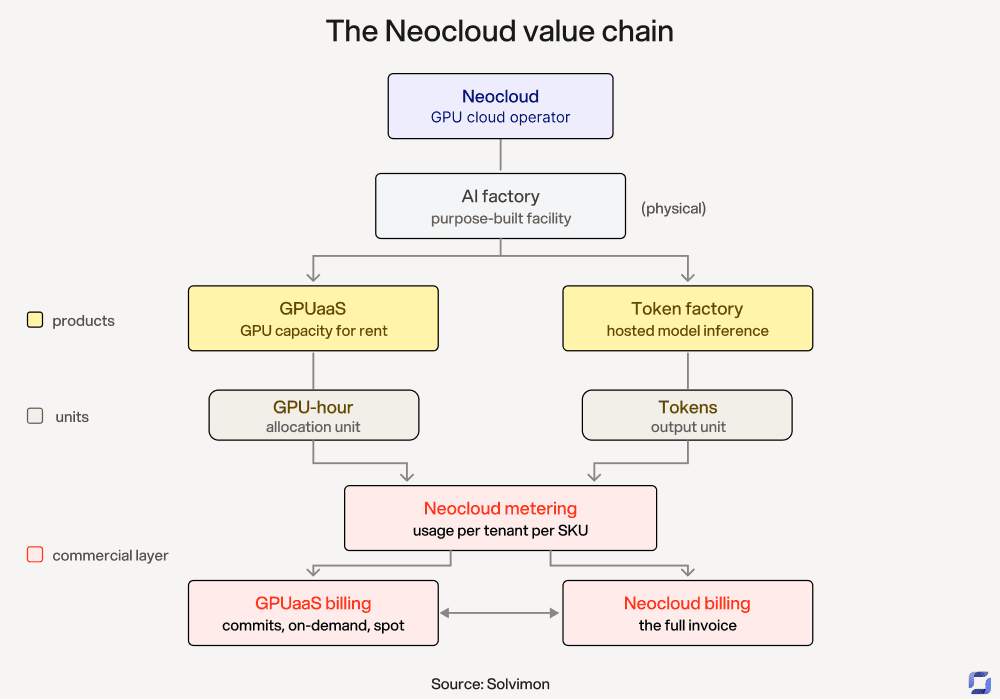
The neocloud is the only layer that meters and bills end customers for AI compute directly, which is why its commercial machinery (neocloud billing) is its own discipline.
Why do neoclouds exist?
Three forces, in order of appearance. GPU scarcity: during the shortage years, neoclouds had allocation when hyperscalers had waitlists, and speed of access built the category. Purpose-built infrastructure: AI training needs ultra-low-latency, lossless networking between thousands of GPUs and rack densities conventional facilities can't power, so purpose-built beats general-purpose on both performance and cost (the facility side of this is the AI factory). And economics: almost no enterprise can justify building this capability, so renting it as a service is the rational default, the same cost-benefit argument that built the original cloud.
There's also a sovereignty force, strongest in Europe: keeping data and inference on infrastructure outside the reach of foreign jurisdiction. European neoclouds sell this explicitly, and it changes what their billing has to support (see sovereign AI billing).
What does a neocloud sell?
A stack, usually in 3 layers. Bare metal or reserved clusters at the bottom: raw GPU capacity per SKU, sold on commitment. A virtualized middle: on-demand VMs and managed Kubernetes or SLURM, sold per GPU-hour. And increasingly an AI-services top: hosted open-source models where the customer logs in, picks a model, and pays per token, which turns the provider into a token factory.
One European neocloud founder put the commercial logic of that top layer plainly: nobody wants a GPU. Customers want AI in operation, to make money or cut costs. The further up the stack a neocloud sells, the less its customers think about hardware at all, and the more its billing looks like a software company's: usage-based, token-metered, credit-wrapped.
How do neoclouds make money?
Reserved commitments anchor the revenue (and the debt financing), on-demand usage prices the burst, spot monetizes idle capacity, and storage and egress round out the invoice. The mechanics live under GPUaaS billing and neocloud billing. The operational risk lives under neocloud metering: at these rates, attribution errors are contract disputes, and unmetered usage is revenue leakage at scale.
Solvimon provides the billing infrastructure layer for exactly this stack: metering, commit drawdowns, token rating, and invoicing on one ledger. See Solvimon for AI.
FAQ
Is a neocloud the same as a GPU cloud?
In practice yes. Neocloud emphasizes the business model (a new kind of cloud provider), GPU cloud emphasizes the hardware. GPUaaS is the product both terms describe.
Are neoclouds only for training?
No, and the mix is shifting. Training built the category, but inference (running models in production) is the growth layer, and it favors smaller, distributed facilities closer to users.
Who are the European neoclouds?
Nebius and Nscale operate at scale, with a sovereign tier building around national and EU requirements. The sovereignty pitch (data residency, EU jurisdiction, no foreign cloud act exposure) is their structural differentiator.
Do neoclouds compete with hyperscalers?
Directly, for AI workloads. Hyperscalers answer with their own GPU fleets and model services, while renting capacity from neoclouds at the same time. The category's biggest customers include the hyperscalers themselves.
Related
Neocloud billing: the commercial machinery
AI factory: the facilities they run
GPUaaS billing: the core product's pricing models
Token factory: the move up the stack
Ready for billing v2?
Solvimon is monetization infrastructure for companies that have outgrown billing v1. One system, entire lifecycle, built by the team that did this at Adyen.