

What is Seat-based Pricing?

Written by Arnon Shimoni
✓ Expert
Last updated on:
Seat-based pricing is a model where the cost of software is determined by the number of individual users (or “seats”) that have access to it. Each user requires their own license or subscription, and the total cost scales with headcount.
For two decades, this was the default pricing model in SaaS. A CRM helped a sales rep. A design tool helped a designer. A support platform helped an agent. You could count your customers by the number of logins. Growth was linear: more employees meant more seats meant more ARR.
Era | Unit of work | Unit of value | Pricing proxy |
|---|---|---|---|
SaaS 2005–2020 | Human performs workflow | Productivity per human | Per-seat license |
That linearity made seat-based pricing simple, predictable, and easy to budget around. For providers, it created a reliable revenue stream tied directly to customer growth. For buyers, it offered transparency: you knew exactly what you’d pay based on team size.
Why seat-based pricing is breaking down
Seat pricing broke quietly, then all at once. Three structural shifts made the decline inevitable:
Shift | What changed | Why seats fail |
|---|---|---|
Agents replace users | Work is done through APIs and automation | Agents don’t log in and don’t occupy a seat |
Teams get smaller | Ten people with agents do the work of a hundred | Headcount stops scaling with output |
AI features eat their own revenue | Every “productivity” feature removes usage minutes | Seat expansion becomes self-defeating |
Seat pricing depends on more humans doing more work. AI depends on fewer humans doing less work.
When a company replaces 50 support agents with one orchestrator running 50 AI assistants, seat metrics collapse. The system’s output increases tenfold, but the revenue signals all point the wrong way. User logins, seats activated, seat expansion revenue: these now measure inertia, not health.
Dropbox is a textbook example. Look at their revenue and user growth from 2015 to 2024:
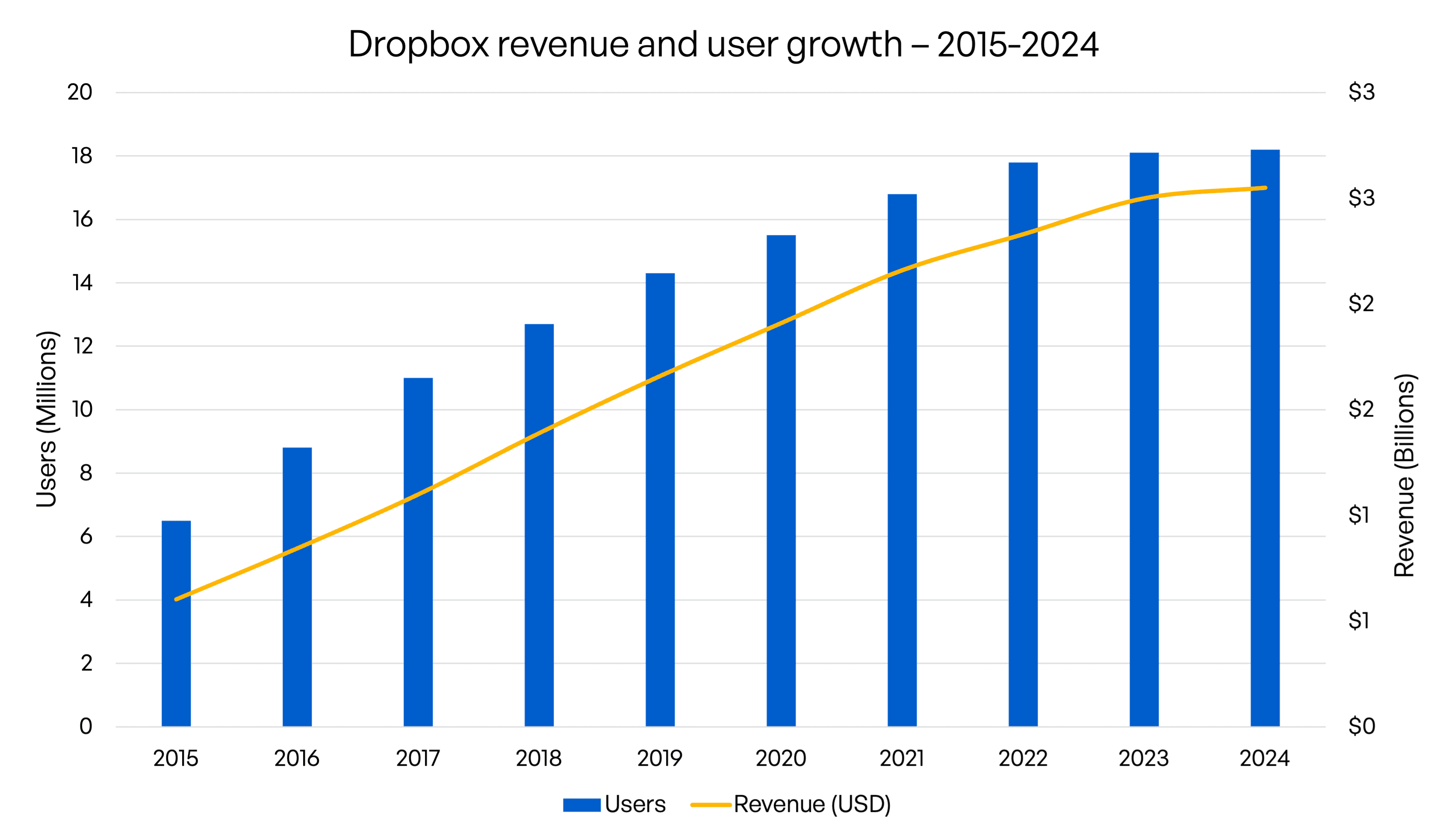
From 2015 to 2020, users and revenue grew in lockstep. After 2020, user growth flatlined around 17-18M paying users while revenue kept climbing only through price increases. Dropbox squeezed more dollars per seat because they couldn’t add more seats. That works for a while. It stops working when customers realize they’re paying more for storage they increasingly share with AI tools and automations that don’t need a login.
This is the ceiling of seat-based pricing in one chart: when your growth lever is “charge existing users more,” you’re extracting, not expanding.
Slack tried to solve the AI problem differently by bundling AI into existing seat tiers and killing its $10/user AI add-on in 2025. That works when AI features are supplementary (summaries, search). It falls apart when AI becomes the core product.
If your growth depends on seat expansion, expansion revenue now fights automation instead of benefiting from it. If your pricing isn’t margin-aware under AI workloads, compute costs eat your unit economics.
The hybrid holding pattern
Many companies respond by adding usage components alongside seats in what is known as hybrid pricing. This is a holding pattern, not a destination. Companies add usage layers because it keeps revenue intact while the core metric stops working.
The data from Bain, PricingSaaS, and ICONIQ all point the same direction: 65% of established SaaS vendors adding AI have adopted hybrid models. Credit models surged 126% year-over-year. 37% of companies plan to change their AI pricing in the next 12 months. Hybrid pricing is the default now.
The telemetry across the industry tells the story: seat count per customer is flat or shrinking, compute cost per customer is rising, and AI adoption cuts user logins while increasing workload volume.
The stranded credits problem
AI pricing models that mix seat-based licensing with per-user credit allotments create a specific failure mode: stranded assets. Companies pay for large credit pools but can’t use them because credits are locked to individual users rather than shared across the organization.
Power users hit hard limits while casual users sit on unused credits, generating artificial breakage that benefits vendors short-term but erodes trust. As AI costs rise, customers scrutinize utilization more aggressively, and products that rely on this friction risk accelerated churn.
The fix is architectural: org-level credit pools with per-user guardrails, not per-seat credit allocations. Telecoms solved this same problem with family data plans fifteen years ago. Credits are a ledger problem, not a packaging problem.
What replaces the seat
The next pricing models track work done, not humans doing it. Three archetypes are emerging:
Model | Example | Unit of value |
|---|---|---|
API calls, tokens, compute minutes | Workload volume | |
Leads verified, tickets resolved | Business result | |
Cost per autonomous agent per month | Synthetic labor |
This will feel messy for a few years, much like AWS billing did in 2008. Complex and unpredictable, but far more aligned with where value actually comes from. The early versions involve tokens, credits, hybrid models, and caps. Over time, the market converges toward work-per-unit and eventually outcomes: software bills for what it delivers, not who touches it.
Companies like Intercom (Fin at $0.99 per resolved conversation), Decagon (per-resolution enterprise contracts), and ElevenLabs (character-based credit tiers with overage) are already shipping these models. The billing complexity underneath is real. Each requires real-time metering, credit ledger logic, and hybrid invoicing that most billing systems can’t handle. See our comparison of how real companies price AI in 2026.
The new denominator
Every few decades, software changes its unit of measurement:
Era | Unit of measure |
|---|---|
Desktop | License |
Cloud | Seat |
AI / Agentic | Work (and later, value) |
Seat-based pricing isn’t dying from lack of innovation. It’s dying from irrelevance. When the average company has more agents than employees, the only question that matters is: what’s your new denominator for software value?
What this means for your billing architecture
Moving off seats sounds like a pricing decision. It’s an infrastructure project.
Most companies that want to shift to hybrid or usage-based models discover that their billing architecture can’t express what their sales team needs to quote. “200K credits at $0.03/credit with a 15% volume discount, plus 10 seats, plus a base platform fee, with credit rollover into Q2” is too complex for systems designed around flat-rate subscriptions.
So sales teams sell what the system can quote, and AI value stays off the invoice entirely. That’s revenue leakage by architecture, not by choice.
Without a billing and monetization rethink behind it, your product’s AI layer is decoration, not disruption.
Migrating contracts is 10x harder than migrating software. Existing customers are on seat-based contracts with annual terms, and you’ll need both models running simultaneously, in the same system, for the same customers, for years. If your billing infrastructure can’t handle that, the pricing migration is blocked by billing.
Learn more about how to architect credit billing that scales, or read about what your billing system needs before your first $200K deal.
Related
Seats are a relic, start selling results. The case for outcome pricing over per-seat plans.
Solvimon flexible pricing. Run any pricing model without engineering sprints.
Usage-based pricing. Charging on what customers consume, and when it works.
Ready for billing v2?
Solvimon is monetization infrastructure for companies that have outgrown billing v1. One system, entire lifecycle, built by the team that did this at Adyen.