
What is a Billing Engine?

Written by Arnon Shimoni
✓ Expert
Last updated on:
A billing engine is the system that turns product usage and contract terms into money. It sits between your product (which generates events) and your bank account (which receives payments), handling everything in between: metering what customers consumed, applying pricing rules, generating invoices, collecting payments, and feeding revenue data to your general ledger.
In a simple business with one product and one price, the billing engine is barely visible. A Stripe subscription charges the same amount every month. There's nothing to calculate.
In a business running hybrid pricing across seats, usage, credits, committed spend, volume discounts, and enterprise overrides, the billing engine is the most critical piece of infrastructure between your product and your revenue. It determines whether pricing changes take hours or months, whether invoices are accurate or disputed, and whether finance can close books in three days or three weeks.
What a billing engine actually does
The term "billing engine" is used loosely. Some people mean the entire billing stack. Others mean specifically the rating engine, the component that applies pricing rules to usage data. For this glossary entry, we're covering the full system: everything from event ingestion to invoice delivery.
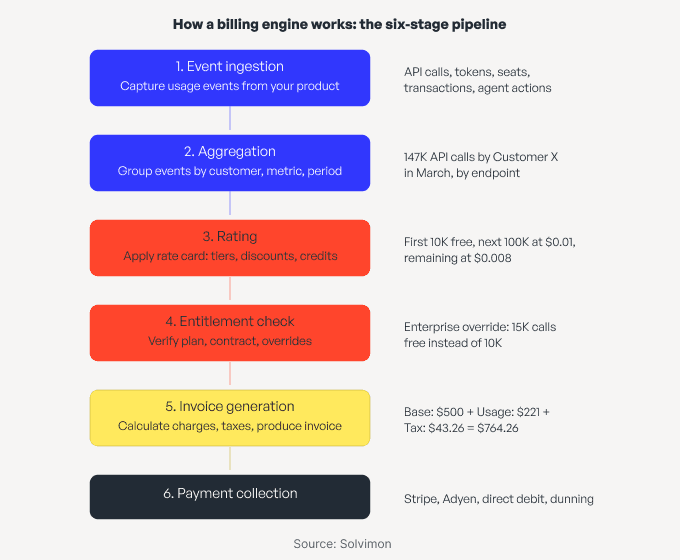
A billing engine performs six functions in sequence. Each depends on the one before it. If metering is wrong, every downstream function produces wrong outputs.
The engine ingests usage events from your product. Every API call, token processed, seat activated, or credit consumed generates an event. The billing engine captures these events in real time or in batch, depending on architecture. For AI products processing millions of events per day, this is a serious infrastructure challenge.
The engine aggregates those events. Raw events are grouped by customer, metric, and billing period. 147,000 API calls by Customer X in March, broken down by endpoint and model tier.
The engine applies rating logic. This is where pricing rules meet usage data. The rate card defines what each unit costs: the first 10,000 calls are included in the plan, the next 100,000 at $0.01 each, the remaining at $0.008. Rating also handles credit deductions, commitment drawdowns, volume discounts, and any customer-specific overrides negotiated by sales.
The engine checks entitlements. What is the customer entitled to based on their plan, contract, and any manual overrides? An enterprise customer might have a negotiated rate that differs from the standard rate card. A self-serve customer hitting their usage limit might need to be throttled or prompted to upgrade.
The engine calculates final charges and generates the invoice. Base fee, usage charges, credit adjustments, taxes, and any prorations are combined into line items that make sense to the customer and to finance.
Finally, the engine collects payment. It integrates with payment processors (Stripe, Adyen, direct debit) to charge the customer, handles failed payments through retry logic (dunning), and records the transaction against the invoice.
Why billing engines matter more now
For twenty years, billing was a solved problem for most software companies. You counted seats, multiplied by price, sent an invoice. The billing engine was invisible because there was nothing complex to calculate.
Three shifts changed that.
AI introduced variable costs. Every inference call has a real price tag. A customer on a flat $49/month plan might cost $0.10 to serve in a quiet month and $15.00 in a busy one. The billing engine needs to meter this, price it, and surface margin visibility to finance.
Hybrid pricing became the default. Bain found that 65% of SaaS companies adding AI adopted hybrid models in 2025. Seats plus usage plus credits plus committed spend, often in the same contract. The billing engine needs to handle all of these on a single invoice.
PLG and SLG converged. Self-serve users convert to enterprise contracts. The billing engine needs to bridge both motions: self-serve checkout and enterprise quoting in one system, without requiring three separate billing stacks.
The result: billing infrastructure is no longer a commodity. It's a constraint on how fast you can iterate pricing, how accurately you can invoice, and whether your finance team trusts the numbers.
What to look for in a billing engine
Not every billing engine handles the same complexity. What matters depends on your pricing model, your stage, and where you're heading.
Capability | What it means | When you need it |
|---|---|---|
Real-time metering | Ingest and process usage events as they happen | When you bill on usage, tokens, or credits and customers need real-time visibility |
Configurable rate cards | Define pricing rules (per-unit, tiered, volume, graduated) without code | When finance needs to change pricing without waiting on engineering |
Credit and wallet management | Handle prepaid balances, drawdown, rollover, expiry natively | When you sell credits or prepaid commitments |
Multi-metric billing | Price on multiple dimensions simultaneously (tokens + seats + storage) | When your product has more than one billable metric |
Entitlement management | Control what customers can access based on plan, tier, and overrides | When packaging changes require code deploys to enforce |
Contract and commitment handling | Annual commits, minimum spend, volume discounts, ramped pricing | When sales closes enterprise deals with custom terms |
Multi-entity and multi-currency | Bill across legal entities and currencies from one system | When you expand internationally |
Revenue recognition | Map charges to ASC 606/IFRS 15 schedules | When finance can't close books without manual reconciliation |
Hybrid model support | Combine subscriptions, usage, credits, and outcomes in one invoice | When your pricing isn't purely subscription or purely usage |
PLG/SLG bridge | Handle self-serve signups and enterprise contracts in one system | When PLG users convert to enterprise deals |
Billing engine comparison
The billing engine landscape in 2026 ranges from payment platforms with billing add-ons to dedicated billing infrastructure to full monetization platforms. Each category solves a different problem and breaks at a different scale.
Platform | Category | Best for | Pricing model support | Usage/metering | Credits | Multi-entity | Rev rec | Starting price |
|---|---|---|---|---|---|---|---|---|
Stripe Billing | Payment platform + billing | Startups, simple subscriptions, developer-first teams | Subscriptions, basic metering, flat + overage | Basic (batch, end-of-period) | Limited (promotional only) | Limited | Via Revenue Recognition add-on | 0.7% of billing volume |
Chargebee | Subscription management | Mid-market SaaS with standard recurring billing | Subscriptions, tiered, some usage support | Supported but not core strength | Limited | Supported | Built-in ASC 606 | From $599/month |
Recurly | Subscription + retention | High-volume B2C subscriptions focused on reducing churn | Subscriptions, add-ons, simple tiered | Limited | No | Limited | Basic | Custom (0.9% revenue fee) |
Zuora | Enterprise billing platform | Large enterprises with complex global operations | Full range: subscription, usage, contract, hybrid | Supported | Supported | Strong (multi-entity, multi-currency) | Built-in (RevPro) | ~$75K/year+ |
Paddle | Merchant of record | SaaS companies selling globally who want tax/compliance handled | Subscriptions, one-time, basic usage | Limited | No | Handled by MoR model | Handled by MoR model | 5% + $0.50 per transaction |
Maxio | Billing + financial ops | B2B SaaS needing billing + SaaS metrics + rev rec | Subscriptions, usage, contract | Batch processing | Limited | Supported | Built-in GAAP compliance | Custom |
Kill Bill | Open-source billing | Teams with engineering resources wanting full control | Subscriptions, usage, custom | Via plugins | Via plugins | Via plugins | Not built-in | Free (self-hosted) |
Lago | Open-source billing | Developer teams wanting transparent usage billing | Subscriptions, usage, credits | Real-time event ingestion | Supported | Growing | Not built-in | Free (self-hosted) or cloud |
Metronome | Usage metering specialist | AI and infrastructure companies with high-volume usage events | Usage-first (metering + rating) | Core strength (real-time, high throughput) | Supported | Growing | Not built-in (integrates with others) | Custom |
Orb | Usage billing | PLG and API products with complex usage pricing | Usage-first with subscription support | Core strength | Supported | Growing | Growing | Custom |
Solvimon | Monetization infrastructure | Companies scaling hybrid pricing across PLG + SLG | Full lifecycle: subscriptions, usage, credits, quoting, payments | Real-time metering | First-class (wallets, burndown, rollover) | Native multi-entity | Built-in | Custom |
A few patterns emerge from this comparison.
Payment platforms (Stripe, PayPal) work well at the start. Stripe is the default for early-stage companies because it handles payments and basic subscriptions with minimal setup. Usage-based billing is supported but feels bolted on rather than native. Once you're managing enterprise contracts, credits, or multi-entity billing, you typically need something on top of Stripe.
B2C Subscription platforms (Chargebee, Recurly) handle recurring billing well but struggle with the usage-based and credit-based models that AI companies need. If your pricing is primarily seat-based with occasional add-ons, these platforms are solid. If you're running hybrid pricing with real-time metering, they hit limits.
Enterprise platforms (Zuora) handle every edge case but come with enterprise implementation timelines and budgets. Zuora is the right answer for a $100M+ ARR company with dedicated billing operations teams. For a $5M-$50M company, the implementation cost and timeline are often prohibitive.
Open-source options (Kill Bill, Lago) give you full control but require engineering investment. You're trading vendor cost for engineering cost. This makes sense if you have unique billing requirements and the team to build and maintain them. For most companies, the engineering team's time is better spent on product.
Usage specialists (Metronome, Orb) solve the metering and rating problem well but don't handle the full lifecycle. You still need separate systems for payments, quoting, entitlements, and revenue recognition.
Monetization infrastructure (Solvimon) aims to handle the full lifecycle: metering, billing, payments, entitlements, credits, quoting, and revenue recognition in one system. This category is newer but addresses the specific problem that hybrid pricing creates: too many systems that don't talk to each other.
The "deploy code, not configuration" trap
The most common billing engine failure isn't choosing the wrong vendor. It's not having a billing engine at all.
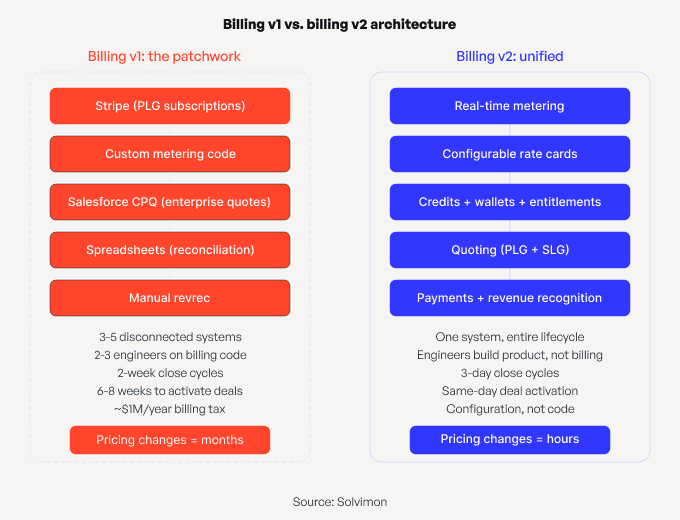
Many companies don't realize they've built one until they're maintaining it. It starts with a few lines of code to calculate charges. Then someone adds tiering logic. Then volume discounts. Then credit deductions. Then enterprise overrides. Then multi-currency. Eighteen months later, two engineers are maintaining billing glue code full-time, and every pricing change requires a deploy.
Fynn Glover, in his book on pricing and packaging, describes this perfectly: the CTO asks the CEO whether to ship critical enterprise features or have engineers work on new pricing. It's a tradeoff that shouldn't exist. Pricing logic should live in a configuration layer that business teams can change without engineering sprints.
The telltale signs you've fallen into this trap: pricing changes take more than a week to ship, finance can't adjust rates without an engineering ticket, and your product team has become a billing team.
How to choose
The decision tree is simpler than it looks.
If you have simple subscription pricing and fewer than a few hundred customers, Stripe Billing is probably enough. Don't over-engineer.
If you have recurring billing with standard plans and your main challenge is churn reduction and lifecycle management, Recurly typically fits well.
If you're running hybrid pricing (seats + usage + credits), need real-time metering, and are bridging PLG and SLG motions, you need billing infrastructure that was designed for this complexity. That's where platforms like Solvimon, or combinations of usage specialists plus subscription tools, come in.
If you're a large enterprise with multi-entity, multi-currency, and complex compliance requirements, and you have the budget and timeline for a full implementation, Zuora remains the enterprise standard.
The wrong time to switch is when you're already drowning. The right time is when you notice pricing changes are slowing down, invoicing errors are increasing, or finance is spending more time reconciling than analyzing.
Learn more about the architectural challenge of hybrid pricing in our post on credit architecture, why hybrid pricing is the default, and how metering fits into the billing stack.
Ready for billing v2?
Solvimon is monetization infrastructure built by the team that scaled Adyen to €970B+ in annual payment volume. If your pricing has outgrown your billing stack, talk to us.
Frequently Asked Questions
What is a billing engine?
A billing engine is the system that turns contracts and usage into charges. It holds the product catalog and rate cards, rates metered usage, applies discounts and commitments, generates invoices, and produces the data revenue recognition runs on.
What is the difference between a billing engine and a payment processor?
A billing engine decides what the customer owes. A payment processor moves the money. Stripe Payments is a processor, Stripe Billing is a billing engine, and many companies use one vendor for each.
Do I need a billing engine or can I build it?
Building is reasonable while pricing is one fixed plan. It stops being reasonable when you add metered usage, commitments, credits, proration and multi-currency, because each of those is a subsystem with its own edge cases and audit requirements.
Can a billing engine handle usage-based pricing?
Some can and many cannot. The test is whether it ingests high-volume events natively, deduplicates and handles late arrivals, and expresses tiers, commitments, drawdown and overage as contract structures rather than as workarounds.
Where does the billing engine sit relative to the ERP?
The billing engine computes charges and produces invoices. The ERP holds the general ledger and the close. They connect through summarised journal entries rather than event-level data.
What breaks first when a billing engine is outgrown?
Manual invoices. A small list of accounts billed by hand appears, grows, and becomes permanent. That list is the clearest signal that the pricing model has passed what the system can express.
Related
Pricing engine. The rating logic inside or alongside the billing engine.
Usage metering. The input a billing engine rates.
Invoice. The output, and what it has to contain.
ERP. Where the ledger lives, and the boundary with billing.
Quote to cash. The full process billing sits inside.
Ready for billing v2?
Solvimon is monetization infrastructure for companies that have outgrown billing v1. One system, entire lifecycle, built by the team that did this at Adyen.