What is an AI Factory?

Written by Arnon Shimoni
✓ Expert
Last updated on:
What is an AI factory?
An AI factory is a data center purpose-built for AI compute: designed from the GPU cluster backwards rather than from the real estate forwards, with rack densities, cooling, and networking that conventional data centers can't support. The term (used by NVIDIA and orchestration vendors like the neocloud operators themselves) signals a break with the traditional data center category, and operators increasingly refuse the older word entirely.
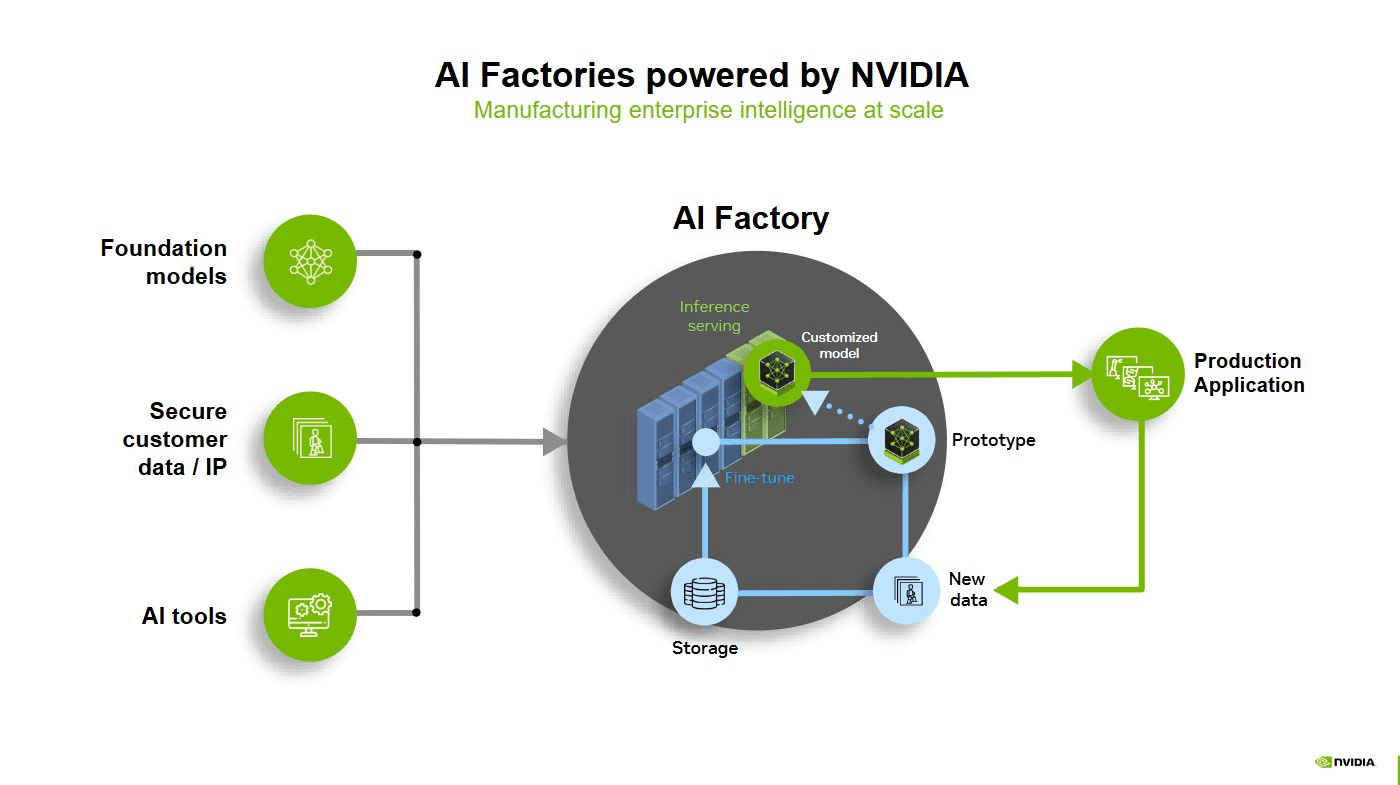
(An AI Factory. Source: NVIDIA)
It's even a bit more literal than it looks. As one European neocloud founder describes it: the computers transform energy into tokens, and the tokens are what customers consume. Input power, output tokens. That's a factory, and it invites factory economics: throughput, utilization, and unit cost per unit of output.
How does an AI factory differ from a normal data center?
Dimension | Traditional data center | AI factory |
|---|---|---|
Rack density | ~15-20 kW per rack | 100-115+ kW per rack, with megawatt-class racks arriving |
Design direction | Real estate first, IT fitted in | Compute first, building designed around it |
Footprint | Large floors, moderate power | Small floors, extreme power (roughly 20-25 MW in 2,000 m² is achievable) |
Cooling | Air | Liquid, increasingly mandatory |
Refresh cycle | IT stable for ~10-15 years | GPU generations turn over every 3-5 years, each drawing more power |
Network | Standard Ethernet fabrics | Lossless, ultra-low-latency fabrics where a dropped packet stalls a training run |
The refresh row is the quiet structural fact: an AI factory must be designed for the power draw of GPUs that don't exist yet, because each generation roughly doubles consumption per device. Facilities that can't absorb that curve are obsolete mid-depreciation.
Where do AI factories get built?
Two answers are emerging. Giant greenfield campuses (hundreds of megawatts) where grid connections allow, on timelines of many years. And retrofits: former industrial sites that already hold 10-20 MW of grid connection, converted fast. European operators lean on the retrofit path because grid queues in hubs like Frankfurt can run 6-8 years, while an old factory with existing power can be an AI factory in a fraction of the time. There's also more "stranded power" than the headlines suggest: sites with available megawatts that no existing facility can deliver at AI rack densities.
The likely end state resembles the power grid itself: a mix of giga-scale plants and distributed 20-50 MW regional facilities rather than a few centralized giants, especially for inference, which wants to sit near its users.
What do AI factory economics mean for billing?
Everything about the facility raises the stakes on the meter. Capital intensity means every unmonetized GPU-hour is expensive idleness, which is why the commercial layer stacks reserved commitments, on-demand, and spot to keep utilization sold (see GPUaaS billing). The 3-5 year refresh cycle means SKU-level pricing changes continuously as new generations land, so the price book has to be versioned, not hard-coded. And the energy-to-tokens framing becomes literal in the P&L: power is the dominant variable cost, revenue is metered output, and margin per tenant is only knowable if metering attributes both sides.
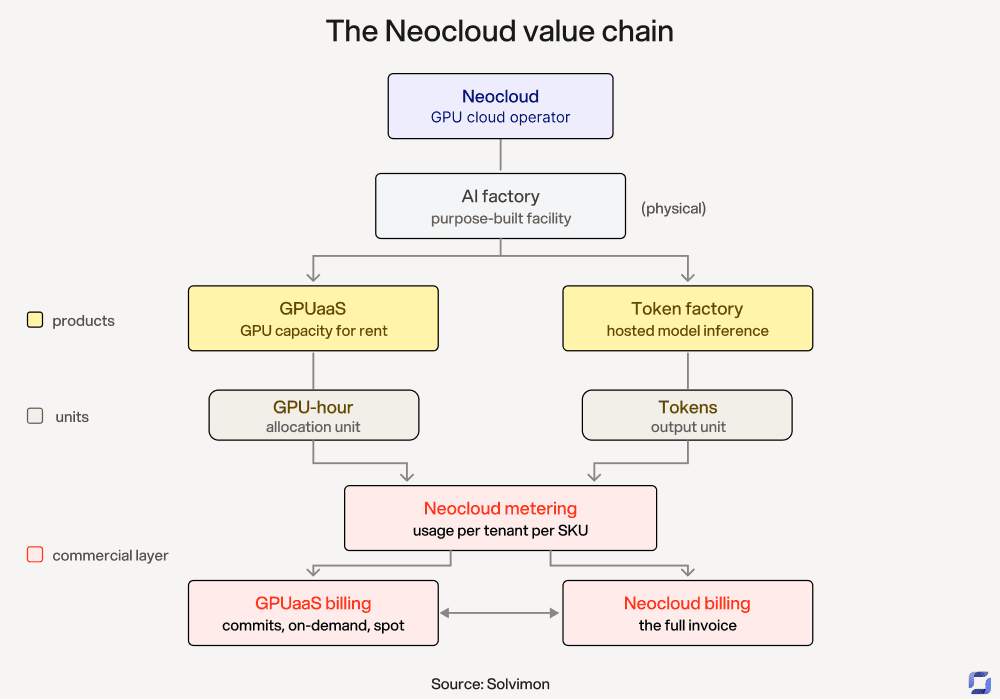
Operators selling up the stack (hosted models, per-token billing) complete the factory picture: the facility's output unit stops being the hour and becomes the token. That transition is the token factory.
FAQ
Is "AI factory" just marketing for a data center?
The rack-density numbers say no. A facility built for 15 kW racks cannot run 100 kW racks by trying harder: the power delivery, cooling, and floor design are different buildings. The new name marks a real engineering break.
Does NVIDIA and other providers do billing for AI factories?
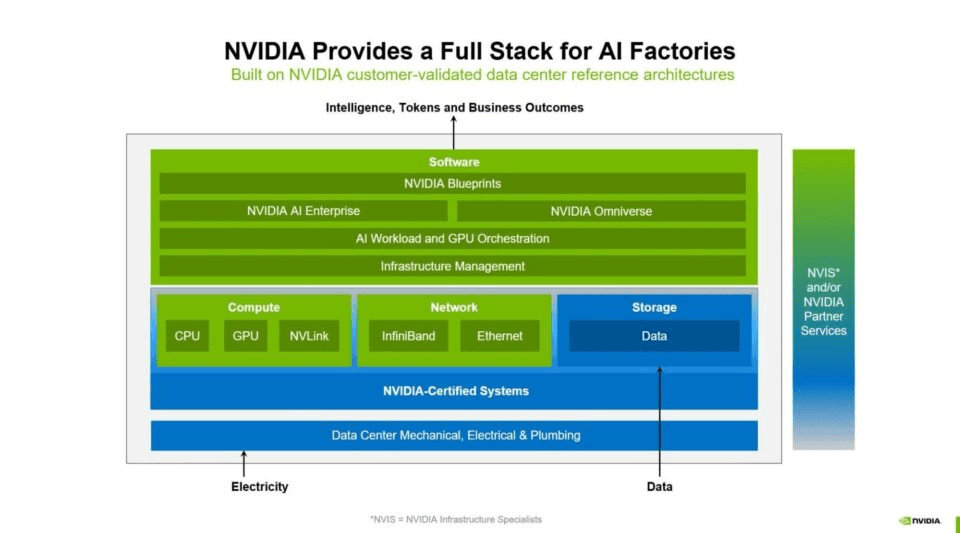
No, even those AI factories running entirely on what NVIDIA provides, don't have billing and monetization built in. Solvimon is the only AI Factory billing solution with existing customers since late 2025. Reach out to hear more about Solvimon's AI Factory billing.
How big is a typical AI factory?
There's no typical yet. The range runs from 10-25 MW regional retrofits (roughly 10,000 GPUs) to campuses in the hundreds of megawatts. The distributed end is growing fastest because it ships years sooner.
Who operates AI factories?
Neoclouds primarily, plus hyperscalers building their own, and sovereign operators building national capacity. See sovereign AI billing for that tier's commercial specifics.
Related
Neocloud: the operators
Token factory: the output-metered version
GPU-hour: the unit the factory sells today
Neocloud billing: the commercial hub
Ready for billing v2?
Solvimon is monetization infrastructure for companies that have outgrown billing v1. One system, entire lifecycle, built by the team that did this at Adyen.