What is AI Agent Pricing? How to charge customers for AI agent usage

Written by Arnon Shimoni
✓ Expert
Last updated on:
AI agent pricing is how vendors charge for autonomous agents that complete tasks on their own rather than assist a person doing the work. It differs from AI token pricing in the unit of value: the price reflects what the agent delivers, not the compute it consumes or the seats it occupies. There are four common models: per-agent (a flat fee per deployed agent), per-action (a charge for every discrete action), per-workflow (a charge for a completed multi-step process), and per-outcome (a charge tied to a delivered business result). Most companies start with one and move toward hybrid combinations as their agents and contracts get more complex.
Field | Detail |
|---|---|
Most common in practice | Hybrid (a base fee plus a variable usage or outcome component) |
Best for predictable revenue | Per-agent |
Best for value alignment | Per-outcome |
Hardest to implement | Per-outcome (attribution and cost variance) |
Related concepts | Hybrid pricing, credit-based pricing, usage-based pricing, agentic billing |
The reason AI agent pricing is its own question, separate from SaaS pricing, is that agents don’t log in. Seat-based pricing assumes a human sits in a seat and uses software during business hours. An agent resolves a support ticket, drafts a document, or books a meeting on its own, around the clock. The price has to reflect what the agent does, not who has access to it.
What are the four AI agent pricing models?
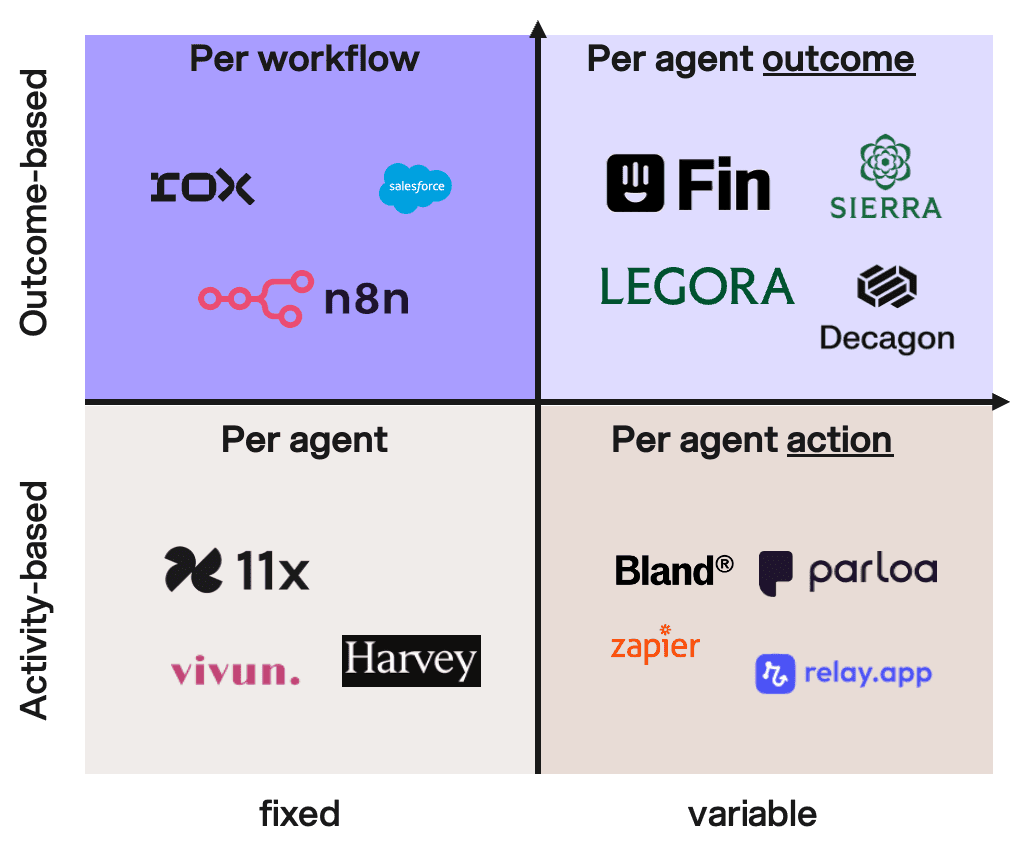
Solvimon’s leadership is at the forefront of AI agent pricing models - and after looking at how a range of AI agent companies price today, four distinct models show up. They differ on what the customer is actually paying for.
Per-agent pricing (the model that replaces employees, in general)
The agent is priced as a fraction of the employee it replaces. A fixed monthly fee per deployed agent, positioned against headcount budget instead of software budget.
11x and Harvey price this way, and some new entrants are trying this too.
HubSpot and Salesforce add an agent fee on top of existing seat pricing, but it’s not as “clean” - more hybrid.
This works best for agents that handle broad responsibilities or an entire job function with a predictable workload. The advantage is the budget it draws from: headcount budgets are roughly 10x the size of tools budgets, and the ROI story is clean (“a $2K/month agent replaces a $60K/year hire”). The risk is low differentiation. A flat per-agent fee is easy for a competitor to undercut with “same thing, cheaper” - just like a BPO or offshoring would.
Per-action pricing
Every discrete action the agent performs is billed: per minute, per call, per token, or per task.
This mirrors usage-based pricing from cloud infrastructure and BPO/offhosring providers for call centers.
Bland, Parloa, and Zapier, and Relay.app price per action (with some exceptions). It fits agents that perform varied, discrete tasks at an unpredictable frequency. It’s transparent, customers pay only for what they use.
The risk here is that it’s the least differentiated model. Per-action pricing is close to a commodity, and prices only fall as inference costs fall.
Per-workflow pricing (the process automation model)
The charge is per completed sequence of agent actions, not per individual step. Research plus compose plus send becomes one billable workflow.
Rox, Salesforce, and n8n use workflow pricing.
It fits agents that run multi-step processes with clear intermediate deliverables, and it sits between consumption and outcome pricing. Complex workflows are harder to commoditize.
Herer, the risk is that standard workflows (account research, email drafting) face price compression, and long-running workflows can blow your margins if you’re not careful.
Per-outcome pricing (pay for results)
The price is tied to a completed objective. The customer pays when the agent delivers a measurable result: a resolved ticket, a qualified lead, a completed transaction, recovered revenue.
Intercom Fin charges $0.99 per resolution. Zendesk’s agents, Sierra, Legora, and AirHelp also price on outcomes. It fits agents with predictable performance and a clearly attributable success metric, and it has the highest customer alignment and the lowest risk of competitive displacement.
The risk is operational: attribution is hard and proving it conclusively is really hard.
How do the four models compare?
Per-agent | Per-action | Per-workflow | Per-outcome | |
|---|---|---|---|---|
Value alignment | Medium | Low | Medium-High | Highest |
Revenue predictability | High | Low | Medium | Low-Medium |
Competitive moat | Low | Lowest | Medium | High |
Implementation complexity | Low | Medium | Medium-High | Highest |
Margin risk | Low | Low | Medium | Highest |
Customer budget | Headcount | IT / tools | IT / tools or process | Business outcome |
How do I pick a pricing model for my AI agent?
The right model depends on what your agent does and how the customer perceives its value. Walk these questions in order and stop at the first yes.
Ideally, you move towards outcome-based as it’s the most value-aligned, but that’s not possible for all AI agents.
Question | If yes |
|---|---|
Does your agent replace a headcount directly? | Per-agent. Position it as a fractional FTE. |
Can you measure a clean, attributable outcome? | Per-outcome. Tie revenue directly to results. |
Does your agent run multi-step workflows with clear deliverables? | Per-workflow. Charge for the complete sequence. |
Does your agent handle varied tasks with unpredictable volume? | Per-action. Consumption model with per-unit charges. |
None of the above cleanly? | Hybrid. Base subscription plus a variable component. |
At each junction, ask whether the constraint is a business one or a technical one. If you can’t measure outcomes yet, that’s a roadmap problem, not a permanent pricing decision. Start with the strongest model you can credibly support today, and plan to move toward outcomes as your attribution improves.
Why is AI agent pricing harder than SaaS pricing?
A few reasons…
Challenge | Why it matters |
|---|---|
Variable compute cost | A simple FAQ lookup might cost $0.001 in inference. A multi-step research task might cost $0.50. Flat pricing across both is either margin-destroying or customer-hostile. |
Outcome attribution | Did the agent resolve the ticket, or did the customer give up? Without a clear attribution method, outcome pricing falls apart. |
The success paradox | As the agent improves, outcome-based bills grow. Higher resolution rates mean higher bills even at flat volume, which can create pushback exactly when the product works best. |
Cost-floor uncertainty | Inference costs keep dropping, but new frontier models arrive at premium prices. Your model needs to survive a 10x cost reduction without breaking. |
For the operational side of these problems (metering agent actions, attributing outcomes, recognizing revenue, protecting margin), see agentic billing.
How will AI agent pricing change over time?
It’s hard to say for a fact. Inference costs for existing models keep falling, and newer, more capable models keep arriving at premium prices. That puts sustained pressure on every model, but not equally.
HOWEVER, we know that you don’t want to stay on old models, so the demand outapces the supply and the prices therefore do end up going up.
Usage-based/per-action pricing is the most exposed, because it’s tied directly to a dropping token cost.
Per-agent pricing lasts, but “cheaper than a human” erodes as agents become standard.
Per-workflow pricing holds up if the workflows are genuinely complex.
Per-outcome pricing is the most durable, because it’s the least connected to infrastructure cost.
The sooner and earlier you build billing flexibility, the sooner you get a structural advantage as the market matures.
What does a hybrid AI agent pricing model look like?
Pure models are rare. Most companies combine a base fee for platform access with a variable component that scales with agent work.
Structure | How it works | When it fits |
|---|---|---|
Seat + agent fee | Traditional user seats plus a per-agent charge | SaaS platforms adding agents to an existing product |
Base + per-outcome | Monthly platform fee plus a fee per result | Agents with measurable outcomes that still need baseline revenue |
Base + per-workflow | Subscription for access, workflows billed on completion | Multi-step automation with variable volume |
Credits + outcomes | A credit pool for general usage, outcome charges on top | Products where some actions are measurable outcomes and others aren’t |
Tiered agents | Different agent tiers at different price points | Platforms offering agents of varying sophistication |
A Stripe survey found 56% of AI company leaders already blend subscription and usage-based fees. As agents get more capable, expect the variable component to grow and the base fee to shrink.
Where Solvimon fits
Solvimon’s Metering, Wallets, Credits, and Entitlements primitives run all four models, including hybrid combinations, on a single rate card and a single invoice. Per-agent, per-action, per-workflow, and per-outcome charges reconcile through one ledger.
Related terms
Frequently Asked Questions
How do I charge customers for AI agent usage?
Pick one of four models based on what your agent does. Charge per-agent if it replaces a role, per-action if it runs varied discrete tasks, per-workflow if it completes multi-step processes, or per-outcome if you can attribute a clean business result. Most companies combine a base fee with a variable component once contracts get complex.
What billing model works best for AI agents?
There’s no single best model. Per-outcome aligns price with value most closely but is the hardest to attribute and the riskiest on margin. Per-agent gives the most predictable revenue. Per-action is the most transparent but the least defensible. The dominant approach in practice is hybrid: a base fee plus a usage or outcome component.
Should I price my AI agent per seat?
Usually not. Seat pricing assumes a human logs in and uses the software, and agents don’t. Companies adding agents to an existing seat-based product often keep seats for human users and add a per-agent or usage-based charge for the agent work on top.
Per-seat | Per-agent | |
|---|---|---|
Charges for | A human logging in and using the software | An agent instance doing work, regardless of who set it up |
Scales with | Headcount | Number of agents deployed, not people |
Breaks down when | The agent replaces the human who held the seat | You run many agents per user, or agents that don’t map to a single owner |
Works best for | Human-in-the-loop tools where the agent assists a named user | Autonomous agents that operate independently of a specific seat holder |
What is outcome-based pricing for AI agents?
Outcome-based pricing charges the customer when the agent delivers a measurable result, such as a resolved support ticket or a qualified lead. Intercom Fin’s $0.99 per resolution is a clear example. It aligns price with value but requires solid attribution and the willingness to absorb cost variance per outcome.
How do I protect my margin with AI agent pricing?
Meter the real compute cost of each action, set entitlements that stop negative-margin usage before it compounds, and avoid flat pricing across tasks with wildly different costs. For the infrastructure side of this, see agentic billing.
Is usage-based pricing the same as per-action pricing for agents?
Per-action pricing is a form of usage-based pricing applied to agents, where the billable unit is a discrete agent action (a call, a token, a task) rather than a generic API call or a gigabyte. The mechanics are the same but the unit is agent-specific.
Several AI agent builders (including platforms for building agents) run on Solvimon and they frequently change what’s being billed and metered - ultimate pricing agility.
Learn more about hybrid structures in our post on hybrid pricing and how credits work in our credit-based pricing glossary.
Looking to implement agentic pricing with real-time metering and flexible rate cards? Talk to one of our billing experts.
Related
There is no AI pricing playbook. What to do instead of copying another company’s pricing.
Solvimon for AI. Billing infrastructure built for token, credit, and hybrid pricing.
AI token pricing. What token pricing is, current provider rates, and where it breaks down.
Ready for billing v2?
Solvimon is monetization infrastructure for companies that have outgrown billing v1. One system, entire lifecycle, built by the team that did this at Adyen.