
What is Neocloud Billing?

Written by Arnon Shimoni
✓ Expert
Last updated on:
What is neocloud billing?
Neocloud billing is the process by which specialized GPU cloud providers (neoclouds) convert metered infrastructure consumption into customer invoices. The billable units span GPU-hours, node-hours, storage, egress, and increasingly tokens for hosted inference, priced across on-demand rates, reserved commitments, and prepaid capacity deals.
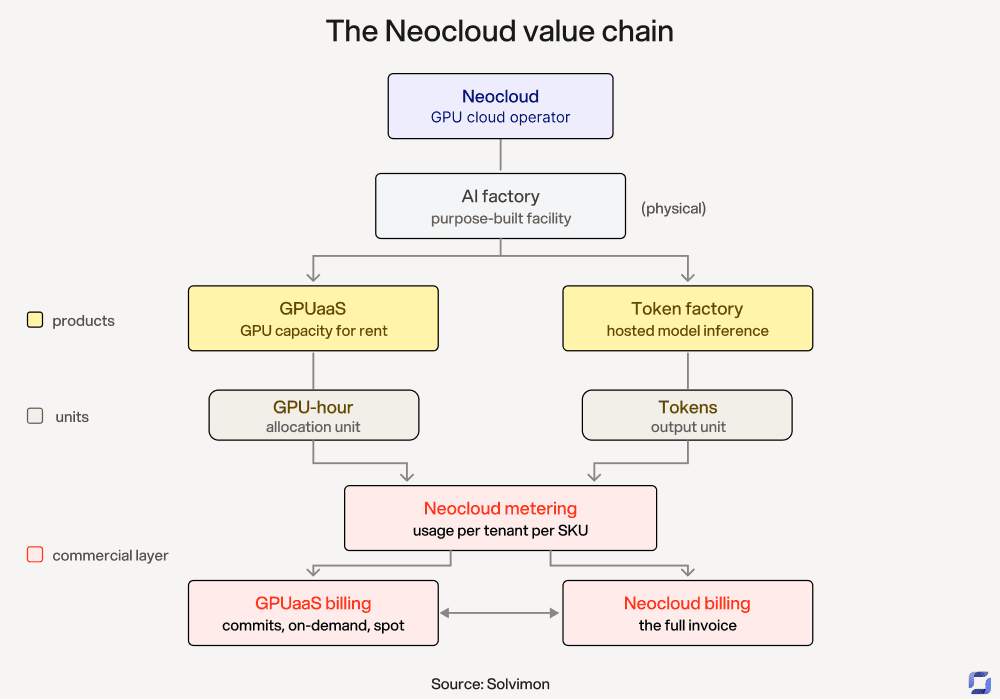
A neocloud is a cloud provider built around GPU compute for AI workloads: CoreWeave, Nebius, Lambda, Crusoe, Nscale, and Fluidstack are the reference names. The category's revenue reportedly tripled to around $23 billion in 2025, and most of that revenue flows through billing models that look nothing like classic SaaS subscriptions.
What does a neocloud actually bill for?
Billable dimension | Typical unit | Typical model |
|---|---|---|
GPU compute | GPU-hour or node-hour, per SKU (e.g., H100, B200) | On-demand rate, reserved commit, or spot |
Clusters and orchestration | Cluster-hour, per profile (e.g., Kubernetes, SLURM, VMs, bare metal) | Bundled or itemized |
Storage | GB-month | Flat rate per tier |
Data egress | GB transferred | Flat rate, often the margin sweetener |
Hosted inference | Tokens in / tokens out, per model | Per-token rates, the newest layer |
Priority and add-ons | Queue priority, support tiers, dedicated networking | Surcharges on the base bill |
The mix matters more than any single rate. A provider selling raw GPU-hours competes on price per hour. One selling token-metered inference competes on price per unit of output, which carries very different margins. Rafay, which builds the orchestration layer several neoclouds run on, frames this as the move from GPU clouds to "token factories"... the billing stack has to support both ends at once.
How is neocloud billing structured commercially?
Three layers, usually stacked in the same contract:
Reserved commitments. The anchor. Customers commit to capacity (e.g., 512 GPUs for 24 months) at a discounted rate, often prepaid quarterly or annually. This is a minimum commit at data-center scale, and the prepaid portion creates real deferred revenue accounting obligations.
On-demand. Metered usage-based pricing per GPU-hour for burst capacity beyond the commit, billed in arrears.
Spot or preemptible. Discounted access to idle capacity, revocable when a committed customer needs it. Pricing here is really utilization management wearing a rate card.
Why is neocloud billing hard?
The metering side has to attribute every GPU-hour to the right tenant, cluster, and SKU across orchestration layers (covered separately under neocloud metering). The commercial side then has to rate that usage against contracts that mix commits, drawdowns, overage rates, and negotiated exceptions per enterprise customer.
And the numbers are large. A single mid-size enterprise deal can run to 7 figures a year, invoiced monthly with line-item detail that finance teams on both sides will audit. Billing errors that would be rounding noise in SaaS become contract disputes at GPU prices. Revenue leakage through unmetered usage or misapplied commit drawdowns scales with the rates.
Multi-currency exposure is structural rather than incidental: European neoclouds (Nebius, Nscale) sell in EUR and USD against hardware and power costs in several currencies. See multi-currency billing.
What infrastructure does neocloud billing need?
The reference architectures published in this space (Rafay's metering APIs, Backblaze's partner billing kit) converge on the same shape: an append-only usage ledger, a price book kept separate from the metering pipeline so rates can change without touching collection, rating logic that joins the two, and reconciliation that catches drift between what was provisioned, what was metered, and what was invoiced.
That is a billing infrastructure problem, and it's the one Solvimon is built for: metering and rating in one ledger, commits and drawdowns as native price structures, and automated invoicing with line-item detail that survives an enterprise audit.
FAQ
Is neocloud billing the same as GPUaaS billing?
Nearly. GPUaaS billing is the product-level term for billing GPU-as-a-Service. Neocloud billing covers the provider's whole commercial stack, of which GPUaaS is the core product.
What's the difference between showback, chargeback, and billing here?
Showback reports consumption per team with no money moving. Chargeback moves internal budget. Billing invoices external customers with contractual consequences. Neoclouds typically need all three, because their enterprise tenants run internal chargeback on top of the provider's bill.
Do neoclouds use credits?
Increasingly, especially for inference products, where credit-based pricing abstracts per-token rates the same way it does for AI application vendors.
Why do neocloud invoices get disputed?
Usually attribution: whose job consumed the GPU-hours, at which rate, drawn against which commit. The ledger that can replay per-tenant usage wins the dispute.
Related
Neocloud metering: the measurement layer underneath
GPUaaS billing: the core product's billing model
Neocloud: the operator category itself
Minimum commit: the anchor structure of neocloud contracts
Ready for billing v2?
Solvimon is monetization infrastructure for companies that have outgrown billing v1. One system, entire lifecycle, built by the team that did this at Adyen.