
What are Volume Commitments? How Committed Spend Changes Pricing

Written by Arnon Shimoni
✓ Expert
Last updated on:
Volume commitments are contracts where a buyer pledges to purchase a defined quantity of goods or services over a set period, typically in exchange for better pricing, reserved capacity, or supply guarantees. The buyer trades flexibility for savings; the seller trades uncertainty for predictability. In practice, the design of the commitment matters as much as its existence. How pricing changes with volume, whether the structure is tiered or smooth, and what happens when the buyer falls short or overshoots all determine whether the commitment delivers what both parties expect.
How Volume Commitments Work
A volume commitment specifies four things: the quantity promised, the pricing structure at that volume, the timeframe, and what happens at the edges. The pricing structure is where most of the design work lives.
There are three ways unit price can respond to volume, and all three appear in real contracts.
Price decreases with volume. The most common expectation, and often the default that gets applied without much examination. Buyers and procurement teams push for it. Sales teams accept it because larger deals look good even at lower unit prices. The economic case for it is real in some situations: fixed costs spread across more units, and ongoing investment in a platform (R&D, infrastructure, AI development) becomes more efficient as the user base grows. The risk for sellers is that offering volume discounts reflexively, rather than based on actual cost or value economics, can hollow out unit economics on large accounts.
Price stays flat across volume. Common in product-led growth companies where pricing is published, automated, and non-negotiable. It makes sense when neither your costs nor the value you deliver change meaningfully with volume. Fewer discounts means cleaner unit economics and simpler forecasting, at the cost of losing deals to competitors who will negotiate.
Price increases with volume. Less intuitive but real. It appears when scarcity is genuine (limited capacity, specialized expertise, constrained infrastructure) or when variable costs actually rise with scale. Professional services businesses often see this: finding more skilled people takes time and cost, so expanding scope mid-engagement costs more per unit than the original scope did. Some limited-edition markets use escalating price as a demand signal by design, where each additional unit sold is evidence of scarcity and raises the price of the next.
Tiered vs. Smooth Pricing Structures
Once you’ve decided how price should relate to volume, you choose whether to implement that relationship as a stepped (tiered) structure or a smooth (algorithmic) one.
Approach | How It Works | Strengths | Weaknesses |
|---|---|---|---|
Tiered | Defined bands with a fixed unit price per band | Familiar to buyers, easy to quote, models behavior changes at scale | Harder to optimize, creates cliff edges at tier boundaries |
Smooth / algorithmic | A formula where volume is the input and total price is the output | Optimizable, no cliff edges, precise | Less transparent, buyers may find it harder to trust |
The tiered approach matches how buyer behavior often actually works. A small business owner makes different purchasing decisions than a VP at a mid-market company, who makes different decisions than an enterprise procurement team. When behavior changes at scale, tiers can model those inflection points. The smooth approach is better for pricing optimization systems that need to connect a pricing function to an optimization model.
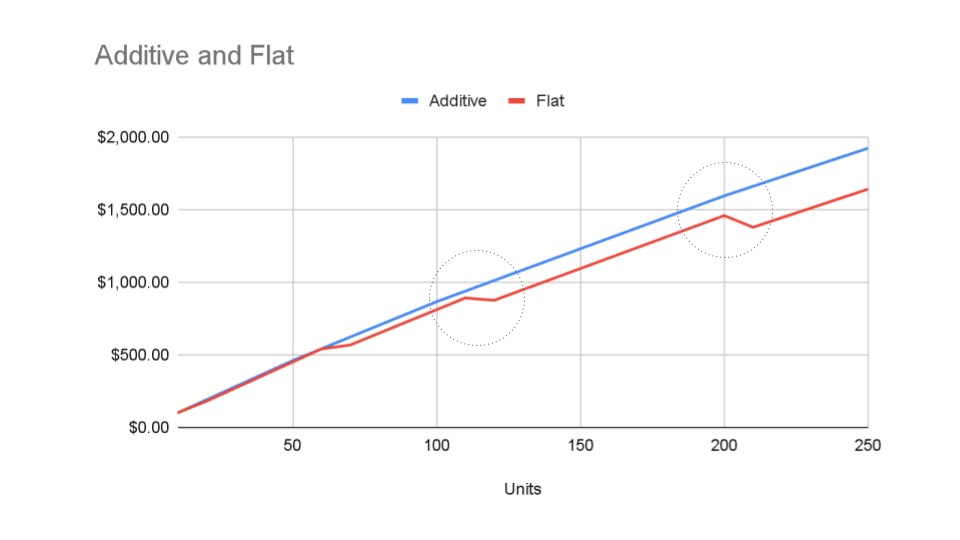
Chart via Steven Forth @ Ibbaka
Most enterprise SaaS and cloud contracts use tiered structures because that’s what buyers expect and sales teams can execute. Smooth pricing appears more often in automated, high-volume, or API-based contexts where the transaction is programmatic rather than negotiated.
Volume Commitments in Cloud and AI
Cloud providers treat volume commitments as a core commercial product. AWS Reserved Instances, Google Committed Use Discounts, and Azure Reserved VM Instances all exchange upfront commitment (one year or three years) for significant unit price reductions, typically 20-60% off on-demand rates. The buyer accepts scheduling and capacity constraints; the provider guarantees the price and reserves the capacity.
AI API products are adding their own commitment structures as enterprise demand grows. Committing to a monthly token or credit volume in exchange for a lower per-unit rate is the AI-native version of a cloud CUD. The complication is that AI consumption is harder to predict than compute or storage. A team building AI agents may use 10x their expected token volume in a single week depending on workflow changes. Commitment structures that work for predictable workloads can create real financial exposure for teams running variable AI tasks.
Minimum commit contracts are the floor version of this: the buyer guarantees a minimum spend regardless of actual consumption, often with usage-based pricing above the floor. This protects seller revenue forecasting while giving buyers flexibility above the baseline.
What Volume Commitments Actually Protect Against
For sellers, the primary value is forecast certainty. Knowing $X of revenue is committed for the next 12 months changes how you staff, plan infrastructure, and negotiate with your own suppliers. The operational savings from this certainty are often the economic foundation for the discount offered, not just margin concession.
For buyers, committed pricing protects against price increases. A three-year committed rate on cloud compute or API calls locks in economics that may look significantly better than spot pricing in year three if demand for that resource grows. Supply stability matters too: committed customers often get priority access during capacity crunches, which can matter for AI infrastructure where capacity constraints are real and growing.
Neither party benefits from a commitment the buyer can’t actually meet. Shortfall penalties, take-or-pay clauses, and true-up structures all exist to manage that risk, but they create friction when consumption falls short of the commitment. The best volume commitment is calibrated to actual expected consumption with some headroom, not to the highest number procurement will sign.
Common Challenges
Commitment levels are set on bad data. Buyers often commit based on optimistic consumption projections, particularly for new products or AI tools where usage patterns aren’t established. The commitment looks right at signing and looks wrong six months in. Building in a review clause or a ramp structure for new workloads reduces this risk.
Tiered pricing creates cliff effects. A buyer consuming 9,900 units with a tier break at 10,000 faces a pricing anomaly: buying 100 more units drops their per-unit cost enough that it saves money overall. Sales teams learn to use this as a closing tool; buyers learn to game their consumption timing. At scale, these cliff effects create lumpy revenue and awkward conversations at renewal.
Shortfall clauses create disputes. Take-or-pay structures require the buyer to pay for committed volume even if they don’t consume it. Clear in the contract, uncomfortable in practice. When a buyer consumes 60% of committed volume due to a business change outside their control, the shortfall clause becomes a relationship test. How this gets handled affects renewal probability more than the original price did.
Volume discounts can obscure poor unit economics. A large account on a steep volume discount may be consuming more support, infrastructure, and customer success resources than a smaller account at full price. Revenue leakage on large committed accounts is common and often invisible until someone models the cost-to-serve. The discount was justified on cost-spreading logic; the actual cost-to-serve told a different story.
Renewal is harder than the original deal. The buyer now has 12-24 months of consumption data and wants to renegotiate based on actuals. The seller wants to hold the committed rate or upsell to a higher tier. If the original commitment was set high, the buyer has leverage. If the original commitment was set low and the buyer overshot, the seller has it.
FAQ
Q: What’s the difference between a volume commitment and a minimum commit? A volume commitment specifies total quantity over a period and prices it accordingly, with the discount contingent on actually reaching that volume. A minimum commit sets a floor on spend regardless of consumption: the buyer pays the minimum even if actual usage falls short. Volume commitments are more common in tiered pricing structures; minimum commits are more common in usage-based contracts where the seller needs a revenue floor.
Q: When should price actually go up with volume?
When your variable costs rise with scale, or when scarcity is real. A professional services firm adding headcount to handle a larger engagement pays market rates for that talent, often above what the original team cost. An AI platform with constrained GPU capacity may charge more per unit to large customers who require guaranteed throughput. The logic runs opposite to traditional volume discounts, but the economics are sound when the inputs are honest.
Q: How do volume commitments interact with usage-based pricing?
They’re often combined. A committed base volume establishes the floor and the per-unit rate; consumption above that floor is billed at usage-based rates, sometimes at the same rate, sometimes at a premium. This structure gives the seller revenue predictability on the committed tier and gives the buyer flexibility above it. See usage-based pricing for how the variable layer is typically metered and invoiced.
Q: What happens when a buyer exceeds their committed volume?
Depends on the contract. In tiered structures, consumption above the committed tier is typically billed at the next tier’s rate or at list price. In cloud-style committed use contracts, overage reverts to on-demand pricing, which is significantly higher than the committed rate. Some contracts allow buyers to roll excess consumption into the next commitment period. The treatment of overage is worth specifying clearly at contract signing, not at the first true-up.
Q: How should you set tier sizes in a tiered volume structure?
Start with where buyer behavior actually changes. If there’s a meaningful difference in how a 50-person company and a 500-person company use your product, that inflection point should be near a tier boundary. Set tier sizes to match natural customer cohorts, not round numbers that feel convenient. Tiers that don’t correspond to real differences in usage patterns or buying behavior create pricing that neither side believes in. See tiered pricing for the mechanics of setting tier sizes and managing transitions between them.
Related
Solvimon flexible pricing. Run any pricing model without engineering sprints.
Usage-based pricing. Charging on what customers consume, and when it works.
Minimum commit. The floor a customer pays regardless of usage.
Ready for billing v2?
Solvimon is monetization infrastructure for companies that have outgrown billing v1. One system, entire lifecycle, built by the team that did this at Adyen.