
What is Marginal Cost Pricing?

Written by Arnon Shimoni
✓ Expert
Last updated on:
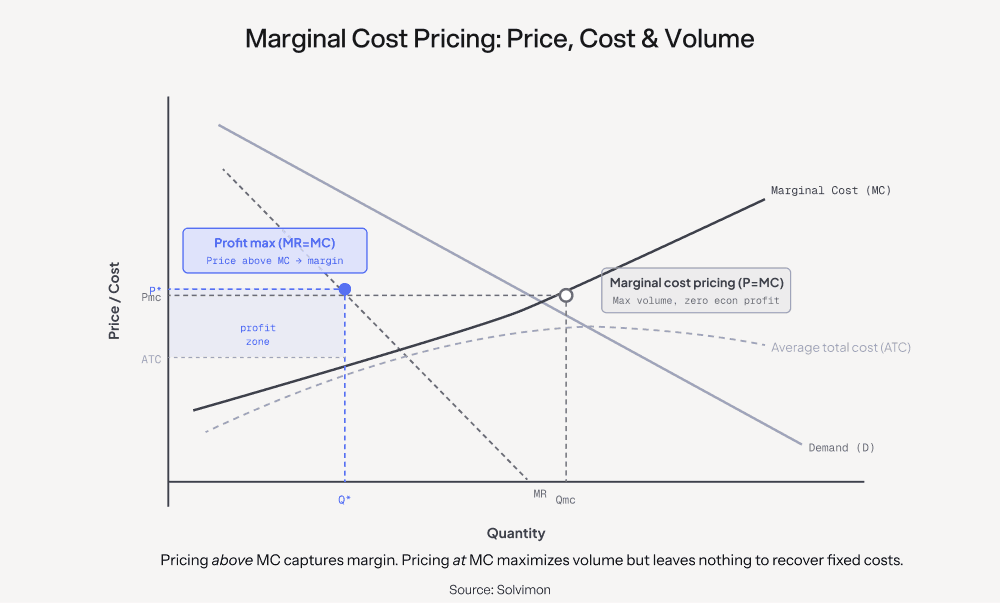
Marginal cost pricing is a strategy where a company sets the price of a product at, or close to, the marginal cost — the cost of producing one additional unit. In theory, pricing at marginal cost drives maximum volume and market efficiency. In practice, companies use it as a floor, a competitive signal, or a strategic lever for specific segments, not as a standalone model.
Field | Detail |
|---|---|
Also known as | Variable cost pricing, incremental cost pricing |
Core principle | Price ≥ marginal cost of one additional unit |
Outcome at price = MC | Maximum market volume; zero economic profit on each marginal sale |
Best suited for | Commodities, excess capacity situations, utilities, digital goods with near-zero marginal cost |
When it stops being useful | When fixed costs are high, when products are differentiated, when customer WTP exceeds MC by a wide margin |
Related concepts | Cost-plus pricing, value-based pricing, contribution margin, break-even analysis |
Why does marginal cost pricing exist?
The concept comes from microeconomics. In a perfectly competitive market, price naturally converges to marginal cost over time: any price above MC attracts competition, which drives price down. Companies that understand their cost structure use this dynamic to reason about floors, competitive responses, and capacity utilization.
For software and AI companies, marginal cost pricing has become newly interesting because the marginal cost of delivering a digital product can be close to zero (hosting a SaaS feature costs almost nothing per additional user), but for AI inference it's decidedly not zero. A model call has a real compute cost. A generated document has a real token cost. A completed agent task has a real orchestration cost. This is one reason AI pricing is evolving so fast: companies are still figuring out what their true marginal cost looks like at scale.
How marginal cost pricing works in practice
The mechanics are straightforward. Calculate the variable cost of producing one more unit (materials, compute, bandwidth, support time). Set price at or above that number. Any price above MC contributes to covering fixed costs and generating profit. Any price below MC means the company loses money on each additional sale, which is only rational in specific circumstances: acquiring customers, burning down excess capacity, or subsidizing a segment as a growth strategy.
Three scenarios where marginal cost pricing appears in practice:
Excess capacity pricing. A SaaS company has a data warehouse that's 40% utilized. Selling additional compute-heavy analytics seats at near-marginal-cost fills capacity without meaningful incremental cost. Margin per unit is thin, but the fixed infrastructure was already paid for.
Penetration pricing at MC. A company entering a competitive market prices at marginal cost to acquire customers quickly, planning to raise prices later. Works when customer acquisition justifies the short-term margin hit. Fails when customers expect marginal-cost prices indefinitely.
Near-zero MC for digital goods. For software where the marginal cost of one more user is genuinely close to zero (no per-seat compute cost, no variable support cost), pricing at MC means pricing near zero. This is the logic behind freemium tiers: the free tier is essentially priced at marginal cost (or below it, subsidized by the paid tier).
What are the limits of marginal cost pricing?
Pricing at MC is economically efficient but commercially unsustainable for most businesses. If every unit is priced at its marginal cost, there's no margin left to recover fixed costs: R&D, salaries, infrastructure, sales and marketing. A company pricing every product at MC will generate zero economic profit, or lose money.
The second limit: marginal cost pricing ignores value. A customer who gets $10,000 of business value from a product that costs $2 to deliver will pay $2 if you let them. Value-based pricing is the corrective: price is set based on what the customer gains, not what the seller spends.
A third limit specific to AI and usage-based products: marginal costs are non-uniform. A simple LLM prompt costs fractions of a cent. A 30-step agentic workflow costs orders of magnitude more. Pricing a single rate against a heterogeneous cost structure means either undercharging heavy users or overcharging light ones. This is exactly why companies like OpenAI and Anthropic moved to tiered and per-model pricing: their marginal costs vary by an order of magnitude across product surface.
How marginal cost pricing connects to billing infrastructure
A billing system that handles marginal cost pricing needs to do a few specific things well:
First, it needs real-time metering. If your pricing tracks marginal cost (per API call, per compute minute, per GB processed), every event needs to be captured at the moment it occurs. Batch billing against estimated usage creates reconciliation gaps.
Second, it needs to handle cost-varying products on a shared rate card. A platform where different actions have different marginal costs needs flexible pricing configuration, not a single price per unit.
Third, it needs margin reporting. Knowing that you're billing $0.008 per call is not useful without knowing that a specific customer's usage mix is generating negative margin on 15% of their calls.
Where Solvimon fits
Solvimon's Metering and Catalog primitives are built to handle variable cost structures: per-meter pricing, tier configurations, and rate cards that reflect real cost variation. The Revenue primitive gives you the margin view: billed vs. cost, by customer, by product line.
Related terms
Frequently Asked Questions
What is marginal cost in simple terms?
Marginal cost is the cost of producing one more unit of a product. If it costs $100,000 to produce 1,000 units and $100,500 to produce 1,001 units, the marginal cost of the 1,001st unit is $500.
Is marginal cost pricing profitable?
Pricing exactly at marginal cost generates zero profit on each marginal sale. It contributes to fixed cost recovery only if the price exceeds variable cost, which is the same as saying: only when there's a positive contribution margin. "Pricing at MC" in practice usually means "pricing just above MC."
When should a company use marginal cost pricing?
It makes sense in three scenarios: filling excess capacity, competing aggressively on price to win market share, or in digital goods with genuinely near-zero marginal cost where the goal is adoption volume. It doesn't make sense as a standalone long-term model.
How does marginal cost pricing apply to SaaS?
For SaaS products with negligible per-user variable costs, marginal cost pricing converges on free tiers. For AI/SaaS products with real per-call compute costs, marginal cost pricing means pricing per usage event at a rate that reflects actual infrastructure cost. Most companies price above MC and capture value, but they use MC as a floor.
What's the difference between marginal cost and average cost?
Marginal cost is the incremental cost of one more unit. Average cost (or average total cost) is total cost divided by units produced. At low volumes, MC is typically below average cost because fixed costs dominate. As volume grows, the two converge. A company that prices at average cost will undercut average cost pricing when MC is low and volumes are high.
Why do AI companies struggle with marginal cost pricing?
Because their marginal costs are heterogeneous: a text completion, an image generation, and a 30-step autonomous agent task all have wildly different infrastructure costs. A single per-unit price forces cross-subsidization across product types, which creates the wrong incentives. The solution is per-model or per-capability pricing, which is what most frontier AI companies have moved to.
Ready for billing v2?
Solvimon is monetization infrastructure for companies that have outgrown billing v1. One system, entire lifecycle, built by the team that did this at Adyen.