What is the Freemium Model?

Written by Arnon Shimoni
✓ Expert
Last updated on:
The freemium model is a business model where a product's core functionality is offered at no cost, and revenue is generated from a subset of users who upgrade to a paid tier. The free tier drives distribution and acquisition. The paid tier captures value from users who outgrow the free limits or need premium capabilities. The word "freemium" (free + premium) describes the two-tier structure, not any specific pricing mechanics because the paid tier can be a flat subscription, usage-based, per-seat, or a combination.
Field | Detail |
|---|---|
Also known as | Free-to-paid, F2P (in gaming), open-core (a variant for dev tools) |
Revenue generation | Conversion of free users to paid tiers, or upgrade within paid tiers |
Key metric | Conversion rate (free → paid), usually 2-5% in B2C, 10-20% in PLG B2B |
Works best for | Developer tools, productivity software, AI apps, consumer apps with network effects |
Fails when | Free tier provides too much value, conversion trigger is unclear, CAC on free users exceeds LTV |
Related concepts | Product-led growth (PLG), open-core, usage-based pricing, conversion funnel |
Why does the freemium model exist?
Distribution. The free tier removes the biggest friction in acquisition: the decision to pay. When a product is free to try without a credit card, without a sales call, and without a procurement process, the top of the funnel opens dramatically. More users enter. More users find value. Some fraction of those converts.
The logic works particularly well for software with high per-user distribution potential (virality, word of mouth, referrals) and near-zero marginal cost of serving additional free users. Figma scaled to millions of users before monetizing aggressively because a collaborative design tool gets better with more users, and adding a free user cost almost nothing. Notion, Airtable, Linear, and GitHub all used freemium to build distribution that sales teams couldn't have bought.
For AI products specifically, freemium is a key acquisition channel because AI utility is easiest to demonstrate when the user can experience it, not just read about it. A free tier that lets a developer run 50 API calls against an inference endpoint converts better than any marketing copy.
How freemium conversion works
The conversion mechanics vary, but the underlying structure is consistent. Free users generate data about usage patterns. Power users emerge. A subset hits a natural limit or wants premium functionality. Some of those upgrade.
The trigger determines the conversion rate. The single biggest lever in freemium is the design of the conversion trigger: the moment a free user decides to pay.
Bad triggers: arbitrary feature paywalls that feel punitive.
Good triggers: usage limits the user has clearly outgrown, team collaboration features that require involving colleagues, or compliance and export features that a growing business needs.
When the trigger aligns with value that the user already recognizes, conversion is a natural step. When it feels arbitrary, users churn out instead of upgrading.
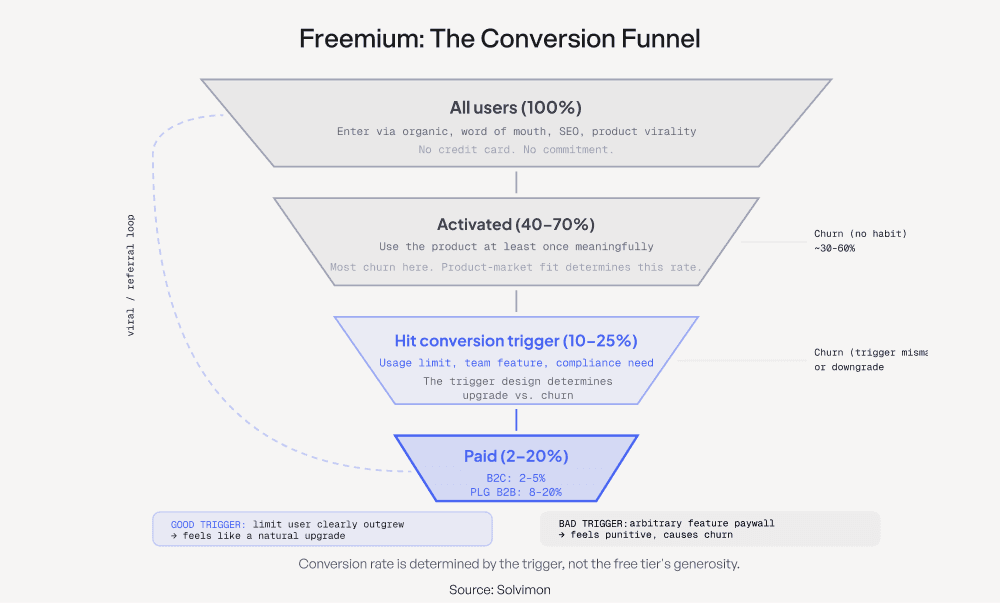
Typical conversion rates by context:
Consumer apps (Spotify, Duolingo, Canva): 1-5%. A large top of funnel makes the math work even at low conversion. The unit economics require either high LTV per paid user or a very efficient cost structure on free users.
PLG B2B tools (Figma, Notion, Linear, Vercel): 8-20% team or seat conversion. The free tier is viral within organizations. One power user brings in colleagues. The conversion moment is often "you need to pay to collaborate with your team."
Developer/API tools (Stripe, Twilio, OpenAI, Anthropic): tiered free credits that expire or usage-based conversion. The trigger is purely usage. When a developer's product ships and starts generating real traffic, they cross the free tier limit and upgrade automatically.
What are the variants of freemium?
Usage-limited free tier. X API calls/month, X GB storage, X seats. Clear, fair, automatic upgrade trigger. Used by OpenAI, Anthropic, Vercel, Snowflake.
Feature-gated free tier. Core features free, advanced features paid. The paid features need to be genuinely valuable (SSO, audit logs, API access, export, advanced analytics) or conversion rates suffer. Figma's Organization plan features (advanced permissions, centralized font management, design system controls) are the paid features that enterprises need.
Time-limited trial with freemium fallback. Full product free for 14-30 days, then a permanent free tier with limits. Common in B2B SaaS. Salesforce and HubSpot use variants of this for inbound.
Open-core. The core product is open-source and free. The managed hosting, enterprise features, or support are paid. GitLab, PostHog, and Metabase use this model. The "free" tier is genuinely powerful; the paid tier targets teams that need managed infrastructure or compliance features.
Where freemium breaks down
Free tier too generous. If the free tier meets the needs of most users indefinitely, there's no upgrade trigger. The company subsidizes a large user base with no revenue path. This is a common failure mode in early-stage companies that want to grow metrics: the DAU looks great, the revenue is flat. Fixing it requires tightening the free tier, which creates churn risk from existing free users.
CAC on free users exceeds expected LTV. Every free user has a cost: compute, storage, support, customer success. If the average free user costs $8/month to serve, converts at 2%, and generates $15/month after conversion, the math is: $8 / 0.02 = $400 cost to acquire one paid customer, on a $180 annual contract. That doesn't compound well.
Conversion trigger misaligned with value. If the trigger is "you need to pay after 5 documents," but users only create 3 documents per month, they never hit the trigger. A trigger that arrives before the user has experienced enough value just creates churn.
No viral loop. Freemium works best when free users also distribute the product (invitations, sharing, public work). A B2B tool where free users work in isolation — no sharing, no collaboration, no virality — gets distribution from the free tier but no compounding. The economics become pure inbound SEO and paid acquisition, where the free tier's only advantage is conversion rate improvement.
How freemium connects to billing infrastructure
Freemium creates billing complexity that simpler models don't have. Free tier usage still needs to be metered — you need to know when a user crosses a limit. The upgrade flow needs to handle mid-cycle activations, prorated billing, and trial-to-paid transitions. Downgrade from paid to free needs to be handled without data loss.
The usage data generated by free users is also the most important input to freemium conversion analysis. Knowing which usage events correlate with upgrade helps optimize the trigger. Billing systems that don't expose usage analytics at the user level make this analysis impossible without separate tooling.
Where Solvimon fits
Solvimon's Metering, Entitlements, and Wallets primitives support the full freemium stack: usage tracking on free tiers, feature flags (Entitlements) for gating premium capabilities, credit pools (Wallets) for usage-based free tiers, and subscription transitions for the free-to-paid moment.
Related terms
Frequently Asked Questions
What is the average freemium conversion rate?
It varies significantly by product type and conversion trigger design. Consumer apps typically see 1-5% conversion. PLG B2B tools typically see 8-20% team or seat conversion. Usage-triggered conversion (API, AI tools) can be higher if the usage trigger is well-designed.
Is freemium the same as a free trial?
No. A free trial is a time-limited offer that gives full access to the product and then requires payment. Freemium is a permanent free tier with feature or usage limits. They can be combined: full access for 14 days, then a permanent free tier with limits.
What is open-core, and how does it relate to freemium?
Open-core is a variant of freemium where the core product is open-source and free (the "community edition"), and revenue comes from managed hosting, enterprise features, or support. PostHog, GitLab, and Metabase use this model. The distinction from traditional freemium is that the free tier is genuinely powerful and community-maintained, not just a stripped-down product.
How do you design a good freemium conversion trigger?
The trigger should align with a moment where the user clearly needs the paid feature to continue getting value. Usage limits work when users will naturally grow into them. Feature gates work when the gated features are genuinely needed by a paying segment (e.g., SSO for enterprise, API access for developers). Arbitrary limits that don't align with real usage patterns produce churn, not upgrades.
Can freemium work for enterprise products?
With caveats. Enterprise products often have a PLG motion (individual users adopt the free tier and then push for company purchase) rather than a traditional freemium motion. Figma is the canonical example: designers adopted it individually, and eventually IT departments licensed it company-wide. The "freemium" in enterprise is really a bottom-up viral strategy, not a consumer conversion model.
What is the difference between freemium and usage-based pricing?
Usage-based pricing means customers pay based on what they use, with no free tier (or a small initial credit). Freemium means a permanent free tier with conversion to a paid tier. They're often combined: free up to X units/month, then pay-as-you-go above that threshold. OpenAI's API uses this hybrid.
Educational reference. Solvimon's Metering, Entitlements, and Wallets primitives support freemium billing: usage tracking on free tiers, feature gating, credit pools, and subscription transitions.
Ready for billing v2?
Solvimon is monetization infrastructure for companies that have outgrown billing v1. One system, entire lifecycle, built by the team that did this at Adyen.