
What is Predictive Pricing?

Written by Arnon Shimoni
✓ Expert
Last updated on:
Predictive pricing uses data, statistical models, and machine learning to forecast what price will produce the best outcome for a given customer, segment, or market condition. Instead of setting a price once and revisiting it annually, predictive pricing continuously analyzes signals (demand patterns, usage behavior, competitor moves, cost changes, willingness to pay) to recommend or automatically adjust prices.
The concept isn't new. Airlines have done it for decades. What's changed is that AI made it viable for software companies. Real-time usage data, customer behavior signals, and inference cost fluctuations create enough variables that manual pricing decisions can't keep up. Bain & Company found that dynamic pricing, powered by predictive models, can increase margins by 2-10%.
Predictive pricing vs. other pricing approaches
Approach | How price is set | When it changes | Who decides |
|---|---|---|---|
Cost-plus | Margin added to cost of delivery | When costs change | Finance |
Competitor-based | Pegged to market rates | When competitors move | Product / Marketing |
Value-based | Anchored to customer willingness to pay | After WTP research (often annually) | Product / Pricing committee |
Dynamic (rule-based) | Rules trigger changes (e.g., "10% off above 100 seats") | When conditions match rules | Pre-set rules |
Predictive (ML-driven) | Algorithms forecast optimal price from multiple signals | Continuously, as data changes | Algorithm recommends, human or system executes |
Predictive pricing doesn't replace value-based thinking. It operationalizes it. You still need to understand what customers value. Predictive models then help you capture that value at the right moment, for the right segment, at the right price point.
How predictive pricing works in SaaS
In e-commerce and retail, predictive pricing adjusts the sticker price in real time (think Amazon changing product prices thousands of times per day). In SaaS, it works differently because prices are typically contractual, not transactional.
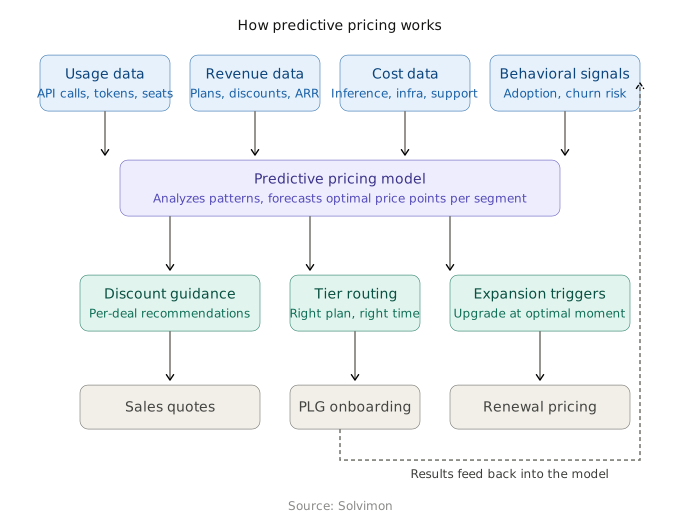
For software companies, predictive pricing shows up in four areas:
Application | What the model predicts | How it's used |
|---|---|---|
Discount optimization | Which discount level maximizes deal close probability without leaving money on the table | Sales gets recommended discount ranges per deal, not blanket approval to cut price |
Tier and plan recommendations | Which tier a prospect should be steered toward based on usage signals and firmographic data | PLG onboarding flow recommends the right plan. Sales quotes the right tier |
Expansion timing | When a customer's usage pattern indicates readiness for an upgrade | Customer success or product triggers an upgrade prompt at the right moment |
Renewal pricing | What price a renewing customer will accept based on usage, engagement, and market alternatives | Finance sets renewal rates that maximize retention without under-pricing |
The common thread: predictive pricing in SaaS is less about changing a number on a pricing page and more about guiding commercial decisions with data rather than intuition.
What predictive pricing requires
Predictive pricing doesn't work without the right inputs. The model is only as good as the data feeding it.
Requirement | What it means | Why most companies struggle |
|---|---|---|
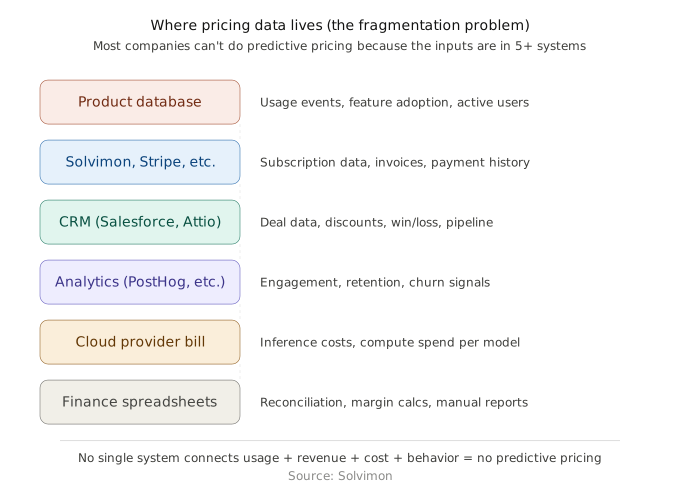
Usage data | Granular, per-customer consumption metrics (API calls, tokens, features used, seats active) | Usage data often lives in product databases, not in billing or CRM systems |
Revenue data | What each customer pays, across which plans, with which discounts | Revenue data is split across Stripe, Salesforce, spreadsheets, and finance tools |
Cost data | What each customer costs to serve (inference, support, infrastructure) | AI companies rarely have per-customer cost visibility |
Behavioral signals | Engagement patterns, feature adoption, support interactions, churn indicators | Signals are scattered across product analytics, support tools, and CRM |
Market data | Competitor pricing, win/loss data, market willingness to pay | Usually anecdotal rather than systematic |
The biggest barrier to predictive pricing is typically the data infrastructure. When usage, revenue, and cost data live in separate systems, you can't build a model that connects them and that's why billing infrastructure matters for pricing strategy, not just invoicing: the billing system is often the only place where usage, pricing, and revenue converge.
Predictive pricing and AI products
AI products have a specific need for predictive pricing because their cost structure is volatile in ways traditional SaaS isn't.
Factor | Why it matters for AI pricing |
|---|---|
Inference cost variability | Model costs drop 10x every 18 months for existing models, but new models arrive at premium prices. Pricing set six months ago may be wrong today |
Usage distribution | 70-80% of token consumption comes from 10% of users. Flat pricing across all users means heavy users are subsidized by light users |
Model routing | Products route between cheap and expensive models per request. Average cost per interaction varies by customer and task type |
Credit economics | Credit conversion rates need to reflect changing provider costs. Predictive models can optimize when and how to adjust conversion rates |
For AI companies, predictive pricing isn't a nice-to-have optimization. It's margin protection. Without it, you're flying blind on which customers are profitable, which pricing tiers are leaving money on the table, and when to adjust rates as infrastructure costs shift.
Common mistakes
Mistake | What happens |
|---|---|
Optimizing price without understanding value | Algorithms find the price customers will pay, not the price they should pay. Without value-based grounding, you race to the bottom |
Personalized pricing without transparency | Customers who discover different pricing feel deceived. B2B buyers talk to each other |
Over-engineering the model before fixing data | Building ML models on fragmented, inconsistent data produces confident wrong answers |
Ignoring the billing layer | You can predict the optimal price, but if your billing system can't execute it (custom tiers, segment-specific rates, dynamic discounts), the insight is unusable |
Have questions about your pricing?
Solvimon has worked with hundreds of companies navigating the transition from simple subscriptions to hybrid, usage-based, and AI-driven pricing models. We've seen what works, what breaks, and where the biggest revenue leaks hide.
If you're unsure whether your pricing captures the value you deliver, or if your billing infrastructure can support the pricing model you want to run, we can help you diagnose it.
Frequently Asked Questions
What is predictive pricing?
Predictive pricing uses historical data and statistical or machine learning models to forecast demand, willingness to pay and price sensitivity, then sets prices from those forecasts rather than from cost or intuition.
How is predictive pricing different from dynamic pricing?
Predictive pricing forecasts what a price should be. Dynamic pricing changes prices in real time as conditions move. Prediction can inform dynamic pricing, but it is also used to set static prices more accurately.
Does predictive pricing work in B2B software?
Partially. It works well for identifying segments, estimating willingness to pay and forecasting consumption. It works poorly as an automated price setter, because B2B prices are negotiated, contractually fixed for a term, and highly visible to customers.
What data does predictive pricing need?
Enough historical transactions to be statistically meaningful, with the outcome of each deal, the discount granted, the segment, and ideally the reason a deal was lost. Most companies have the first three and not the fourth, which limits the models substantially.
What is the most common mistake?
Modelling on won deals only. A model fitted to deals you closed learns the prices customers accepted, not the prices they would have accepted, and it drifts systematically downward.
Is predictive pricing useful for AI products?
Mostly for cost forecasting rather than price setting. Predicting consumption and therefore infrastructure cost per account is high value and tractable. Predicting willingness to pay in a market this young usually is not.
Related
Price estimation. Projecting what a consumption deal will cost.
Pricing analytics. The data foundation prediction runs on.
Yield optimization. Acting on what the analysis reveals.
Price benchmarking. External reference points for pricing decisions.
Sales forecasting. Forecasting revenue rather than price.
Ready for billing v2?
Solvimon is monetization infrastructure for companies that have outgrown billing v1. One system, entire lifecycle, built by the team that did this at Adyen.