Quote to Cash (Q2C): the complete guide to CPQ, contracts, billing and revenue

Written by Arnon Shimoni
✓ Expert
Last updated on:
Quote to Cash (often abbreviated Q2C or QTC) is the end-to-end revenue process that starts when a prospect requests pricing and ends when cash hits the company's bank account and is recognized as revenue. It covers eight discrete stages: configure-price-quote (CPQ), contract execution, order management, provisioning, billing, invoicing, payment collection, and revenue recognition. Q2C is sometimes used interchangeably with Contract to Cash (C2C). It's broader than CPQ (which is just the quoting stage) and broader than Order to Cash or O2C (which starts after the order is confirmed).
Field | Detail |
|---|---|
Also known as | QTC, Contract to Cash (C2C), revenue lifecycle |
Stages | CPQ → Contract → Order → Provisioning → Billing → Invoicing → Payments → Revenue recognition |
Adjacent concept | Order to Cash (O2C). Starts after order confirmation, skips CPQ and contract. |
Subset concept | CPQ. Only the first stage of Q2C. |
Common owners | Sales (CPQ, contract), RevOps (orchestration), Finance (billing, recognition), Engineering (provisioning) |
Typical leakage rate | 1-5% of revenue across the lifecycle (industry estimates) |
Tools involved | CRM, CPQ tool, contract lifecycle management (CLM), billing platform, payment processor, ERP, revenue subledger |
Standards that apply | ASC 606 (US GAAP), IFRS 15, SOC 2, country-specific tax and e-invoicing rules |
What does Quote to Cash typically cover?
Q2C is the operational counterpart to revenue recognition. Revenue recognition asks when to record revenue. Q2C asks how does the entire process from sales motion to cash collection work. The eight stages:
Configure-Price-Quote (CPQ). A sales rep configures products from a catalog, applies pricing rules, requests approvals for discounts, and generates a quote. Outputs: an approved, mathematically correct quote document.
Contract execution. The quote becomes a contract. Legal terms are negotiated, e-signatures are captured, the executed contract is stored. Outputs: a signed contract with enforceable terms.
Order management. The contract triggers an order. Order details, billing schedule, ramps, and start dates are loaded into the billing system. Outputs: a billable order tied to the contract.
Provisioning entitlements. The product or service is made available to the customer. For SaaS, this is account creation and entitlement activation. For physical products, this is fulfillment. Outputs: customer has access to what they paid for.
Billing. The billing engine generates the right charges on the right schedule, including base subscriptions, usage-based fees, overages, ramps, escalators, and discounts. Outputs: a set of billing items ready to be invoiced.
Invoicing. Billing items are aggregated into customer-facing invoices, formatted per tax and e-invoicing rules, delivered to the customer. Outputs: a delivered invoice with payment terms.
Payment collection. The customer pays via card, ACH, wire, SEPA, or another rail. Failed payments trigger dunning and retry workflows. Outputs: cash in the bank account, applied to the right customer and invoice.
Revenue recognition. Cash is recognized as revenue per ASC 606 or IFRS 15, with deferred revenue drawn down as performance obligations are satisfied. Outputs: a GAAP-compliant revenue figure on the income statement.
The full chain is what "quote to cash" describes. Most companies do not have one system that handles all eight stages. The typical stack: CRM (CPQ, contract), billing platform (order, billing, invoicing, payment), ERP or subledger (revenue recognition), with custom integration code stitching it together.
CPQ vs Quote to Cash: what's the difference?
CPQ is the first stage of Q2C, not a synonym. The vocabulary often gets used interchangeably, especially in sales-led organizations where CPQ is the most visible part of the revenue stack.
Aspect | CPQ | Quote to Cash |
|---|---|---|
Scope | Configuring, pricing, and producing a quote | The full lifecycle from quote to cash to revenue |
Ends at | Quote approval | Recognized revenue, bank deposit, audit trail |
Who's the primary user? | Sales reps | Sales, RevOps, Finance, Engineering |
Tools | Salesforce CPQ, DealHub, PandaDoc, Conga | Billing platforms, ERPs, revenue subledgers, plus CPQ |
Failure mode if missing | Manual quoting, pricing errors, slow deals | Revenue leakage, GAAP-compliance gaps, slow cash collection |
A company can have excellent CPQ and still have a less-than-stellar Q2C process if billing, invoicing, or revenue recognition fail downstream. A company can have great billing infrastructure and still have a broken Q2C process if the CPQ stage produces quotes the billing system can't actually invoice.
Order to Cash (O2C) vs Quote to Cash: what's the difference?
Order to Cash starts where Quote to Cash leaves off the front-end work. O2C assumes the order already exists and focuses on the operational chain from order through cash collection.
Order to Cash (O2C) starts at the confirmed order and covers: order management, provisioning/fulfillment, billing, invoicing, payment collection, dunning. It's the term used in manufacturing, distribution, and traditional ERP language.
Quote to Cash (Q2C) prepends CPQ and contract execution to O2C. It's the term used in SaaS, AI, and modern B2B selling motions where the front-end sales process is a substantial part of the lifecycle.
The two terms describe overlapping processes from slightly different starting points:
Companies that sell standardized products with no negotiation think in O2C.
Companies that sell complex contracts with custom pricing think in Q2C.
PLG and SLG: two motions through the same funnel
Most companies selling software in 2026 run two revenue motions at once. Product-led growth (PLG) brings customers in through self-serve signup, a card on file, and usage that grows on its own. Sales-led growth (SLG) brings them in through a rep, a configured quote, a negotiated contract, and an invoice with payment terms. Quote to Cash is the process that has to serve both.
The two motions look different at the top and identical at the bottom. PLG skips quoting and contracting almost entirely: the pricing page is the quote and the terms of service are the contract. SLG spends most of its cycle time there, in configuration, approval, and redlines. But from provisioning onward both motions need the same things. Entitlements have to be granted. Usage has to be metered. Charges have to be calculated, invoiced, collected, and recognized.
The failure mode is building them as two stacks. A self-serve stack on a payment processor, an enterprise stack on CPQ plus manual invoicing, and a spreadsheet in the middle reconciling the two.
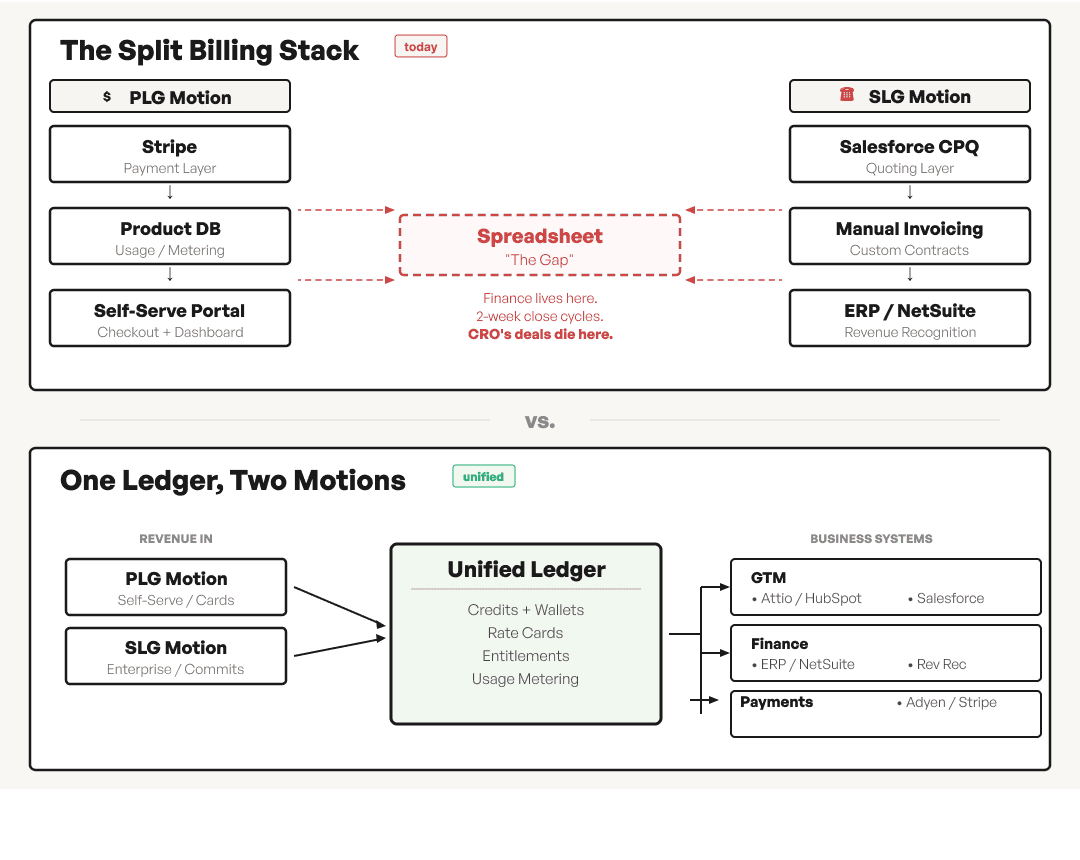
The split shows up in predictable places. Finance cannot answer what a single customer is worth if that customer started self-serve and later signed an enterprise commit, because the two records live in different systems. A rep cannot see current consumption when negotiating an expansion. Revenue recognition runs twice under two sets of assumptions.
What each motion needs from Quote to Cash
Stage | PLG motion | SLG motion |
|---|---|---|
Quote | Public pricing page, in-product upgrade flow | |
Contract | Click-through terms of service | Negotiated MSA, order form, e-signature, custom terms |
Pricing shape | List rates, credit packs, published tiers | Minimum commits, volume discounts, ramps, custom rate cards |
Provisioning | Instant, automated entitlement grant | Triggered on countersignature, often with a start date in the future |
Metering | Identical: usage metering against the same meters | Identical, plus drawdown against the commit |
Invoicing | Card charged automatically, receipt emailed | Invoice on terms, PO reference, e-invoicing where mandated |
Collection | Retry and dunning logic | AR follow-up, bank transfer, aging report |
Recognition | Ratable or usage-based under ASC 606 | Same standard, more performance obligations to separate |
Read down the table and the pattern is clear. The motions diverge for the first two stages and converge for the last six. That is the argument for one ledger underneath both: the divergence is a sales process problem, not a billing architecture problem.
Why AI products push companies into both motions at once
A company selling an AI product usually cannot choose one motion. The self-serve tier is how developers evaluate the thing, and the enterprise contract is where the revenue is. The same account often moves from one to the other inside a quarter, sometimes without anyone in sales noticing until consumption spikes.
That transition is where revenue leakage concentrates. Usage accrued on the self-serve plan before the contract starts, credits bought at list price sitting in a wallet the enterprise agreement was meant to replace, and a commit that nobody is measuring drawdown against. See AI-led growth for what happens when the buyer evaluating your product is itself an agent.
Where does revenue leakage happen across Q2C?
Q2C has eight stages, and each one has its own failure modes. Most companies leak 1-5% of revenue across the full chain. See our revenue assurance article for the full taxonomy. The high-impact failure points by stage:
At CPQ. Rep applies a discount that violates pricing policy. Margins erode silently across many deals. Approvals route slowly, deals stall.
At contract. Custom terms in the signed PDF don't propagate to the billing system. Ramps, escalators, ratchets, and floors don't fire on their scheduled dates.
At order. Order details don't match the contract. Start dates drift. Billing schedule gets configured incorrectly.
At provisioning. Service activated but not billed. Customer gets the product free for weeks or months until someone notices.
At billing. Usage events get lost between the application and the meter. Overage rates get applied incorrectly. Hybrid pricing models (seats + usage + commits) produce invoices that don't reconcile to the contract.
At invoicing. Invoices fail to deliver. Tax calculations are wrong for some jurisdictions. E-invoicing requirements (Italy, France, Germany, India) aren't met.
At payments. Failed ACH debits sit unhandled. Card chargebacks reverse revenue months later. Multi-rail payment reconciliation breaks.
At revenue recognition. Performance obligations aren't tracked. Deferred revenue doesn't get drawn down on schedule. Audit trail is incomplete.
A well-designed Q2C process treats every stage transition as a reconciliation point. The output of stage N must equal the input of stage N+1, with full audit lineage from contract to cash to recognized revenue.
Quote to Cash for hybrid pricing and AI
Q2C was originally built for SaaS subscription pricing, where the model was simple: customer signs up for a plan, gets billed monthly or annually, recognized straight-line. Modern AI and SaaS pricing has shattered that model.
The dominant pricing pattern in 2026 is hybrid: a base subscription (seats or platform fee) plus usage-based consumption (API calls, agent tasks, compute minutes, documents generated) plus enterprise commits (prepaid pools with overage rates) plus features and add-ons priced separately. A single contract might contain four or five pricing dimensions.
What this means for Q2C:
CPQ has to model hybrid pricing. A quote for an AI product needs to capture the seat count, the included credits, the overage rate, the rate card for variable usage, and the commit minimum. CPQ tools that were built for subscription-only pricing struggle here.
Contract terms need to be programmatic. Ramps, escalators, ratchets, and floors are common in enterprise AI deals. They need to fire automatically on their contractual dates. Manual tracking in a spreadsheet doesn't scale.
Provisioning needs entitlements that match the contract. If the contract says 10 seats with 1 million credits per month, those 10 seats and 1 million credits need to be provisioned correctly. Drift between contract and provisioning is one of the most common leakage points in AI deals.
Billing needs metering, rating, and reconciliation. Every billable event needs to be captured, deduplicated, rated, and reconciled against the source application. At AI scale (billions of events per month), even a 1% loss rate is meaningful revenue.
Invoicing needs to combine fixed and variable on one document. A customer should see the subscription fee, the included credits used, the overage charges, and the commit drawdown on a single invoice. Stitching multiple invoices together creates customer friction and breakage.
Revenue recognition needs to handle variable consideration. Performance bonuses, refund rights, overage projections, and usage-based fees all require estimation under ASC 606. The recognition system needs to model this from contract inception.
Multi-currency, multi-entity becomes table stakes. A US-headquartered AI company selling into Europe needs Euro invoicing, local tax compliance, e-invoicing per jurisdiction, and a parallel IFRS 15 revenue subledger. Q2C systems that treat these as add-ons rather than first-class capabilities fall over at scale.
Quote to Cash best practices
At Solvimon, we see patterns that consistently produce a clean Q2C process across implementations:
One source of truth for the catalog. Products, plans, pricing models, add-ons, and discounts live in one place. CRM, CPQ, billing, and revenue all read from it. Sales cannot quote a price that doesn't exist in the catalog.
Programmatic contract execution. Ramps, escalators, ratchets, floors, and renewals are scheduled in the billing system as code. They fire automatically on their contractual dates without manual intervention.
Single ledger across billing and revenue. Billing items, invoices, payments, and revenue entries all reconcile back to the same contract and customer through a unified data model. No reconciliation across systems for the same revenue event.
Continuous reconciliation across stages. The output of every stage is reconciled to the input of the next stage daily. CRM-CPQ, CPQ-contract, contract-billing, billing-payments, payments-revenue. Drift becomes an alert, not a quarterly discovery.
Full audit lineage by default. For any revenue number, the system can produce the originating contract, the order, the invoice, the payment, and the recognition entry. Building this lineage retroactively is expensive. Building it natively is the only durable answer.
Stage ownership is explicit. RevOps owns the orchestration. Sales owns CPQ. Finance owns billing through recognition. Engineering owns provisioning and metering. Distributed responsibility across "everyone" doesn't work at scale.
How Solvimon fits in the Quote to Cash stack
Solvimon is the billing-through-revenue layer of Q2C, not a full CPQ. The platform covers stages 3 through 8: order management, provisioning entitlements, billing, invoicing, payment collection, and revenue recognition. For CPQ and contract execution (stages 1 and 2), Solvimon pairs with Salesforce CPQ, DealHub, HubSpot, or a customer's existing CLM tool through native integrations.
The mapping to Solvimon primitives:
Order and provisioning map to Subscriptions and Entitlements. Contracts flow from CRM into Subscription Schedules with ramps, escalators, and renewal logic encoded as scheduled events. Entitlements are provisioned automatically based on the plan and add-ons in the contract.
Billing maps to Catalog, Metering, Wallets, and Pricing Groups. Hybrid pricing (seats + usage + commits + overages) runs through a single pricing engine. Metering captures every billable event, deduplicates it, and reconciles against the source application.
Invoicing maps to the Invoicing primitive. Multi-currency, multi-entity, tax (CA, EU), e-invoicing per jurisdiction, and multi-rail payment methods (ACH, card, wire, SEPA) are all native.
Payment collection maps to Payment Methods, Payment Collections, and Workflows. ACH, card, wire, SEPA, and other rails all reconcile back to the same invoice. Returns, chargebacks, and failed debits are first-class events.
Revenue recognition maps to the Revenue primitive. ASC 606 and IFRS 15 run from a single ledger, with the audit trail from contract to cash to recognized revenue available at the line-item level.
The result: a single ledger spans the back-end half of Q2C. The CPQ and CLM front-end stays in the customer's CRM or a specialized tool. The integration is bidirectional, so contract changes in the CRM propagate to billing automatically, and billed amounts flow back into CRM for sales visibility.
For an evaluation of Solvimon and the other platforms in the category, see our Q2C platform comparison.
The Quote to Cash map
Every stage below has its own entry. Use this as the index for the quoting, contracting, and sales-led side of revenue operations.
Quoting and deal construction
CPQ (Configure, Price, Quote). Turning a product catalog and a pricing policy into an approved quote.
Quoting. The document, what it has to contain, and why quotes and invoices disagree.
Price configuration. Modelling rate cards, rules, and customer-specific pricing.
Deal management. Approvals, thresholds, and the deal desk.
Discount management. Controlling reductions so they expire when they are supposed to.
Volume discounts. Lower unit prices at higher committed volume.
The sales motion
AI-led growth (ALG). When the buyer evaluating and adopting your product is an agent.
PLG billing. Self-serve signup, card on file, in-product upgrade.
Guided selling. Putting the pricing policy inside the tool the rep already uses.
Sales enablement. Equipping reps to sell a consumption product.
Sales optimization. Improving conversion and cycle time across the funnel.
Sales forecasting. Predicting revenue when part of it is consumption based.
Contract shapes and commitments
Minimum commit. A contracted floor the customer draws down against.
Volume commitments. Committed quantities over a contract term.
Grandfathering. Keeping existing customers on old terms after a change.
Entitlements. What the contract actually grants access to.
Billing and collection
Billing engine. The system that turns contracts and usage into charges.
Usage metering. Counting what was consumed, accurately enough to bill.
Invoice. Types, legal requirements, and the invoice-to-cash cycle.
Advance billing. Invoicing before delivery, and when to use it.
Consolidated billing. One statement across multiple accounts or entities.
Dunning. Recovering failed and overdue payments.
Revenue and margin
Revenue recognition. When revenue can be recorded.
Deferred revenue. Cash collected before the obligation is met.
Revenue leakage. Where contracted revenue quietly fails to arrive.
Margin leakage. Where the profit on a deal disappears after signature.
Revenue assurance. The controls that catch both.
Pricing models the quote has to express
Usage-based pricing. Charging for what is consumed.
Hybrid pricing. Platform fee plus usage plus commitments.
Seat-based pricing. Per user, and where it breaks for AI.
Tiered pricing and flat rate pricing. Packaging shapes.
Credit pricing. Prepaid wallets drawn down by usage.
Value-based pricing. Pricing to perceived value rather than cost.
For an evaluation of the platforms in this category, see the best Quote to Cash platforms for SaaS and AI.
Frequently Asked Questions about Quote-to-Cash
What does Quote to Cash mean in simple terms?
Quote to Cash is the full process from "we're going to send you a price" to "the money is in our bank account and recognized as revenue." It includes quoting, contracts, orders, billing, invoicing, payments, and revenue recognition.
Can you explain it like I'm 5?
Sure, why not! Imagine you are running a lemonade stand. Quote to Cash (Q2C) is the story of how you go from talking to a customer to putting their money in your piggy bank.
Here is the 8-step journey of a single cup of lemonade:
1. The Quote (The "Menu")
A kid comes up and asks, "How much for a big cup with extra sugar?" You look at your rules and say, "That’s $2.00." You write it on a piece of paper and show them.
Big kid word: CPQ (Configure, Price, Quote)
2. The Promise (The "Handshake")
The kid says, "Okay, but only if you give me a straw too." You both agree and sign a little note saying you’ll provide the drink and the straw for $2.00.
Big kid word: Contract Execution
3. The List (The "To-Do")
You write down on your notepad: "One big sugar-lemonade for Timmy." Now you know exactly what you need to make.
Big kid word: Order Management
4. Making It (The "Pouring")
You grab the cup, pour the juice, and give Timmy his straw. Now he actually has the lemonade in his hand.
Big kid word: Provisioning
5. The Math (The "Counting")
You look at your notepad. You remind yourself: "Timmy owes me $2.00 for that drink."
Big kid word: Billing
6. The Bill (The "Ask")
You tap Timmy on the shoulder and say, "Okay Timmy, time to pay your $2.00!"
Big kid word: Invoicing
7. The Money (The "Piggy Bank")
Timmy hands you two dollar bills. You put them in your pocket. Success!
Big kid word: Payment Collection
8. The Victory (The "Reporting")
At the end of the day, you tell your parents, "I officially earned $2.00 today!" You don't just have paper in your pocket; you've finished the job.
Big kid word: Revenue Recognition
But sometimes, things go wrong!
Leaking money: What if you forgot to charge for the extra sugar? Or what if Timmy took the drink and ran away without paying? That’s called Revenue Leakage.
The "O2C" shortcut: Some kids just sell plain lemonade with no special requests. They skip the first two steps (the Quote and the Contract) and go straight to the Order. That’s called Order to Cash.
Back to adult things now!
What's the difference between CPQ and Quote to Cash?
CPQ (Configure-Price-Quote) is just the first stage of Q2C. It produces an approved quote. Quote to Cash covers everything after that as well: contract execution, order management, provisioning, billing, invoicing, payment, and revenue recognition.
What's the difference between Quote to Cash and Order to Cash?
Order to Cash (O2C) starts at a confirmed order. Quote to Cash (Q2C) starts earlier, at the initial quote request. Q2C adds CPQ and contract execution on top of the O2C chain.
What's the difference between Quote to Cash and Contract to Cash?
The two terms are used interchangeably. Contract to Cash emphasizes that the contract is the source of truth for everything downstream (billing, invoicing, recognition). Quote to Cash includes the pre-contract quoting motion. In practice they describe the same lifecycle.
Why do companies need Quote to Cash software?
Without a Q2C system, the process runs across CRM, CPQ tool, contract tool, billing tool, payment processor, ERP, and revenue subledger, with manual reconciliation between each. Errors compound, deals stall in approvals, billing doesn't match contracts, and revenue leaks at every stage transition. Q2C software (or an integrated Q2C stack) ties the stages together with shared data and automated handoffs.
How does Quote to Cash handle hybrid pricing?
The Q2C stack needs to model hybrid pricing at every stage: CPQ must quote a hybrid model accurately, contracts must capture all dimensions, billing must produce one invoice that combines subscription, usage, overage, and commits, and recognition must handle variable consideration under ASC 606. Most legacy Q2C systems were built for subscription pricing and struggle here.
What's the typical implementation time for Quote to Cash software?
Highly variable. Lightweight CPQ tools (PandaDoc) can ship in days. Subscription billing platforms (Stripe Billing, Chargebee) in weeks. Full enterprise Q2C suites (Salesforce Revenue Cloud, Zuora, Oracle CPQ) typically take 6-12 months. Modern billing platforms (Solvimon, Hyperline, Lago) target weeks-to-months depending on complexity.
What's "revenue leakage" in a Quote to Cash context?
Revenue leakage is revenue that should have been earned but wasn't, because of failures at any stage of Q2C: pricing errors at CPQ, contract terms that didn't propagate to billing, unbilled usage, missed escalators, failed payments left unhandled. Industry estimates put typical leakage at 1-5% of revenue.
Does Quote to Cash include revenue recognition?
Yes. The final stage of Q2C is revenue recognition under ASC 606 or IFRS 15. Some teams treat recognition as a separate process owned by finance, but it's part of the same end-to-end chain and breaks if upstream stages are incorrect.
What's the relationship between Quote to Cash and ASC 606?
ASC 606 governs when revenue is recognized. Quote to Cash is the operational process that produces the data ASC 606 acts on. If Q2C is broken, ASC 606 compliance is harder because the underlying contracts, invoices, and payments don't reconcile cleanly.
Can a CRM be a Quote to Cash platform?
Most CRMs cover CPQ and contract execution well, but stop at the order/billing handoff. Salesforce extends further with Salesforce CPQ, Salesforce Billing, and Salesforce Revenue Cloud, but most companies still pair the CRM with a dedicated billing platform for the back half of Q2C.
What's a "deal desk" and how does it relate to Quote to Cash?
A deal desk is an internal function (often within RevOps) that approves non-standard pricing, custom terms, and complex deals before they're sent to the customer. It sits in the CPQ stage of Q2C and is the human escalation path when automated approval workflows don't cover a deal.
Ready for billing v2?
Solvimon is monetization infrastructure for companies that have outgrown billing v1. One system, entire lifecycle, built by the team that did this at Adyen.