
What is Accounts Receivable?

Written by Arnon Shimoni
✓ Expert
Last updated on:
Accounts receivable (AR) is the money your customers owe you for invoices you've issued and they haven't yet paid. On the balance sheet it's a current asset. In practice it's a list of open invoices with due dates, and the work of turning that list into cash.
For a subscription or usage-based business, AR is where billing meets finance. Billing produces the invoice; AR tracks it from issued to paid, chases it when it's late, matches the payment when it arrives, and tells revenue and treasury what to expect.
At a glance | Accounts receivable |
|---|---|
What it is | Invoiced amounts not yet collected. A current asset |
Created by | A finalised invoice. Reduced by a payment or a credit note |
Key metric | Days sales outstanding (DSO): average days from invoice to cash |
Core activities | Invoicing, payment collection, cash application, dunning, dispute handling, bad-debt provisioning |
Invoice payment states | Unpaid, partially paid, paid, overpaid |
What makes it hard in SaaS | Volume, mixed payment methods, multi-entity and multi-currency, and invoices that bounce for compliance reasons |
The AR cycle
Invoice. A finalised invoice creates a receivable for its total, due on its due date.
Deliver and collect. The invoice goes to the customer by email, portal, API or e-invoicing network, with a way to pay: a stored card or mandate charged automatically, a payment link, or bank details for a transfer.
Cash application. A payment arrives and is matched to the invoice. Automatic for payment links and stored methods. Manual, and error-prone, for bank transfers with a mangled reference.
Dunning. If the due date passes, reminders and escalation. If a stored payment method fails, retries. The dunning page covers both.
Disputes and corrections. The customer questions a line, the invoice is wrong, or they've paid the wrong amount. A credit note adjusts what's owed; a refund returns money already paid.
Write-off. When collection fails, the receivable is written off as bad debt. Whether you can reclaim the VAT depends on national bad-debt relief rules.
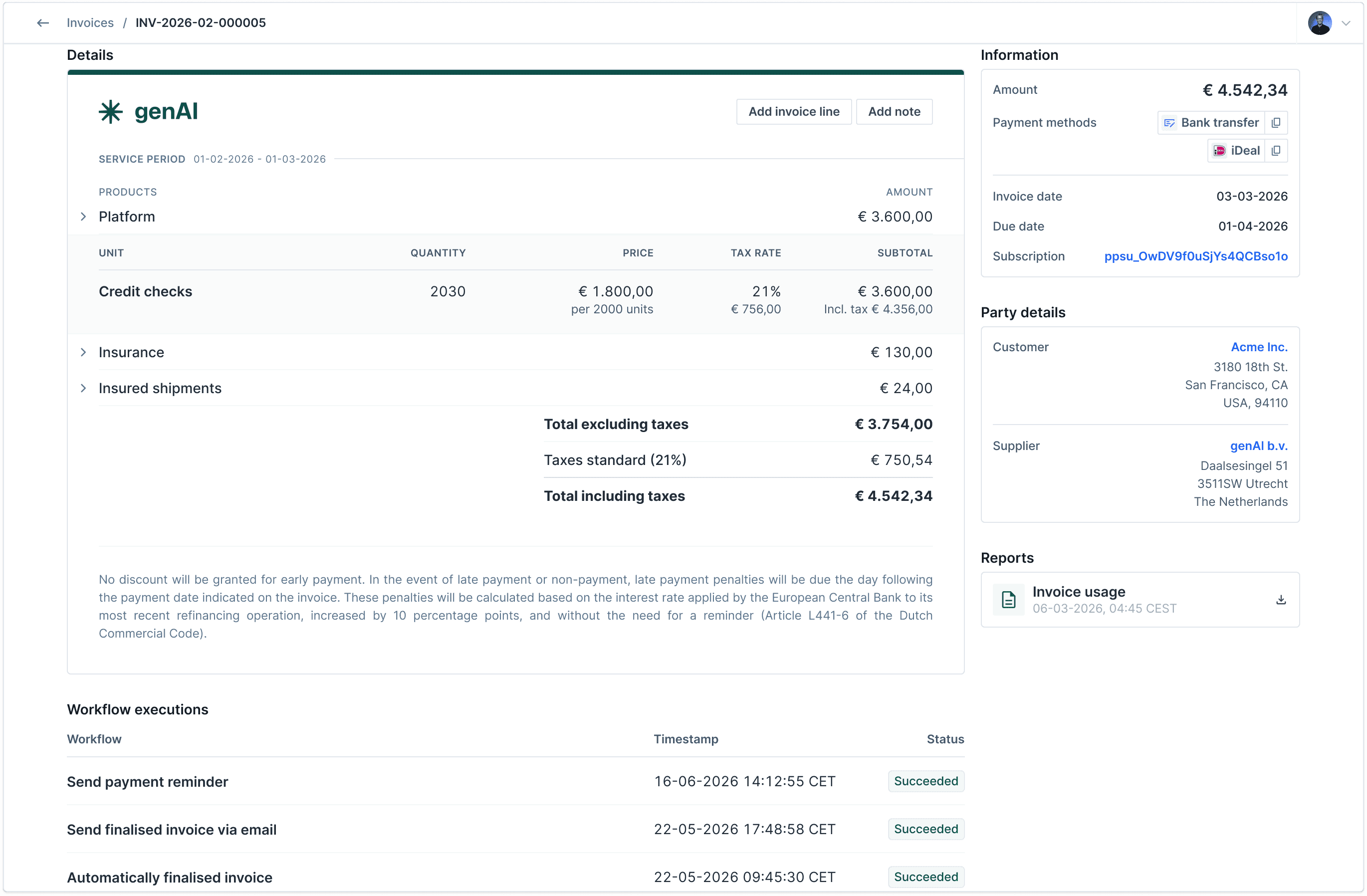
The AR cycle on one invoice: payment methods offered, a due date, and the reminder workflow that ran when it passed.
Measuring AR
Metric | What it tells you |
|---|---|
Days sales outstanding (DSO) | Average time from invoice to cash. Receivables ÷ revenue × days in period. Lower is better; compare to your payment terms |
AR ageing | Open invoices bucketed by how overdue they are: current, 1–30, 31–60, 61–90, 90+. The 90+ bucket is where bad debt lives |
Collection effectiveness index | Share of collectable receivables actually collected in the period |
Bad debt ratio | Written-off receivables as a share of revenue |
Dispute rate | Share of invoices queried by customers. A leading indicator of billing accuracy problems |
What makes AR hard in SaaS
Invoices that bounce. Enterprise accounts payable teams reject invoices that are missing a PO number, name the wrong legal entity or carry the wrong VAT treatment. Each rejection restarts the payment clock. A large share of DSO in B2B SaaS is invoices that were technically issued but never accepted, which makes invoice compliance an AR problem, not just a tax one.
Mixed payment methods. Card and direct debit customers pay automatically. Enterprise customers pay by bank transfer on their own schedule, with references that don't match. Cash application across both is where AR teams spend their time.
Multi-entity, multi-currency. Receivables sit in several entities and currencies, each with its own bank account, and the group view has to consolidate them at consistent exchange rates. The multi-entity billing page covers the structure.
Usage-based disputes. A metered invoice invites "why is this number what it is?" If the usage data behind the line isn't available to the customer, every question becomes a ticket, and the invoice sits unpaid while it's resolved.
Volume. Thousands of invoices a month means AR is a system, not a person with a spreadsheet and a reminder template.
Reducing DSO
Issue invoices the moment the period closes, not at month end. Every day of invoicing delay is a day of DSO.
Get the invoice right the first time: correct entity, PO number, VAT treatment, structured e-invoice where required.
Put a payment link on every invoice and store payment methods where customers allow it.
Automate reminders on a fixed ladder (7, 15, 30 days overdue) and retries on failed payments, with a human step only when automation is exhausted.
Give customers the usage detail behind every line so disputes are resolved from data rather than emails.
Sync payment status to the ERP so the receivable ledger reflects reality without manual posting.
Where Solvimon fits
Solvimon runs the front half of AR. Every invoice carries a payment status (unpaid, partially paid, paid, overpaid) that updates automatically when a payment lands through your PSP's payment link or stored method, can be marked paid for bank transfers, and syncs to your ERP to update the receivable. Failed payments are retried through the PSP, and overdue reminders run on a workflow ladder you define, stopping the moment the invoice is paid. Disputed invoices can have dunning cancelled, corrections go through linked credit notes with referenced refunds, and every invoice has its usage report attached, so the customer's question is answered by the data. If your DSO is driven by invoices bouncing rather than customers being slow, talk to one of our experts.
FAQ
What's the difference between accounts receivable and revenue?
Revenue is what you've earned. Receivables are what you've invoiced and not yet been paid. An invoice can create a receivable before the revenue is recognised (annual prepay), or after (usage billed in arrears).
Is a credit note a payment?
No. A credit note reduces the receivable. A payment settles it. If a customer has already paid and you issue a credit note, you owe them a refund.
What is a good DSO for SaaS?
Close to your payment terms. With net-30 terms, a DSO in the 30s is healthy and in the 60s means a third of your receivables are overdue.
Does dunning change the receivable?
No. Dunning is the process of collecting it. The receivable changes only when a payment or credit note is recorded.
Can I reclaim VAT on a bad debt?
In most EU countries yes, under national bad-debt relief rules, after a waiting period and with evidence of the write-off. The conditions vary by country.
This page was last reviewed in October 2026.
Related
Dunning. Collecting overdue invoices.
Invoice. What creates the receivable.
Credit note. What reduces it without a payment.
Invoice compliance. Why invoices bounce.
Revenue recognition. Receivables vs revenue.
Payment processing. How the money actually moves.
Ready for billing v2?
Solvimon is monetization infrastructure for companies that have outgrown billing v1. One system, entire lifecycle, built by the team that did this at Adyen.