Hybrid pricing is the default now - here's the data

Insights
Read time: 3 min

Arnon Shimoni
✓ Expert opinion
Pure seat-based pricing is irrelevant for AI. It creates no growth.
Don’t be silly though - it didn’t “die” because people said it died in a LinkedIn post, it just hasn’t created any growth in 2025, and that trend continues in 2026.
Building on our own analysis and others’ (Bain’s SaaS study, PricingSaaS’s Q1 2026 report, and ICONIQ’s State of AI), we reach the same same conclusion:
Hybrid is no longer experimental. It’s the default.
The numbers
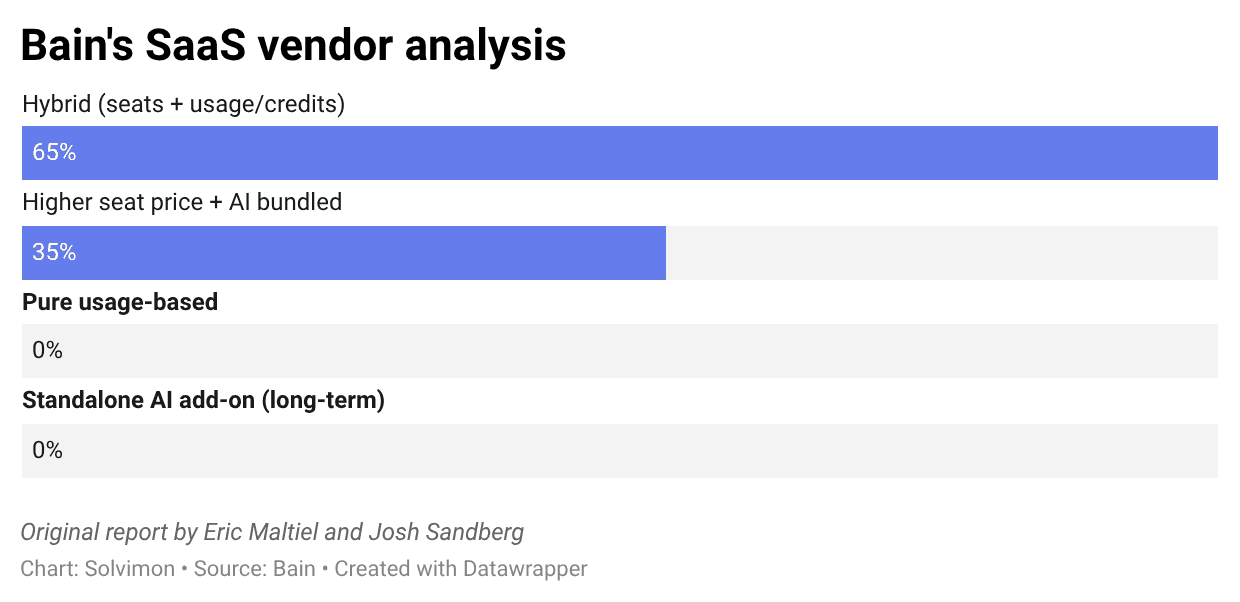
Bain analyzed established SaaS vendors adding AI capabilities:
Pricing strategy | % | Why? |
|---|---|---|
Adopted hybrid models (seats + usage/credits) | 65% | Most common approach |
Raised seat prices and bundled AI into existing tiers | 35% | Because it’s a good middle step |
Went pure usage based | 0% | No sustained adoption |
Kept AI as a standalone add-on | 0% | Not viable at scale |
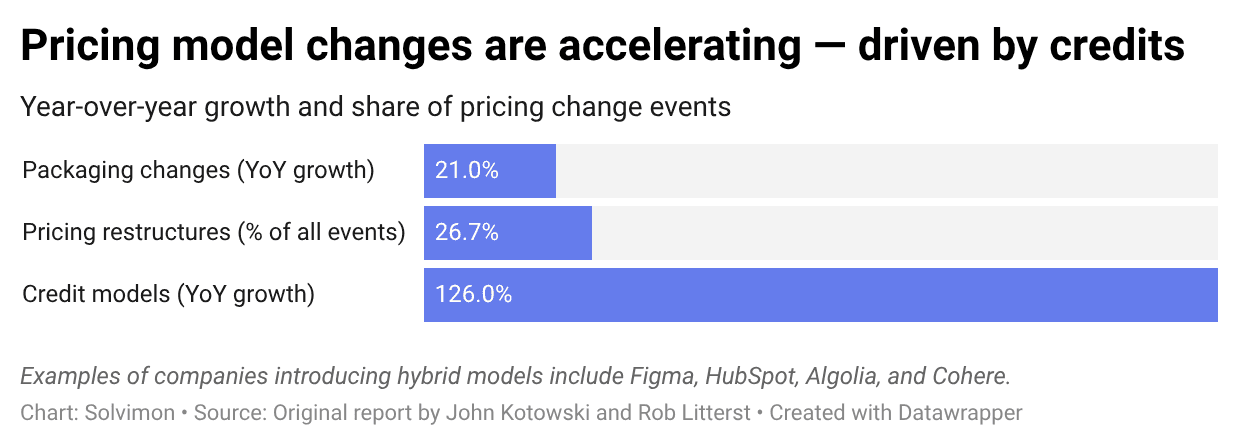
PricingSaaS tracked 498 companies across 8,394 pricing events in 2025:
Credit models surged 126% year-over-year
Packaging changes increased 21%
Pricing restructures were the #1 event type (26.7% of all changes)
Companies like Figma, HubSpot, Algolia, and Cohere all introduced hybrid models
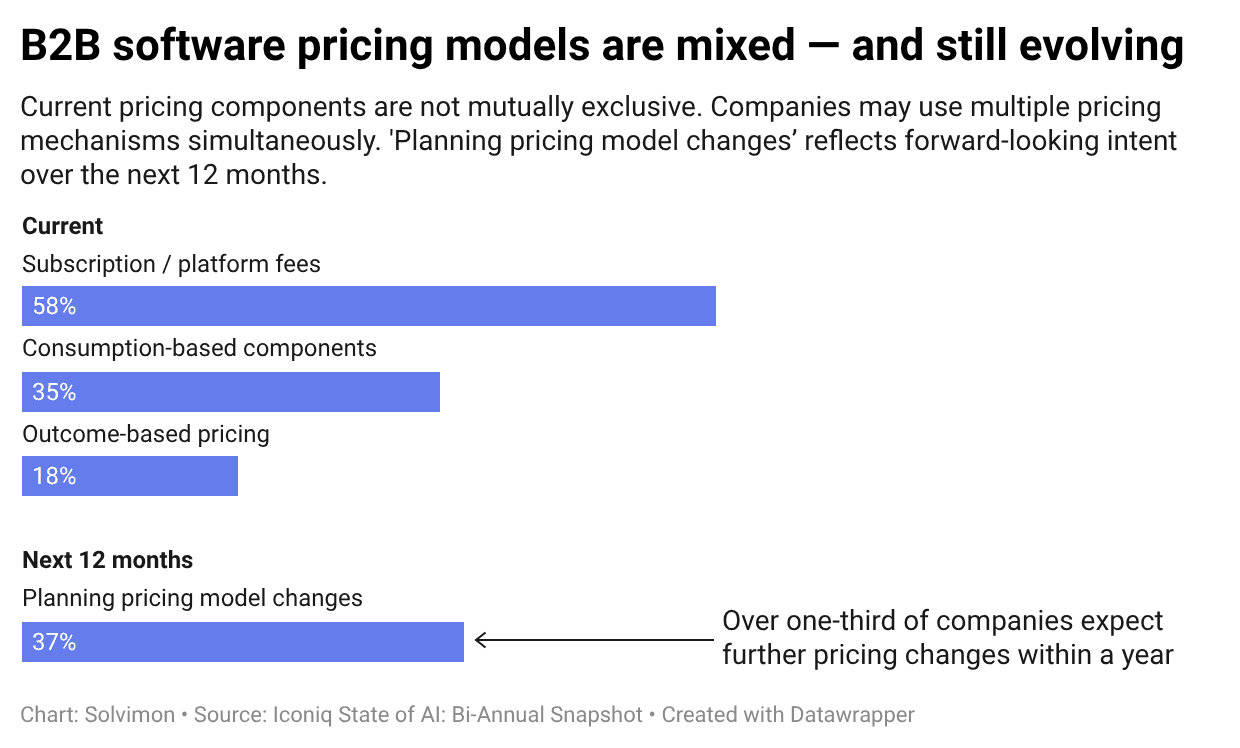
ICONIQ surveyed AI builders in December 2025:
58% still include subscription/platform fees
35% use consumption-based components
18% experiment with outcome-based pricing
37% plan to change their pricing model in the next 12 months
To me, the pattern is clear: companies aren’t choosing between seats and usage. They’re combining them.
Why is hybrid pricing winning?
As always, this is all down to economics.
AI introduced two structural problems that seat-based pricing can’t solve:
Problem 1: Volatile costs. Model inference, fine-tuning, and compute don’t scale linearly with headcount. I’ve seen one AI vendor whose top 5% of users consumed 75% of compute costs while paying a flat fee. That’s completely unsustainable.
Problem 2: Value misalignment. When AI automates tasks that previously required humans, charging per-seat stops making sense. The product delivers more value, but the revenue metric doesn’t move with the value (and sometimes goes entirely the other way).
Hybrid models solve both in a way most of us can accept:
A platform fee covers baseline infrastructure and feature access
Usage charges protect margins from heavy users
Credits abstract token costs while preserving most of the usage-based alignment
What hybrid looks like
The term “hybrid“ is vague. Here’s what companies actually ship:
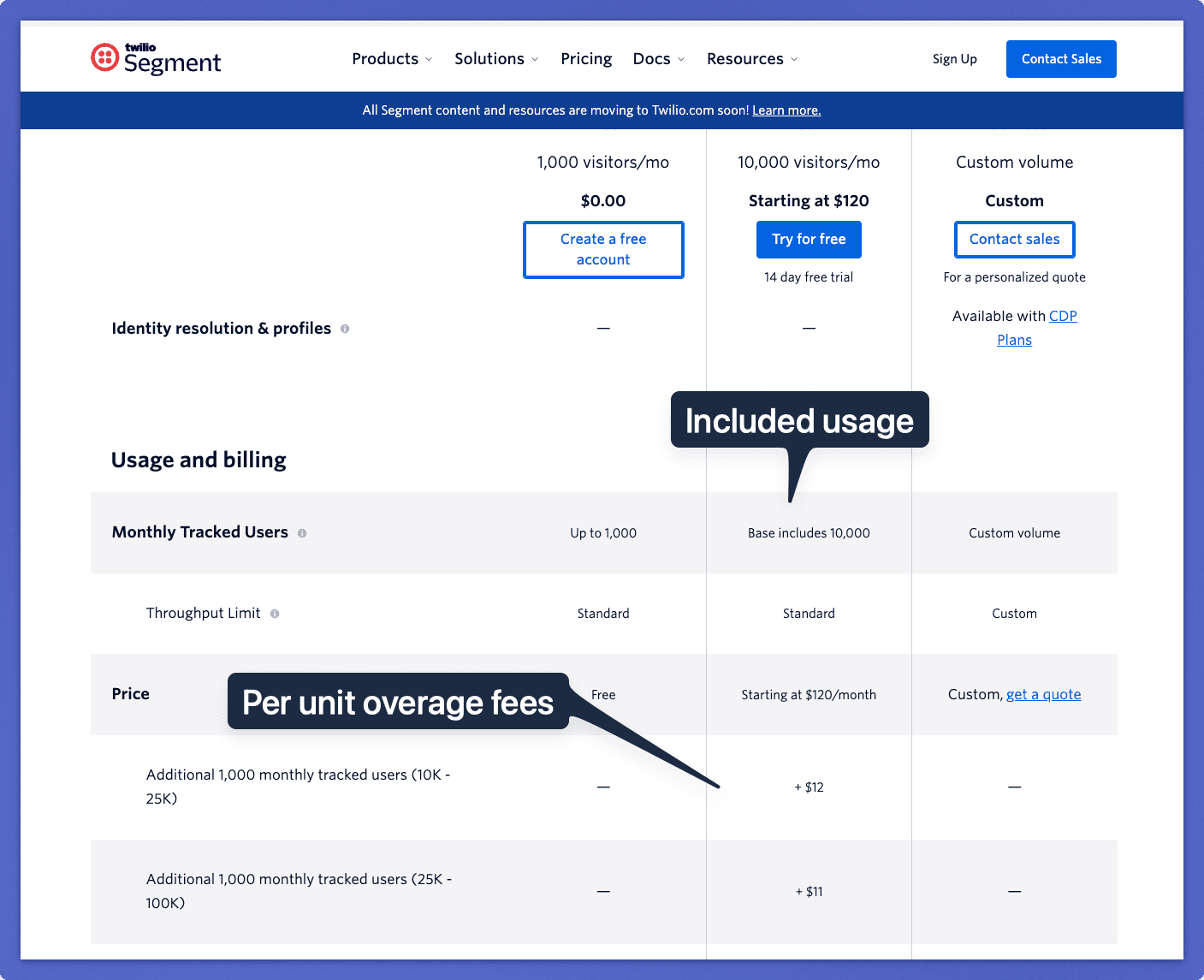
Flat + Limit + Overage (most common)
Base subscription includes X usage per month
Per-unit charges beyond the limit
Example: Cursor, OpenAI Teams, Segment
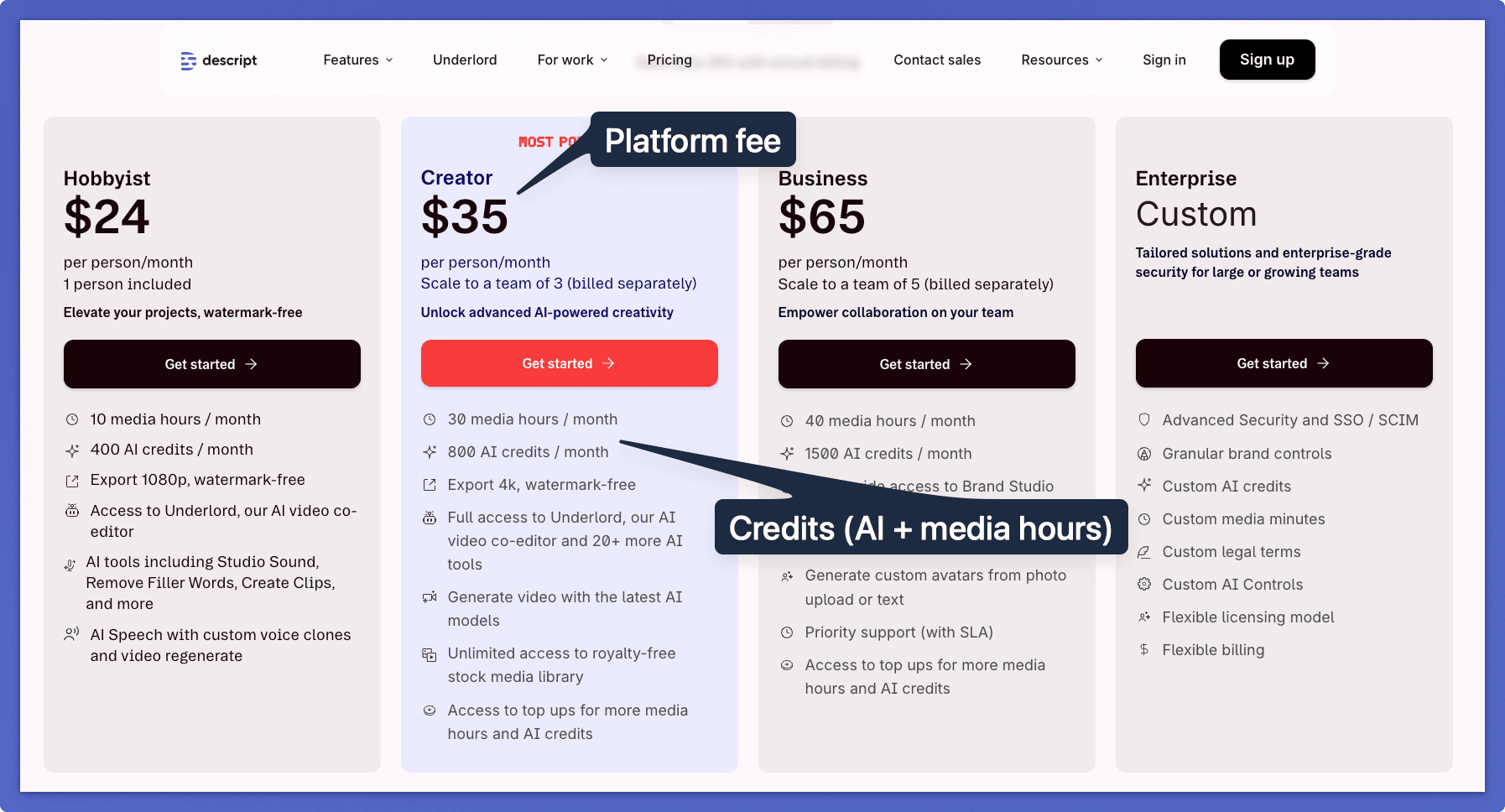
Flat + Credits
Platform fee + pre-purchased credit allocation
Different actions consume different credit amounts
Example: Clay, ElevenLabs, Descript, AssemblyAI
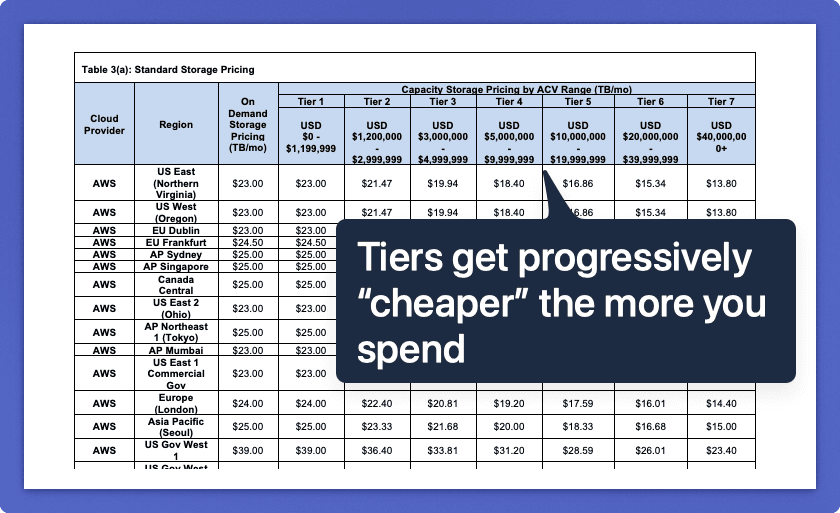
Tiered Commitments
Annual commit drives pricing tier
Usage charged at tiered rates based on volume
Example: Snowflake, Vercel (AI workloads)
The PricingSaaS data shows companies iterating rapidly on these structures.
Cohere changed its pricing metric from “per image” to “per million image tokens”.
LaunchDarkly shifted from “experimentation keys” to “experimentation MAU”.
Algolia introduced a pay-as-you-go tier at $1.75 per 1K searches.
That’s the new normal.
What it means for billing architecture
Hybrid models create architectural complexity that most billing systems weren’t designed to handle.
Bain’s research found the primary blocker wasn’t strategy - it was implementation. We can echo this, as some of our customers delayed pricing changes for years because:
Product catalogs existed in many disconnected systems. Sometimes as many as 7!
Entitlements were hard-coded to plan IDs
Billing systems couldn’t support credits or burndown logic
Every pricing change required engineering work
This was true both for entirely home-built systems, but also for systems hacked around Stripe, Chargebee, Zuora, and others.
Vercel ships as many as 6 pricing changes per month, but most companies take 6 months to ship one - not because they don’t want to, they just can’t.
What Happens Next
ICONIQ’s data shows 37% of companies plan to change their AI pricing in the next 12 months. The drivers are clear:
Customer demand for consumption/outcome-based pricing (46%)
Customer demand for predictable pricing (40%)
Competitive pressure (39%)
Margin erosion (34%)
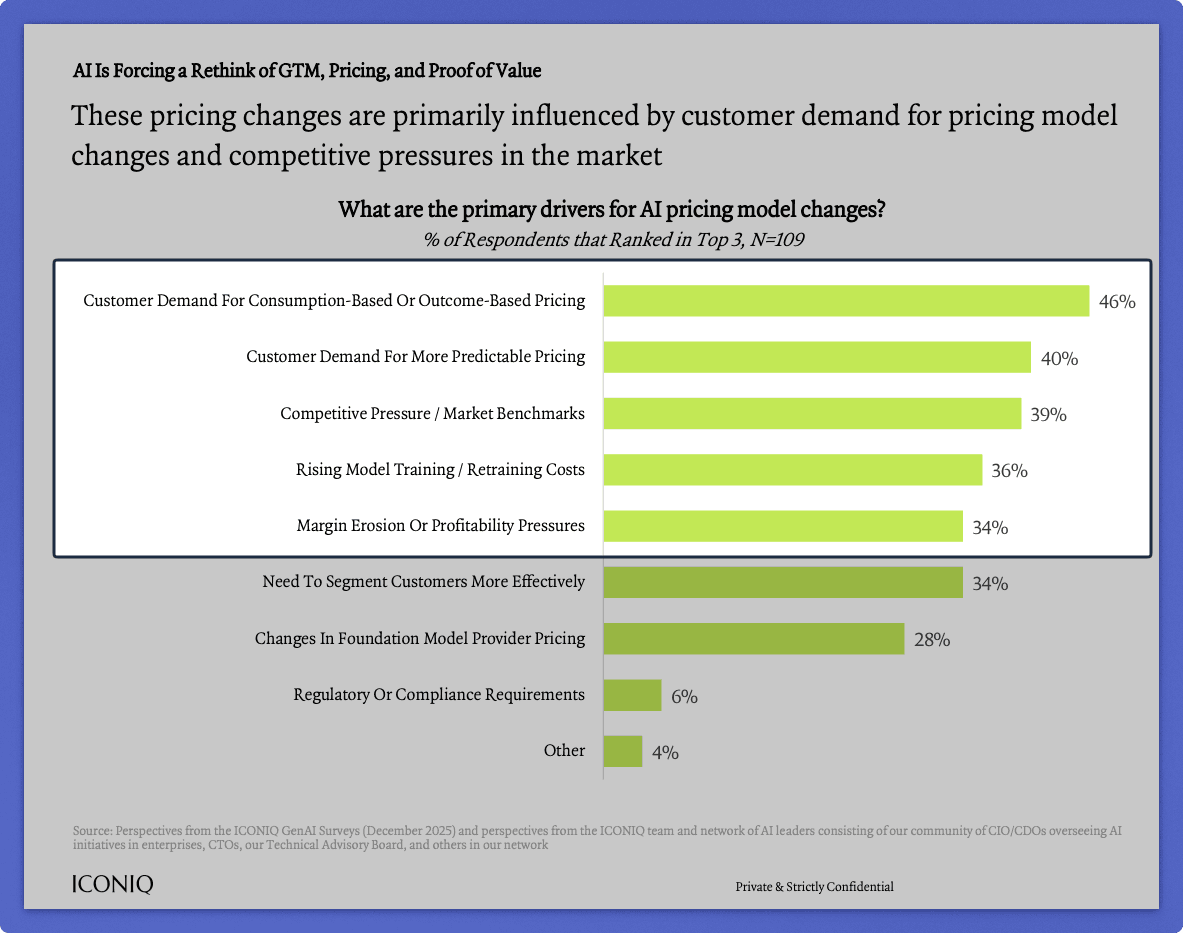
These pressures don’t resolve by picking a model once, because they require continuous iteration. It’s a pricing and monetization muscle you have to build up.
No one will “get pricing right” - you have to iterate on pricing as fast as you iterate on product. That requires treating pricing as architecture, not a number.
Bottom line
Hybrid pricing is the default because:
AI economics force it (volatile costs, value misalignment)
Customers accept it (predictable base + usage upside)
The data proves it (65-78% adoption across studies)
If you’re still running pure seat-based pricing for AI features you’re leaving margin on the table.
You have to go hybrid - but can your billing infrastructure can support it?
Related
How to implement hybrid pricing. The components of a hybrid model and the order to decide them.
Usage-based pricing. Charging on what customers consume, and when it works.
Solvimon flexible pricing. Run any pricing model without engineering sprints.
Ready for billing v2?
Solvimon is monetization infrastructure for companies that have outgrown billing v1. One system, entire lifecycle, built by the team that did this at Adyen.