Claude vs Solvimon: should you build your billing system with AI?

Billing
Read time: 6 min

Arnon Shimoni
✓ Expert opinion
Claude and Solvimon play two distinct roles: a building engine that turns a description into working code, and billing infrastructure that runs metering, pricing, invoicing, and revenue recognition over one ledger. Claude wins the first afternoon. Solvimon is built for taking you to IPO readiness and beyond.
But you don't have to choose. The two layers can stack. You can have Claude run Solvimon for you. Our MCP accepts write operations, so the same model that would scaffold your billing stack can instead create meters, configure rate cards, migrate customers to new plans, and even and set up plas.
That makes the comparison a layer choice:
Do you want Claude to hand you a shoddily-built billing codebase that your team owns forever
… or do you want Claude to configure billing that is battle-tested?
I wrote this page because prospects tell us "the AI said it can build our whole billing stack". You shouldn't.
Quick comparison
Factor | Claude (claude.ai / Claude Code) | Solvimon |
|---|---|---|
What you walk away with | Billing code in your repo | Running the entire Quote-to-Cash infrastructure: quoting, metering, pricing, invoicing, revenue recognition |
Time to something working | An afternoon | A guided integration ( |
Pricing changes | You may have to redeploy the whole thing | Configuration |
Edge cases (dedup, proration, rounding) | Included if you know to ask | Included because earlier customers already hit them |
Audit trail and ASC 606 | You build it | We built it already |
Cost at day zero | Your existing Claude subscription | Nothing until you hit $3M. |
Owner in year 3 | Your team, forever | We own and operate it for you |
Works with the other one | Yes, via the Solvimon MCP |
Is Claude Code (or Codex) alone ever the right choice?
Before product-market fit, with one pricing dimension and pricing that changes weekly, a billing vendor is overhead. Stripe plus a few hundred lines of AI-written code may be the right call. You will outgrow it, the same way you outgrow your first CI pipeline.
Claude is also the better tool to reason through your pricing architecture before you commit.
So if billing is your product, build it.
If a data residency rule excludes every hosted vendor, build it yourself, sure.
When Solvimon is the right choice
When you start layering credits on top of usage, or committed spend on top of either - for example when you have an SLG motion.. From that point, you start hitting wall after wall with your home-built system.
The Claude-built metering may be fine, but once a client retries a timed-out request, the same event appears in your system twice and causes a big downstream effect. The customer paying twice is the least of your concern here. How do you give them usage again? How do you make sure they don't hit the limit, etc. If the customer was the one who noticed - that's…. The worst monitoring system you could have for this.
The system you built in Claude probably stores money in floats. At $0.000002 per token, the invoice total depends on where you round: per event, per day, or per line. What happens when you need to settle it in JPY afterwards, and that has no fractions in theory?
What about a subscription anchored on January 31st needs a next billing date (February remains undefeated for having a bad amount of days, fight me no this).
The Claude-built system treats an invoice as a row to edit. But you know the law says a finalized invoice must not change. Corrections are credit notes, and an auditor or an enterprise procurement team checks this not just on the system level but also on your processes. You accounted for that, right? Right?
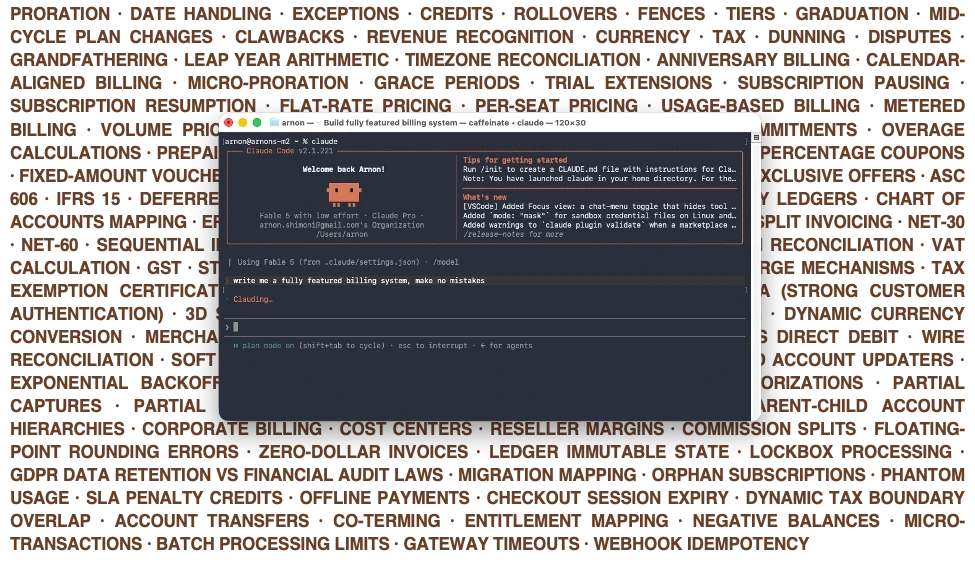
Hey Claude mate, build me a billing system make no mistakes thanks.
Claude can in theory fix each of these if you ask but knowing what to ask is the product. Are you building a whole product for this?
On Solvimon, earlier customers already hit these edge cases, and we're very grateful for them. That's why we can offer you a robust service.
Some of our best customers are payment companies. They know how hard it is to build this correctly, so they let Solvimon handle their billing.

What happens to the Claude-built scaffolding you already built?
Eh, probably not that much. The event stack you built could still work, plug it into Solvimon. Solvimon accepts events from your existing pipeline (including Metronome and other metering stacks). The pricing logic and invoice code retires. Retiring code you shipped last quarter stings, less than reconciling invoices by hand in month 14, but it stings...
If you already run Kafka and ClickHouse for analytics, keep the metering and buy the layer above it. Watch for the glue code! It gets really messy…. How do you handle mismatched event schema?
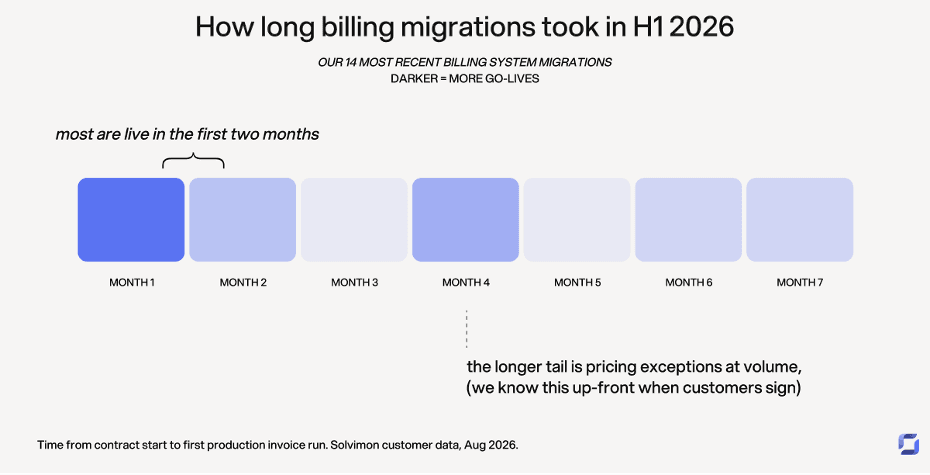
Last month we evaluated how long most of our billing migrations took, and the results would surprise you. Most finish within 2 months.
How to evaluate this yourself
Ask Claude these five questions in the same chat that scaffolded your stack:
How do we deduplicate a retried event?
What type stores money, and at what point do we round?
What is the next billing date for a subscription anchored on January 31st?
How does a finalized invoice get corrected?
Which billing invariants do our tests assert?
The answers improve the scaffold either way. The list of questions is the product you were considering buying.
Use both
Reason through your pricing model with Claude. Then point Claude Code at the Solvimon MCP and let it do the configuring. It creates the meters, plans, and rate cards it would otherwise have coded from scratch, on infrastructure with the edge cases already handled. npx @solvimon/create scans your codebase and suggests meters to start from.
I'd ask, finally: What do you need to walk away with? A billing codebase, or billing that runs and gets you paid?
FAQ
Can Claude build a working billing system?
Kinda. It will confidently tell you it can. It scaffolds event ingestion, pricing logic, and invoice generation in an afternoon, and the code runs but you can't build a reliable system right now. Most of the gaps appear a bit later with duplicate events, rounding, proration, invoice immutability, internationalization, e-invoicing, tax, and untested invariants. The sections above list them.
Can Claude operate Solvimon, or only read from it?
Claude can create meters, configure pricing plans, and set up checkout through the MCP on Solvimon. Many billing MCPs are read-only. Ours accepts writes.
Does this work with Cursor, Gemini, or other agents?
Yes. Because MCP is an open standard, any MCP client gets the same write operations. This page names Claude because that is who prospects tell us they want. But you can use Codex too for example.
When do we outgrow Stripe plus custom code?
Two common triggers: the second pricing motion (credits on usage, or commits on either), and metered volume around 10 million events a month, where Stripe's Events API rate limits start to bind.
Does AI change the build vs buy math?
It changes the cost of starting, which was already the cheap part. The cost of owning (edge cases, audits, pricing migrations, an owner in year 2) is where it always was.
We already built billing with Claude. Is migration painful?
Your event stuff and data survive. The pricing and invoice code retires. The usual path: run Solvimon in parallel for one billing cycle, compare invoices, then cut over.
What does Solvimon cost at day zero?
Less than your Claude subscription. Solvimon is free for the first $3M you bill.
Ready for billing v2?
Solvimon is monetization infrastructure for companies that have outgrown billing v1. One system, entire lifecycle, built by the team that did this at Adyen.


