
When do you have to issue an invoice?

Written by Arnon Shimoni
✓ Expert
Last updated on:
The invoice issuance deadline is the latest date by which you must issue an invoice after a supply. EU law fixes one deadline for cross-border B2B transactions, the 15th day of the month following the chargeable event, and leaves domestic deadlines to each Member State. From 1 July 2030, the cross-border deadline shrinks to 10 days.
For a subscription or usage-based business the question is really "when does the clock start?", because the chargeable event for a continuous service isn't obvious. This page covers both.
At a glance | Invoice issuance deadline |
|---|---|
EU rule (Article 222) | 15th of the month following the chargeable event, for intra-EU supplies of goods and for services where the customer accounts for the VAT |
Domestic supplies | Set by each Member State. From "at the time of supply" to six months |
From 1 July 2030 (ViDA) | 10 days after the chargeable event for intra-EU B2B, as a structured e-invoice |
Chargeable event for continuous services | End of each period the invoice or payment relates to, and at least once a year for cross-border reverse-charge services (Article 64) |
Summary invoices | Allowed for supplies in the same calendar month (Article 223); longer periods at national option until 2030 |
Advance payments | Invoice due when the payment is received |
The EU-wide deadline
Article 222 of the VAT Directive sets a single deadline that applies in every Member State: for intra-EU supplies of goods exempt under Article 138, and for services where the customer is liable for the VAT under Article 196 (the reverse charge), the invoice must be issued no later than the 15th day of the month following that in which the chargeable event occurs.
The reason this one is harmonised is reporting. Both parties report the transaction in their VAT returns and the supplier lists it in the EC Sales List, and the tax authorities match the two. If the invoice is late, the customer may declare the VAT in a different period from the supplier's report, and the match fails.
For a Dutch SaaS company billing a German business monthly, the invoice for the March subscription period must exist by 15 April.
National deadlines for domestic supplies
For everything else, Article 222 lets Member States impose their own time limits. They vary a lot.
Country | Deadline for domestic B2B invoices | Source |
|---|---|---|
Belgium | 15th day of the month following the chargeable event | |
France | At the time of supply. A periodic (summary) invoice may be issued by the end of the month for supplies in that month | |
Germany | Within six months of the supply | |
Italy | Immediate invoice within 12 days of the supply; deferred invoice by the 15th of the following month | |
Netherlands | Before the 15th day of the month following the supply | |
Spain | At the time of supply for B2C. For B2B, by the 16th of the month following the chargeable event |
The invoicing rules that apply are those of the Member State where the supply takes place (Article 219a), except for cross-border reverse-charge supplies, where your own country's rules apply. So a Belgian company's domestic invoices follow the Belgian deadline, and its invoices to German business customers also follow Belgian rules, which happen to match the EU 15th-of-the-following-month rule anyway.
When the clock starts: the chargeable event
The deadline counts from the chargeable event, the moment the legal conditions for VAT to become chargeable are met. For a one-off delivery that's the delivery date. For recurring and usage-based services it's governed by Article 64:
Continuous supplies that give rise to successive statements or payments are regarded as completed at the end of each period the statement or payment relates to. A monthly subscription has a chargeable event at the end of each month.
Cross-border reverse-charge services supplied continuously over more than a year without interim payments or statements are deemed completed at the end of each calendar year. You can't let an annual contract run three years without an invoice.
Advance payments trigger VAT when the payment is received (Article 65), and an invoice is due for the payment.
In practice: the invoice for a usage period that ends on 31 March has a chargeable event on 31 March and a cross-border deadline of 15 April. If the customer prepays a year on 10 January, the invoice for that prepayment is due on the national deadline counted from 10 January.
Summary invoices
Article 223 lets you combine several supplies to the same customer onto one summary invoice, as long as VAT on all of them became chargeable in the same calendar month. Member States may allow longer periods. This is the legal footing for one consolidated monthly invoice per customer covering a platform fee, several usage lines and a credit from the previous period.
The summary invoice is still subject to Article 222. For cross-border reverse-charge supplies it must be out by the 15th of the following month. From 1 July 2030, under ViDA, summary invoices for intra-EU supplies are limited to one calendar month, must be issued within 10 days of the end of that month, and aren't permitted for goods on the fraud-sensitive list.
Invoice date vs supply date vs due date
Three dates appear on an invoice and the deadline rules only concern one of them.
Date | What it is | Governed by |
|---|---|---|
Supply date or period | When the goods were delivered or the service period ran. Mandatory on the invoice when it differs from the issue date (Article 226(7)) | What actually happened |
Invoice (issue) date | When the invoice was issued. Determines the VAT period for the supplier and whether the deadline was met | Article 222 and national deadlines |
Due date | When payment is expected. Not a VAT concept | Your contract and payment terms, within the limits of the Late Payment Directive |
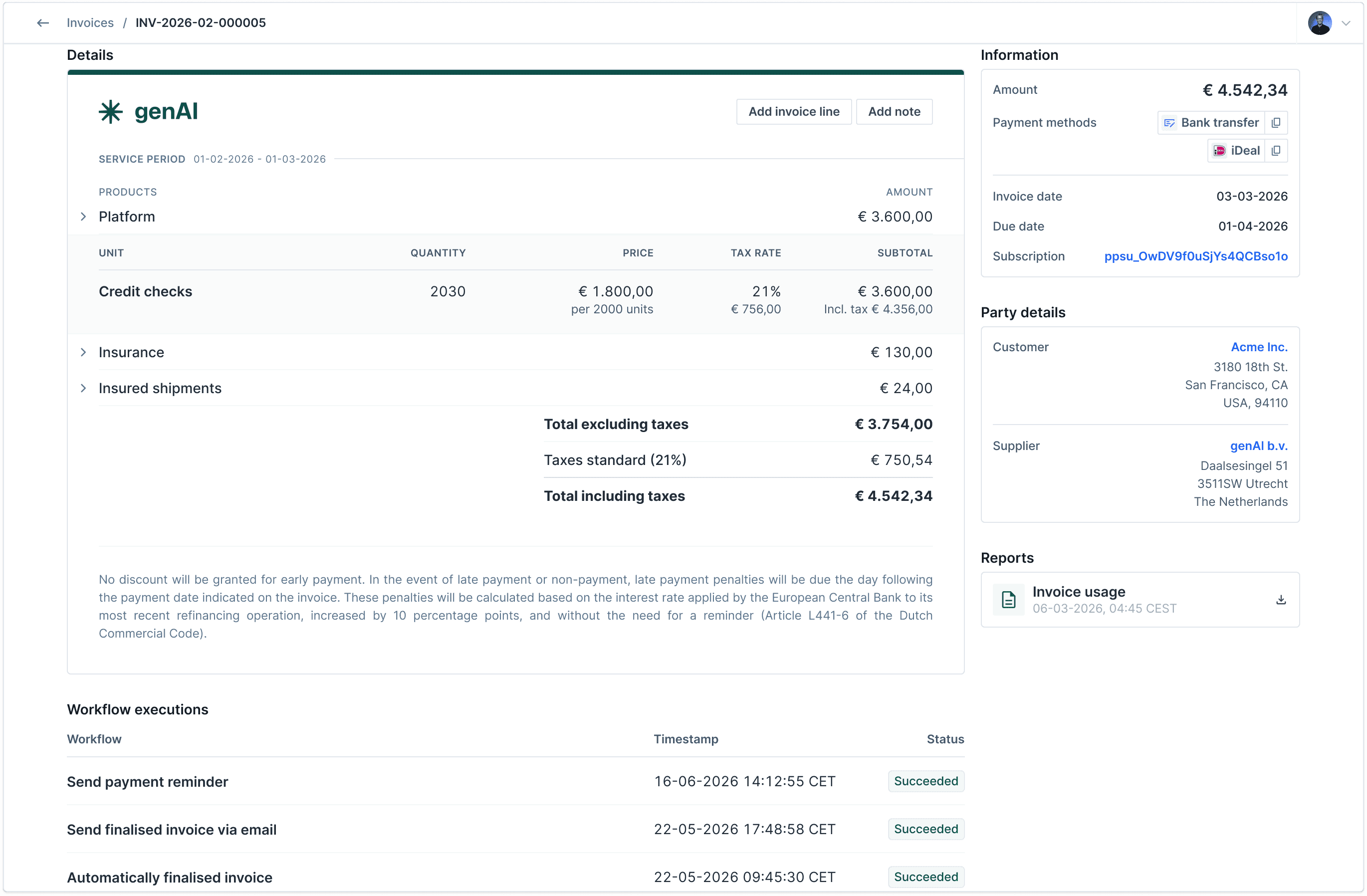
Service period, invoice date and due date side by side on a Solvimon invoice. Only the invoice date is subject to the issuance deadline.
For automated billing the invoice date should be set by rule rather than by hand. Three sensible rules are: the last day of the billing period, the first moment after the period ends, or the moment the invoice is finalised. The first two keep the invoice date inside or adjacent to the supply period, which makes period-end reporting clean. The third reflects when the document really existed. Whichever you pick, apply it consistently so invoice numbers and dates stay in the same order.
What changes in 2030
Council Directive (EU) 2025/516, the ViDA package, rewrites Article 222 in two steps. From 1 July 2028 the 15th-of-the-following-month rule is extended to more domestic reverse-charge cases. From 1 July 2030, for intra-EU B2B supplies of goods and reverse-charge services, the invoice must be a structured e-invoice issued within 10 days of the chargeable event, and its data is reported to the tax authority in near real time. The month-end close that many finance teams use to review invoices before sending no longer fits inside the deadline, which is the main operational change the rule forces.
Where Solvimon fits
Solvimon generates the invoice from the billing period automatically: two hours after the period ends the invoice moves to draft, and eight hours later it finalises unless you hold it, so a period that ends on the 31st has a numbered, sent invoice on the 1st. The invoice date is set by rule to the last day of the period, the first moment after it, or the finalisation time, and the on-hold flag gives you a controlled review step for the invoices that need one without delaying the rest. Advance payments, annual prepayments and consolidated monthly invoices are all first-class billing periods, so the chargeable event and the invoice line up. If your invoices go out whenever someone finishes checking them, talk to one of our experts.
FAQ
What happens if I issue an invoice late?
Penalties are national and range from fixed fines per invoice to a percentage of the VAT. The VAT itself still becomes chargeable at the chargeable event, so a late invoice doesn't delay your liability. It just adds a fine.
Can I invoice before the supply?
Yes. Nothing in the Directive prevents invoicing in advance, and advance payments must be invoiced. The VAT becomes chargeable when payment is received or the supply is made, whichever comes first.
Does the 15th-of-the-following-month rule apply to my domestic invoices?
Only if your Member State has adopted it for domestic supplies, which Belgium, the Netherlands and Italy have. Germany allows six months. Check your own country.
When is the chargeable event for a monthly subscription?
The end of each month the subscription covers, under Article 64. The invoice deadline counts from there.
Can I send one invoice for a quarter?
For domestic supplies, if your Member State allows summary invoices over more than a month. For cross-border reverse-charge services, each month's supplies must be invoiced by the 15th of the following month, so a quarterly invoice is late for two of its three months. From 2030 the one-month limit is fixed for intra-EU supplies.
Does the due date have a legal deadline?
Payment terms are commercial, not VAT law. The Late Payment Directive sets a default of 30 days for B2B with a 60-day cap unless expressly agreed otherwise and not grossly unfair.
This page was checked against the VAT Directive, national tax authority guidance and Council Directive (EU) 2025/516 in October 2026. It is a general explanation and doesn't replace advice from your tax adviser.
Related
EU invoice requirements. When an invoice is compulsory and what it must contain.
Reverse charge invoice. The supplies the 15th-of-the-following-month rule applies to.
Billing cycle. The period that defines the chargeable event.
Invoice numbering. Why numbers and dates have to move together.
Advance billing. Invoicing before the service period.
Dunning. What happens after the due date.
Ready for billing v2?
Solvimon is monetization infrastructure for companies that have outgrown billing v1. One system, entire lifecycle, built by the team that did this at Adyen.