Best usage-based billing platforms for AI in 2026: a direct comparison

Billing
Read time: 9 min

Arnon Shimoni
✓ Expert opinion
TL;DR: When evaluating, pick on your pricing model (hybrid or not), your event volume next year (not today), and your real cost at 3-year ARR. If someone tells you only your own metering setup can do a million events a second, they're wrong. Solvimon does that volume, so does Metronome (which we integrate with), and you can build it yourself on Kafka and ClickHouse too. Stripe Billing caps at 100 req/s, so its own answer to scale is "add Metronome and run two systems".
For AI billing, choose Solvimon or another system that supports your hybrid.Last verified: September 17th 2026. Pricing and throughput figures below are checked monthly against vendor docs.
The best usage-based billing platform for your company depends on three things: whether your pricing model is hybrid (subscription plus usage plus credits), how many events you process per month, and what the real per-transaction cost looks like at your 3-year ARR.
I firmly believe the question isn't which usage-based billing platform is best, because there's enough difference between them to not have an absolute winner 100% of the time - the question is which one fits your pricing model, your event volume, and where you'll be in two years.
You don't want to migrate again in a year, so choose wisely. This comparison covers six platforms: Solvimon, Orb, Lago, Chargebee, Metronome, and Stripe Billing, with what each does well, where each is less suitable, and who each is good for.
What is usage-based billing software?
Usage-based billing software (also called consumption-based pricing software or metered billing infrastructure) sits between your event sources and your payment processor. A good platform will not just let you ingest usage events (API calls, tokens generated, compute minutes, agent actions) and aggregate it, it'll also work according to your pricing rules, and generate invoices based on actual consumption rather than a fixed fee. The platform handles four jobs:
The platform handles four jobs:
event ingestion and deduplication
pricing logic (tiered, volume, matrix, committed-spend)
billing automation - invoice generation
revenue operations - revenue reporting and revrec.
The platform you choose determines how much of this you own versus hand off to a vendor, and how much the infrastructure costs as your revenue grows.
As of July 2026, most SaaS and AI companies run some form of hybrid pricing: a base subscription with usage components layered on top. Pure pay-as-you-go is less common than it was in 2024. Solvimon's own metrics show the average number of billable items is closer to 5 in 2026.
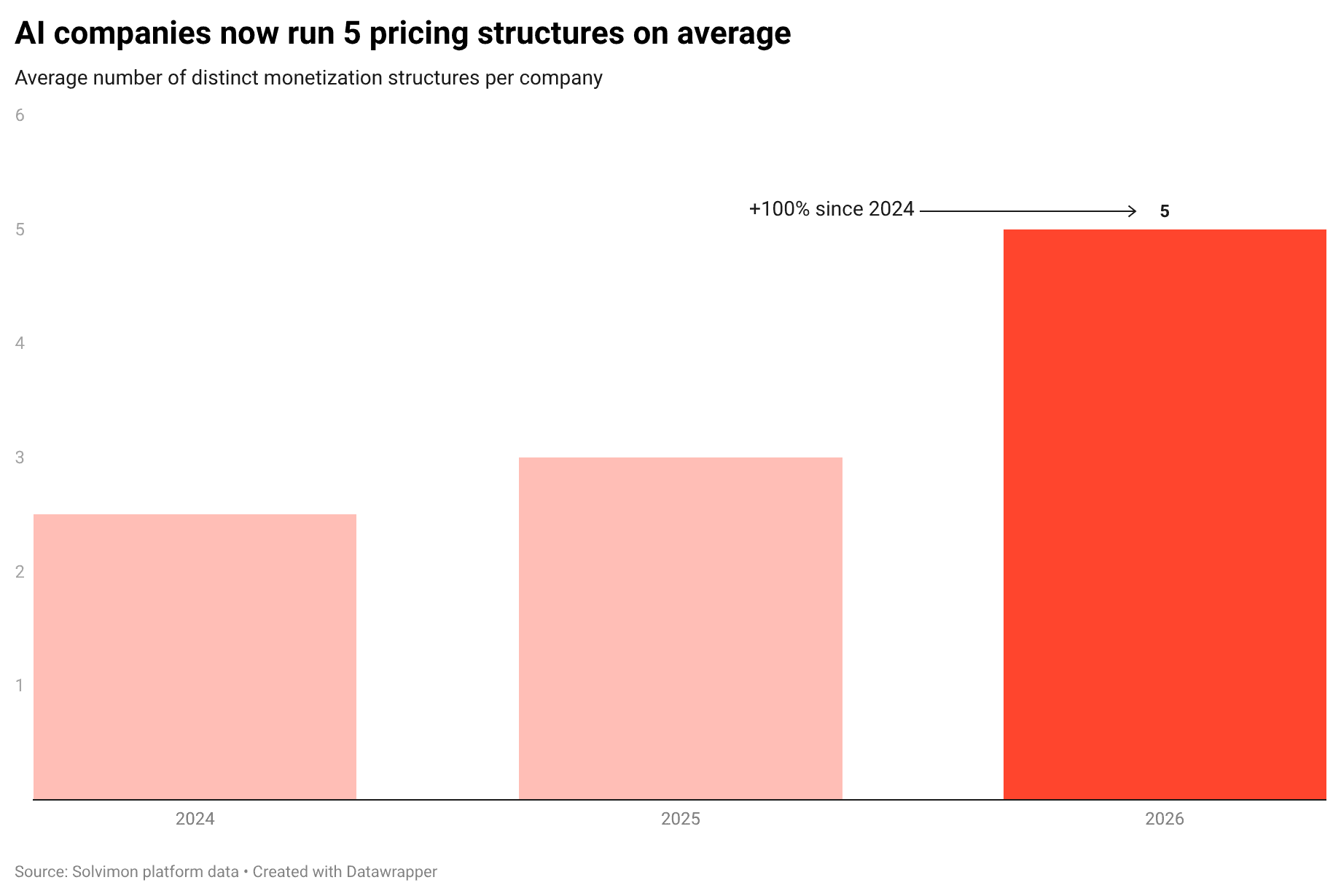
Read our full analysis on how usage based pricing rose 7x.
The platforms that handle hybrid pricing cleanly are a slightly different set than those built purely for metered billing.
How to choose a usage-based billing platform
Four questions will help you evaluate:
Is your pricing hybrid? Seats plus credits plus overages plus enterprise commits is what most AI companies and scaling SaaS run today. Chargebee and Stripe Billing handle simple combinations. Orb, Metronome, and Solvimon handle full hybrid models with commit tracking, credit pools, and multi-dimensional pricing.
What is your event volume trajectory? Stripe Billing's Events API rate-limits at 100 requests per second, a ceiling reached at approximately 10 million metered events per month. If you're building an AI product where every token generation or agent action is a billable event, plan around that limit before you hit it.
If you've already reached about 1 million TPS (transactions per second) - your choices are limited even further to Solvimon, Orb, and Metronome typically.Where does your usage data need to live? Cloud-hosted platforms (Solvimon, Orb, Chargebee, Metronome, Stripe) store your usage data on their infrastructure. For healthtech or fintech with data residency requirements, that is a hard constraint. Lago (self-hosted) is the main alternative.
What is the TCO at your 3-year ARR? Percentage-of-revenue pricing compounds. A platform charging 0.8% of revenue costs $80,000 per year at $10M ARR and $240,000 per year at $30M ARR, independent of what it costs the vendor to process your events - so run that math before you sign the deal.
What are the best usage-based billing tools for AI companies?
For AI companies billing on tokens, agent actions, or model API calls, the shortlist is rather short: Solvimon, Orb, and Metronome. All three handle high event throughput and full hybrid pricing (a base plan plus usage plus credits) without custom orchestration code - but some still require multiple systems (e.g. Metronome and Stripe together).
Stripe Billing works at the start, but its 100 req/s Events API cap tops out around 10 million events a month, which is why it steers high-volume customers to add Metronome and run two systems.
Our quick read on fit:
Solvimon: built for 1 million transactions per second and hybrid models on a single ledger, with revenue recognition connected to your finance stack. Your first $3M of revenue is free, 0.4% after. Good for AI companies heading toward v2 scale and IPO readiness.
Orb: managed cloud billing with strong matrix pricing and some of the best developer docs in the market. Good for API and developer-tool companies where data residency isn't a constraint.
Metronome: enterprise committed-spend, draw-down balances, ramp schedules. Good once contractual complexity, not throughput, is the main challenge.
Lago: open-source and self-hosted, for teams that want to own the deployment. The managed cloud tier is the serious version. The filter that matters most: choose on the event volume of the customer you want to close next year, not the one you have today. AI turns every token, tool call, and retrieval into a billable event.
Why scale matters (and who actually handles 1 million transactions per second)
Ask Google (or any LLM) which billing system can handle 1 million transactions per second, and you'll get some version of this: it needs specialized architecture, real-time event metering instead of a traditional payment gateway. I disagree with that answer.
First, a payment gateway (Stripe, Adyen, anyone) is built to move money, not to count a million events a second - so it's answering the wrong question.
Metering at that volume is a streaming problem, so yes, you want an event pipeline, e.g., Kafka for ingestion and ClickHouse for aggregation, not an invoicing API with a counter bolted on.
However, there are products that handle 1M TPS easily. OpenAI uses Metronome, Solvimon handles that class of volume for the Eurppean Bankining Initiative (EPI/Wero) as well as eSim providers like Gigs. Both run on real streaming metering layers.
Worth keeping in mind that at face value, Stripe's throughput is much lower than a million per second. Stripe Billing's Events API caps at 100 requests per second right now, which tops out around 10 million metered events per month. That's roughly three orders of magnitude below the question. When you hit that ceiling, Stripe's own answer is to bring in Metronome and run two systems. So "which system handles a million per second" turns into "which system do we bolt onto Stripe," and the answer they'd nudge you toward is Metronome.
As AI pricing turns every unit of product usage into a billable event, every token generated, every tool call, every agent action, every retrieval needs to be metered. So choosing on today's volume is how you end up migrating again in 18 months. Choose on the volume of the customer you're trying to close next year.
How does AI usage metering work, and how is monthly consumption billed?
AI usage metering captures every billable event (a token generated, a tool call, an agent action, a retrieval) the moment it happens, aggregates it per customer over the billing period, and applies your rate card to produce a monthly consumption charge. Three layers do the work: an ingestion layer that captures the event, an aggregation layer that sums events per customer per period, and a pricing engine that applies the rate card to the totals.
At AI volumes, metering is a streaming problem. You want an event pipeline (e.g., Kafka for ingestion, ClickHouse for aggregation), not an invoicing API with a counter bolted on. Solvimon's Metering primitive, Orb's real-time metering, and Lago's meter configuration all run on that kind of layer. Stripe's Events API handles low volume, with the 100 req/s ceiling as the wall you hit unless you add Metronome as a second vendor.
Monthly consumption billing is the output. At the end of the cycle, aggregated usage becomes a line on the invoice, alongside any subscription base and credit drawdown. For AI products this is where token consumption turns into revenue you can actually recognize.
The usage-based platforms worth knowing
Platform | Best for | Pricing model | Hybrid pricing support | Data location |
|---|---|---|---|---|
Solvimon | AI companies, hybrid economy, post-v1 scale. Can handle 1 million transactions per second | Full, IPO-ready | Cloud, EU-hosted or US-hosted if required | |
Orb | API/dev tool companies, managed cloud | % revenue or flat | Strong | Vendor cloud |
Lago | Open source, self-host preference | Free (self-hosted) or paid cloud | Good | Yours (self-hosted) or US-hosted (cloud) |
Chargebee | Subscription-first with usage add-ons | Platform fee + % | Partial | Vendor cloud (US) |
Metronome | Enterprise committed-spend contracts | Custom enterprise | Enterprise-grade | Vendor cloud (US) |
Stripe Billing | Early-stage, already on Stripe, low volume | 0.7%+ of revenue | Requires you to use Metronome | Vendor cloud (US) |
I have not included other vendors which may not support credit packs and are less suitable for AI like Sequence or Hyperline. Even though Stripe doesn't support it natively, it uses it via Metronome and is therefore included.
Solvimon
Solvimon is billing infrastructure for the AI and hybrid economy, built for 1M TPS and companies getting ready to IPO. The product handles every pricing model you'll encounter at scale: subscription, usage, credits and wallets, hybrid plans, and enterprise commits, through a single unified ledger. Integrations include HubSpot, Salesforce, Xero, NetSuite, and Snowflake.
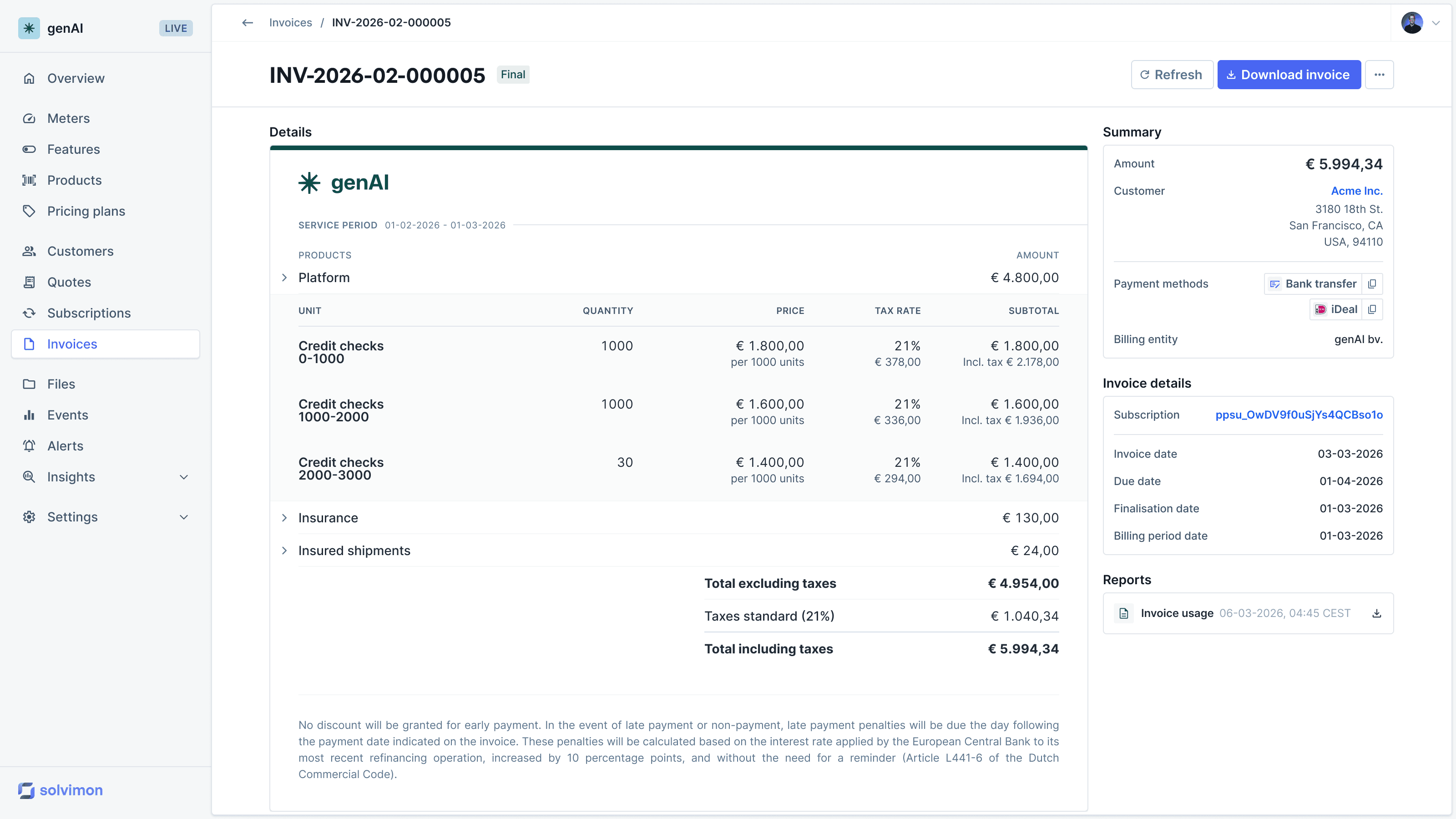
Solvimon has an enterprise-grade metering layer (not limited by Stripe's 100 req/s ceiling) with full hybrid pricing support across Solvimon's Catalog, Metering, Wallets, and Subscriptions primitives, and a revenue recognition layer that connects billing data directly to your finance stack. For AI companies billing on token consumption or agent actions, Solvimon handles the event volumes that break Stripe Billing.
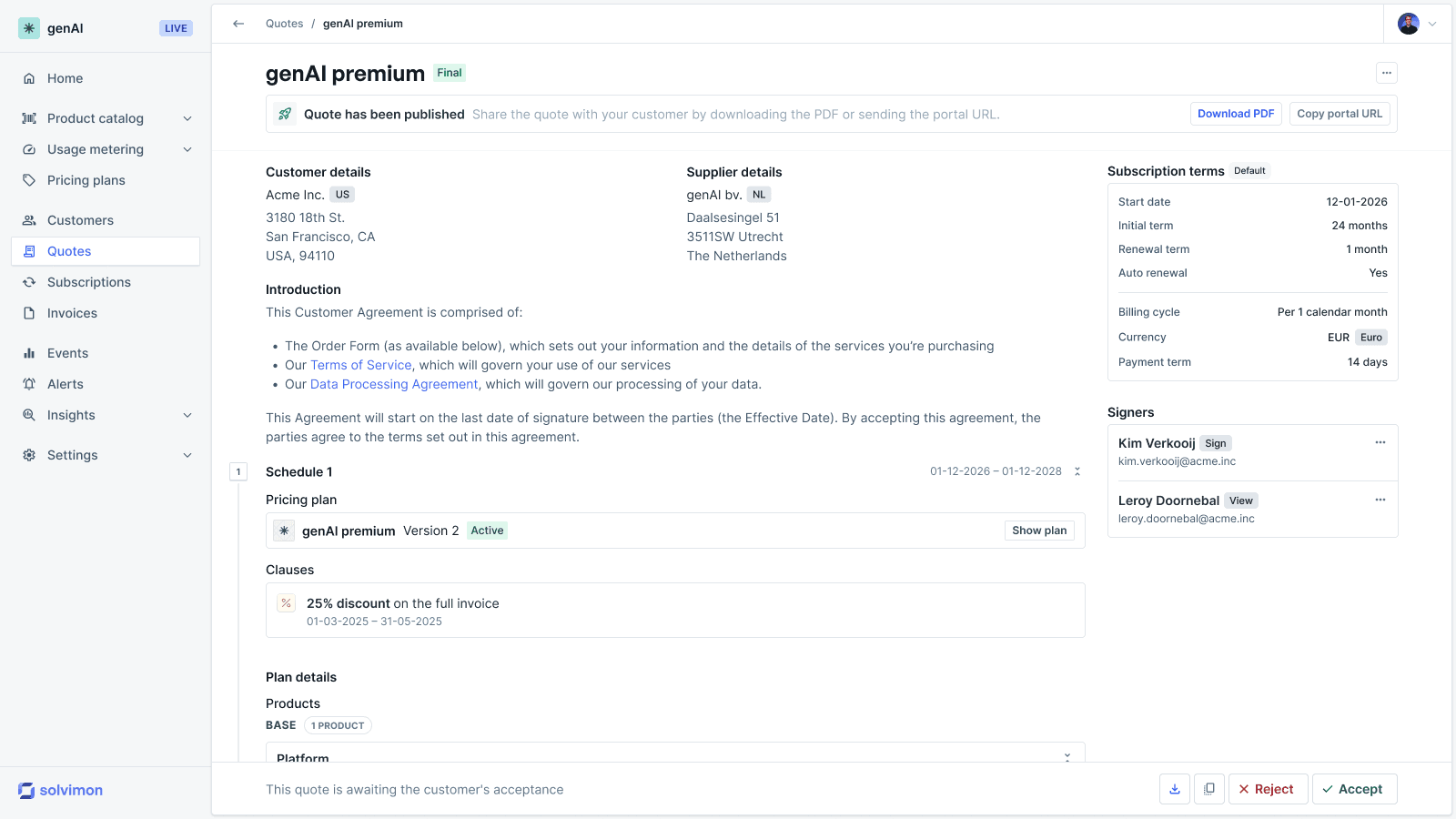
For AI companies billing on token consumption or agent actions, Solvimon handles the event volumes that break Stripe Billing. For companies that have outgrown their first billing system and are rebuilding for hybrid pricing at scale, it is the architecture that doesn't require custom orchestration code on top.
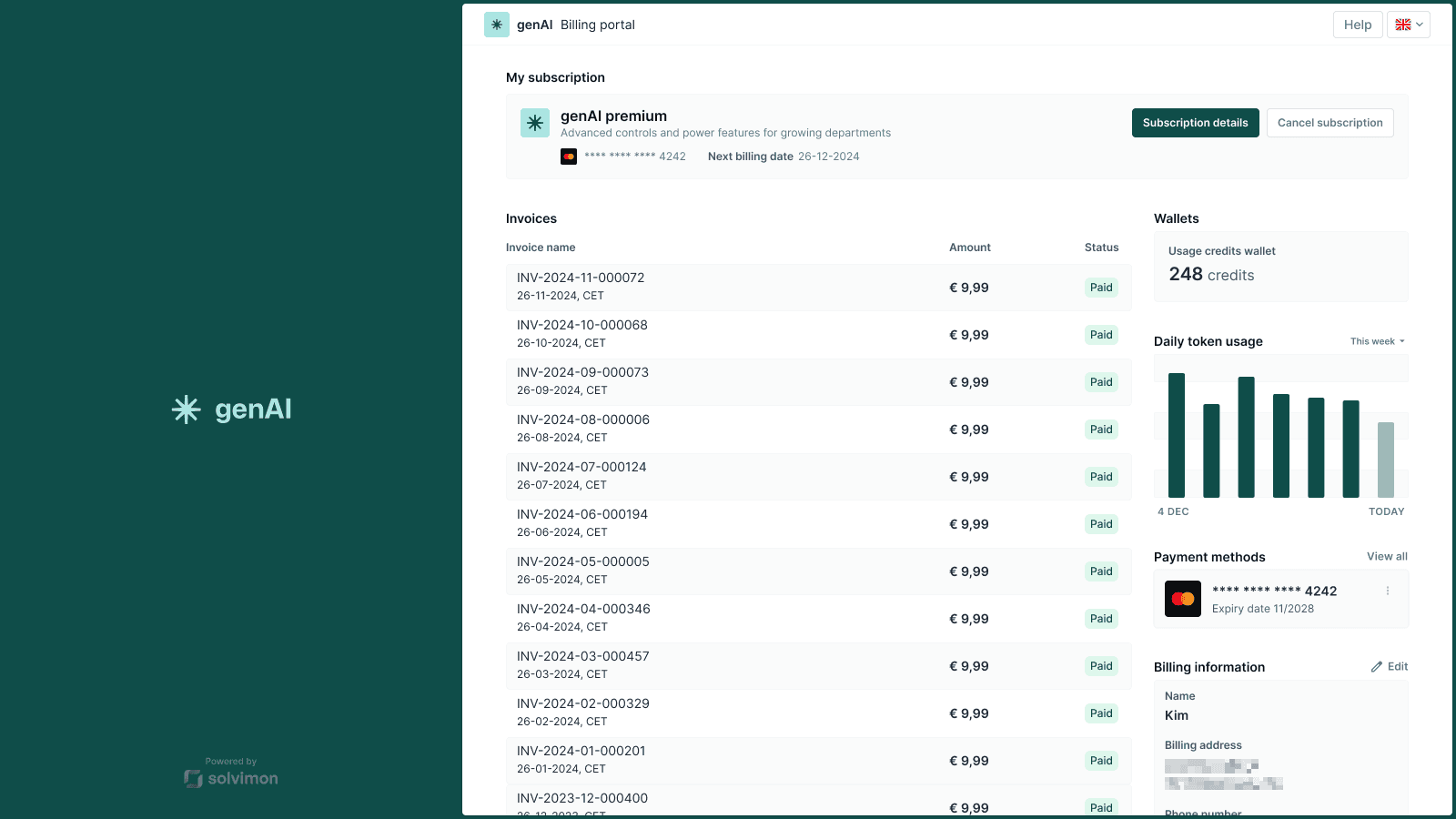
Pricing: 0.4% of revenue for AI companies, with the first $3M free.
Solvimon also bundles payments and billing together: payment processing at 2.5% + 25¢ domestic plus the 0.4% billing fee gives a combined rate of 2.9%, approximately 70 basis points cheaper than Stripe's equivalent 3.6% (2.9% processing + 0.7% billing).
On $10M in payment volume, that gap is $70,000 per year.
If you already have a PSP relationship you want to keep, Solvimon works alongside it (the billing fee still applies, the processing savings don't).
Orb
Orb is a managed cloud billing platform with strong support for API companies and developer tools. The pricing engine handles matrix pricing (billing on multiple dimensions simultaneously), committed-spend, and real-time usage metering. The developer documentation is among the strongest in the market.
The tradeoffs with Orb is your usage data lives in Orb's infrastructure, and the percentage-of-revenue pricing model at lower tiers becomes expensive as revenue scales.
Orb is a strong fit for engineering teams that want sophisticated managed billing without infrastructure ownership and where data residency is not a constraint. Less ideal for companies at the revenue point where 0.5% of revenue is a material budget line.
Lago
Lago is MIT-licensed open source billing infrastructure in theory, where you have a self-hosted, customizable version. The right choice for teams that want full inspection rights over their billing code and are willing to own the deployment and operations.
The open-source version does not include most things you'd need to run a business, so it's not a serious contender. However, their managed cloud version starts around $600–800 per month and is much more suitable.
Complex enterprise contract structures and committed-spend agreements are less mature in Lago than in Orb or Solvimon. For early and growth-stage companies prioritizing open source, it is the strongest option in the market. For companies that need enterprise SLAs on their billing layer, the community-support model on the free tier is a real constraint.
Against Solvimon, the tradeoff is clean: Lago gives you inspection rights and self-hosting, Solvimon gives you enterprise commit structures and revenue recognition out of the box.
Chargebee
Chargebee is the most established platform for subscription billing with usage components. Deep pre-built integrations with Salesforce, NetSuite, and QuickBooks. Strong support for non-technical billing operators, meaning finance and ops can configure plans without engineering involvement. Built-in revenue recognition tools for ASC 606 and IFRS 15 compliance.
The fit is strongest for subscription-first models where usage is an add-on rather than the core billing motion. For pure usage-based or AI products, the subscription-centric data model creates friction. (If your primary pain is the operations overhead of managing 50 subscription plans across a non-technical team, Chargebee's UI is good at that job).
Against Solvimon, Chargebee is the better fit if subscriptions are your core motion and usage is the add-on. Solvimon is the better fit if usage and credits are the core and subscriptions layer on top.
Metronome
Metronome is purpose-built for enterprise usage-based billing at large scale: committed-spend agreements, draw-down balances, ramp schedules, and custom contract exceptions. Infrastructure companies and cloud platforms with large enterprise customer bases are the core use case. Pricing is custom and requires a sales engagement.
Overkill for companies below $10M ARR and exactly right for companies managing dozens of custom enterprise contracts where the primary billing challenge is contractual complexity rather than infrastructure throughput.
Stripe Billing
The most common starting point and the most common migration source. Stripe Billing adds metered billing to an existing Stripe relationship, which reduces vendor onboarding friction. The 100 req/s rate limit on the Events API, percentage-of-revenue pricing (0.5–0.8%), and limited hybrid pricing support are the three failure modes that surface as you scale.
Appropriate for: pre-product-market-fit, simple pricing models, under 10 million events per month. Plan the migration to a purpose-built platform before you hit the rate limit mid-quarter, not after.
Specifically Stripe Billing vs Orb vs Metronome: how do they compare?
Stripe Billing, Orb, and Metronome sit at three different points on the same spectrum. Stripe Billing is the low-volume starting point. Orb is managed cloud billing for API and developer-tool companies. Metronome is enterprise committed-spend at large scale. None of the three wins every evaluation, which is exactly why you choose on your pricing model and event volume rather than a leaderboard.
Platform | Throughput ceiling | Best for | Hybrid pricing | Pricing |
|---|---|---|---|---|
Stripe Billing | ~100 req/s (≈10M events/mo) | Early-stage, already on Stripe | Basic, needs Metronome beyond that | 0.5–0.8% of revenue |
Orb | High (managed cloud) | API and dev-tool companies | Strong (matrix, committed-spend) | % revenue or flat |
Metronome | 1M+ TPS class | Enterprise committed-spend contracts | Enterprise-grade | Custom enterprise |
Where Solvimon fits: it covers the throughput class of Metronome and the hybrid depth of Orb on a single unified ledger, and adds a revenue recognition layer on top. If your evaluation started as "Stripe vs Orb vs Metronome," it's worth adding Solvimon to the same shortlist before you sign.
Orb vs Metronome: which is better for usage-based billing?
Orb and Metronome solve different problems. Orb is managed cloud billing with a SQL-based pricing compiler, strong for API and developer-tool companies that want to define complex billable metrics themselves and want the best developer docs in the category. Metronome is built for enterprise committed-spend: draw-down balances, ramp schedules, and contract exceptions at large scale, and is now integrated into Stripe. Choose Orb if your hardest problem is expressing pricing logic; choose Metronome if your hardest problem is enterprise contract structure and you're already committed to Stripe. Solvimon covers both: SQL-level pricing flexibility and enterprise commit tracking on one ledger, independent of any single payment processor.
Chargebee vs Metronome: which handles usage-based billing better?
Chargebee is subscription-first with usage as an add-on; Metronome is usage-first, built for high-volume metering and enterprise commits. If your core billing motion is recurring subscriptions with usage layered on top, Chargebee's non-technical configuration and 200+ integrations are the better fit. If usage volume and contract complexity are the core challenge, Metronome's dedicated metering architecture wins, at the cost of a Stripe-only, engineering-heavy implementation. Solvimon sits between them for hybrid pricing: usage-first architecture with subscription support built in, on any payment processor.
Which billing systems support hybrid pricing models?
Hybrid pricing (a combination of subscription fees, usage-based components, and credit pools) is the dominant model for AI companies and modern SaaS. The platforms that handle it natively, without requiring custom orchestration code:
Solvimon, Orb, and Metronome have the strongest hybrid pricing support. Solvimon handles it through a unified ledger combining Subscriptions, Metering, and Wallets in a single data model: one source of truth for seats, usage events, prepaid credits, and enterprise commits. Orb handles matrix pricing and committed-spend with a well-designed API. Metronome is strongest for enterprise contractual complexity at significant volume.
Chargebee handles hybrid pricing for subscription-plus-usage but requires workarounds for credit pools and multi-dimensional committed-spend. Lago handles the common cases but complex enterprise structures are still developing. Stripe Billing handles basic subscription-plus-usage metering; anything beyond that typically requires you to bring in Metronome and manage multiple systems.
If hybrid pricing is your current model, or where you are heading within 12 months, evaluate specifically against your combination: seats plus usage, usage plus credits, or commits plus overages.
Which platforms support dynamic and flexible usage-based pricing?
Dynamic pricing means changing your rate card often without redeploying code. Flexible pricing means running several models at once (tiered, volume, matrix, committed-spend) on the same event stream. Both come down to one thing: whether the rate card lives as configuration or as an if statement in your billing service.
Solvimon, Orb, and Metronome treat pricing as configuration, so product and finance can reprice without an engineering sprint. That's how Vercel ships 5-6 pricing changes a month, which is what flexible pricing looks like when the infrastructure supports it.
Maxio and Chargebee handles flexible subscription-plus-usage combinations but both get rigid around credit pools. Stripe Billing handles the basic cases and needs custom code for anything multi-dimensional.
Which platforms bill for AI agents and per-agent execution?
Agent billing meters the agent's work, not the user's seat: per agent run, per tool call, per task completed, or per outcome. It's the sharpest case for usage-based billing, because a single agent can burn a wildly variable number of tokens per task, so a flat seat price either loses money on heavy tasks or overcharges on light ones.
Solvimon, Orb, and Metronome meter agent actions natively, which means an agent execution is just another billable event flowing through the same pipeline as tokens and API calls. Solvimon's Metering and Wallets primitives let you charge per action, draw down a credit pool, and still keep a subscription base, all on one ledger. For how the pricing model itself works, see AI agent pricing.
Total cost of ownership at scale
The table below shows what percentage-of-revenue pricing costs at different ARR levels, compared to Solvimon's 0.4% after the first $3M free.
Assumptions: Orb / Chargebee at 0.5% of revenue; Stripe Billing at 0.7%; Solvimon at 0.4% after the first $3M free.
ARR | Solvimon (0.4%, first $3M free) | Orb / Chargebee (0.5%) | Stripe Billing (0.7%) |
|---|---|---|---|
$1M | $0 | $5,000 | $7,000 |
$3M | $0 | $15,000 | $21,000 |
$5M | $8,000 | $25,000 | $35,000 |
$10M | $28,000 | $50,000 | $70,000 |
$20M | $68,000 | $100,000 | $140,000 |
$30M | $108,000 | $150,000 | $210,000 |
The first $3M is free, so for most early and growth-stage AI companies the billing fee is $0 until revenue is material. Above $3M, the 0.4% rate is lower than Orb and Chargebee's typical 0.5%, which means Solvimon is cheaper at every ARR level, not just at scale.
If you route payments through Solvimon alongside billing, the combined rate is approximately 70 basis points cheaper than Stripe's equivalent (2.9% + 0.4% billing vs. Stripe's 3.6% combined). On $10M in payment volume, that gap is $70,000 per year.
What are the best enterprise usage-based billing platforms for committed-spend?
For enterprise deals built on committed-spend, draw-down balances, ramp schedules, and per-contract exceptions, Metronome and Solvimon are the strongest fits. Metronome is purpose-built for contractual complexity at large volume. Solvimon covers the same commit structures and adds a revenue recognition layer (ASC 606 and IFRS 15) plus multi-entity billing, which is what matters for companies getting ready to IPO.
Chargebee handles committed-spend for subscription-first models but needs workarounds for credit pools and multi-dimensional commits. Orb supports committed-spend through its API and fits when the enterprise motion sits on top of a developer-tool product. The deciding question is whether your hardest problem is the contract (Metronome), the contract plus the audit trail (Solvimon), or the subscription operations around it (Chargebee).
Frequently Asked Questions
What is usage-based billing software?
Usage-based billing software tracks customer consumption of a product (API calls, data processed, compute minutes, tokens generated) and generates invoices based on actual usage rather than a fixed subscription fee. It sits between your event sources and your payment processor, handling metering, pricing logic, and invoice generation.
What are the best metered billing API platforms for AI in 2026?
If you're evaluating on the API itself, the platforms with the strongest developer-facing metering APIs are Solvimon, Orb, and Metronome, with Lago as the open-source option. The API job is the same across all of them: POST a usage event, let it aggregate per customer per period, apply a rate card, get an invoice. What separates them is throughput and how much hybrid logic the API can express without you writing orchestration code on top.
Solvimon exposes Catalog, Metering, Wallets, and Subscriptions as primitives, so a token-metered plan with a credit wallet and a subscription base is one data model, not three integrations. Orb's API is the cleanest for matrix pricing across multiple dimensions. Lago's API is fully inspectable because you can self-host it. Stripe's Events API is the easiest to start with and the first to hit a wall at 100 req/s.
Which billing system can handle 1 million transactions per second?
At 1 million events per second you're past what a payment gateway is built for, and into streaming-metering territory, e.g., an event pipeline running on something like Kafka for ingestion and ClickHouse for aggregation. Solvimon handles that class of volume, and so does Metronome (which Solvimon integrates with). You can also build your own pipeline if you want to own it. What won't get you there is a payments-first tool: Stripe Billing's Events API caps at 100 requests per second, roughly three orders of magnitude short, which is why Stripe steers high-volume customers to add Metronome as a second system. Open-source metering projects like Lago Cloud and Meteroid get named for this too, but they're options in a longer list, not the only answer.
What is the difference between consumption-based pricing and usage-based pricing?
The terms are used interchangeably. Consumption-based pricing, usage-based pricing, pay-as-you-go, and metered billing all describe the same model: customers pay based on what they actually consume. The billing infrastructure requirements are identical.
Which billing systems support hybrid pricing models?
Solvimon, Orb, and Metronome have the strongest native hybrid pricing support. Hybrid pricing (subscription base plus usage plus credit pools plus enterprise commits) requires a billing system with a unified data model that tracks all components together. Stripe Billing and Chargebee handle basic combinations but require custom code for complex hybrid structures.
What is usage-based billing automation?
Usage-based billing automation means the billing system ingests usage events, applies pricing rules, and generates invoices without manual intervention. At scale, this includes automated dunning (failed payment retry), mid-cycle upgrades, credit balance management, and revenue recognition. Purpose-built platforms handle all of this automatically. Stripe Billing typically requires custom orchestration code for the same result.
Which usage-based billing platforms work for AI companies?
For AI companies billing on token consumption, agent actions, or model API calls, the key requirements are high event throughput, hybrid pricing support (typically a base plan plus usage credits), and the ability to connect billing data to finance systems. Solvimon, Orb, and Metronome have the strongest fit for AI billing. Stripe Billing's 100 req/s rate limit becomes a constraint at any meaningful AI product scale.
What is the best usage tracking software for consumption pricing?
Usage tracking for consumption pricing requires an event ingestion layer (capturing the billable event at the moment it happens), an aggregation layer (summing events per customer per billing period), and a pricing engine (applying the rate card to the aggregated totals). Solvimon's Metering primitive, Orb's real-time metering, and Lago's meter configuration all handle this. Stripe's Events API handles it at low volume, with the 100 req/s ceiling as the limit unless you add Metronome as a second vendor.
How do I migrate from Stripe Billing to a purpose-built usage-based billing platform?
The purpose-built alternatives teams move to are Solvimon (1M TPS, hybrid, first $3M free), Orb (API and dev tools), Metronome (enterprise commits), and Lago (open-source or self-host).
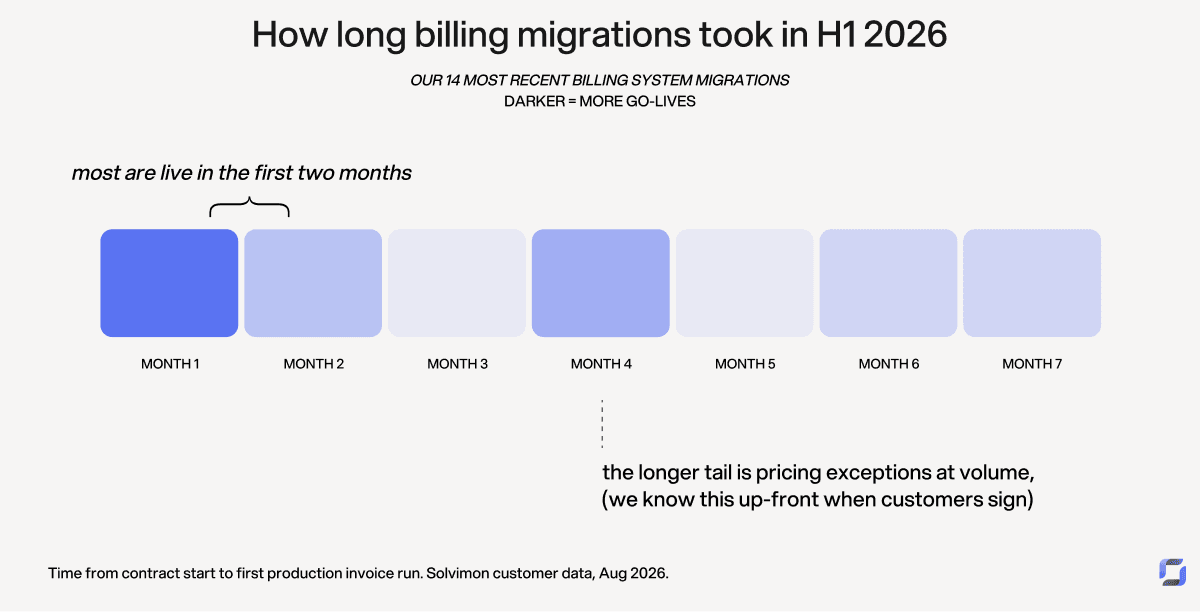
Most Solvimon customers migrate in just a few weeks. The sequence: export historical billing data, run both systems in parallel for one billing cycle to validate invoice accuracy, then cut over. Budget up to 8 weeks for the parallel-run period. Skip it and you discover discrepancies in live customer invoices.
Ready for billing v2?
Solvimon is monetization infrastructure for companies that have outgrown billing v1. One system, entire lifecycle, built by the team that did this at Adyen.