AI pricing is not broken. We already have the answers for how to do it.

Insights
Read time: 10 min

Arnon Shimoni
✓ Expert opinion
This is a response piece actually, because a roundup of four practitioner talks went around last week under the headline that "AI pricing is broken". It opens like this: three out of four SaaS companies have added generative AI features, and only 15% are successfully charging for them.
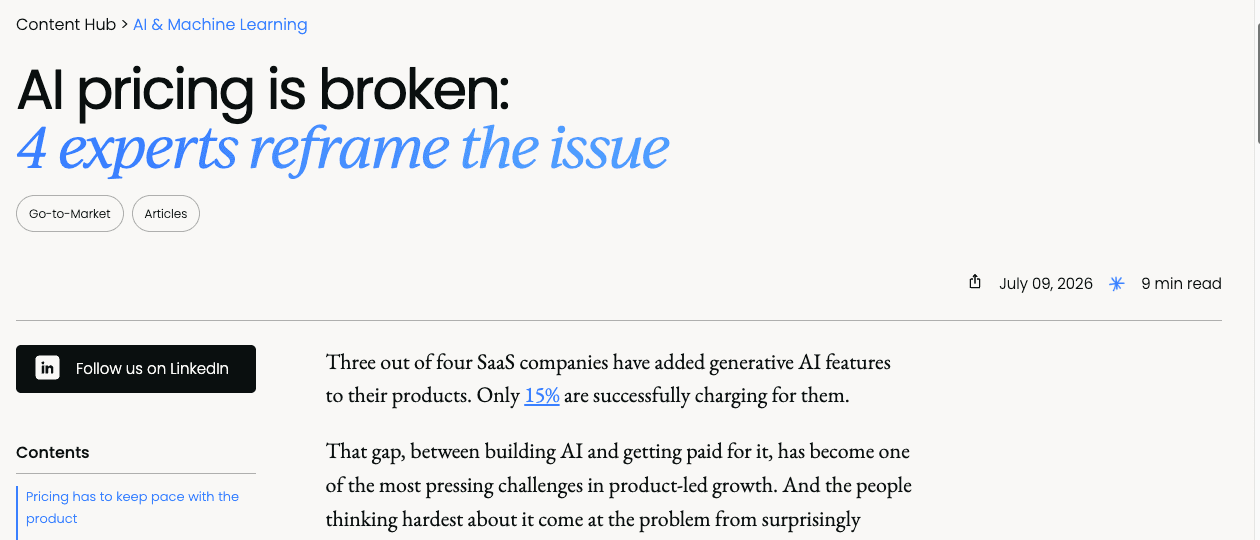
(I've redacted the details because I don't want to call them out specifically)
Sure, fine. But that 15% is doing SO MUCH heavy lifting in this. Everything the experts argue immdiatley after it (mainly that product should own pricing, PLG metrics don't fit agents, your heaviest user is your most expensive one, start from revenue architecture) just glosses over how the AI pricing is stuck or "broken".
It's a very Claude-heavy attempt to grab your attention (Claude LOVES saying things are "quietly broken")
So I decided to go do some more work on this. I can't find a 15% rate as-is so I'm going to assume it's made up to sell software (I know, I know… Pot calling a kettle black, etc.)
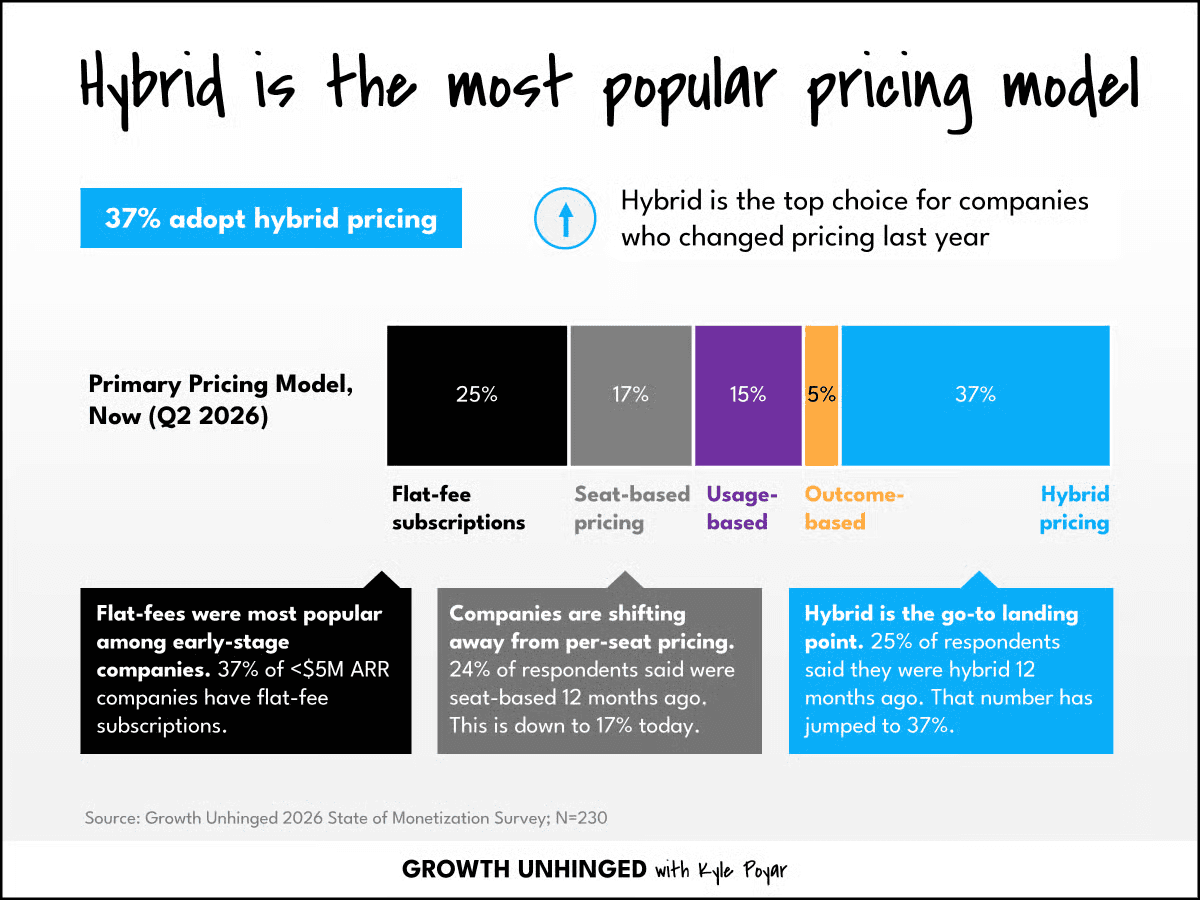
So I'm going to rely on Growth Unhinged (Kyle Poyar's) The state of B2B monetization in 2026 which 230+ B2B software and AI companies and got published about three months ago. 3/4 of the respondents changed pricing or packaging in the last twelve months.
While hybrid pricing sits at 37%, it's way up (25%!) from 2025 and AI credit adoption is at 29%, with another 33% saying they'll add credits within the next year.
You know what? That's an industry changing its mind in public, at speed, and getting better at it.
And the tl;dr is that's why AI pricing ISN'T BROKEN.
OK so what happened until now? Why do we think it's broken?
I guarantee no one sat down in 2023-2024 and picked the wrong model.
What happened is a sequence. A journey, if you will - where each step was and is a rational response to the thing that hurt at the time.
Bundling, for when you can't measure anything yet
The first move was to bundle - which means you ship the AI feature, you don't meter it and you certainly don't raise the price of the tier and let AI be the reason.
Notion is a great example. AI was a $10 per member per month add-on you could stack on any plan.
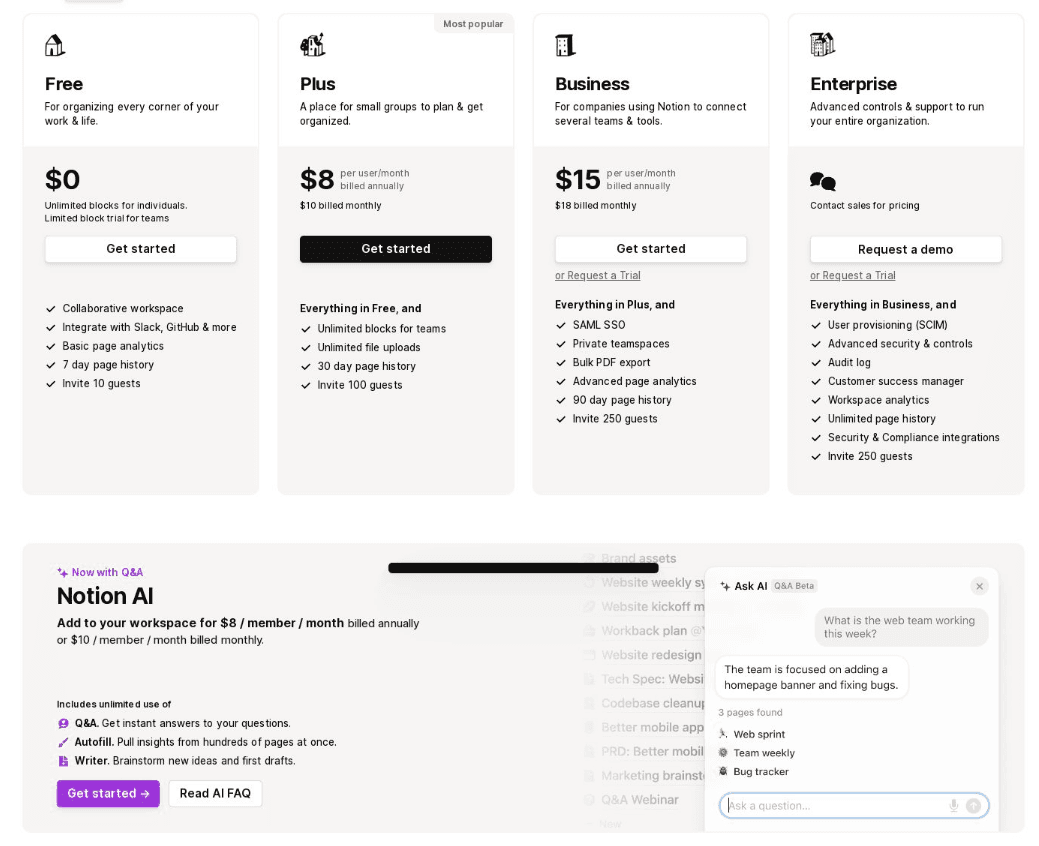
Then, in Q3 2025 they folded it into Business and Enterprise, pulled the add-on for new Free and Plus customers, and moved Business from $15 to $20 on annual billing. Existing customers hit it at their first renewal after 13 August 2025.
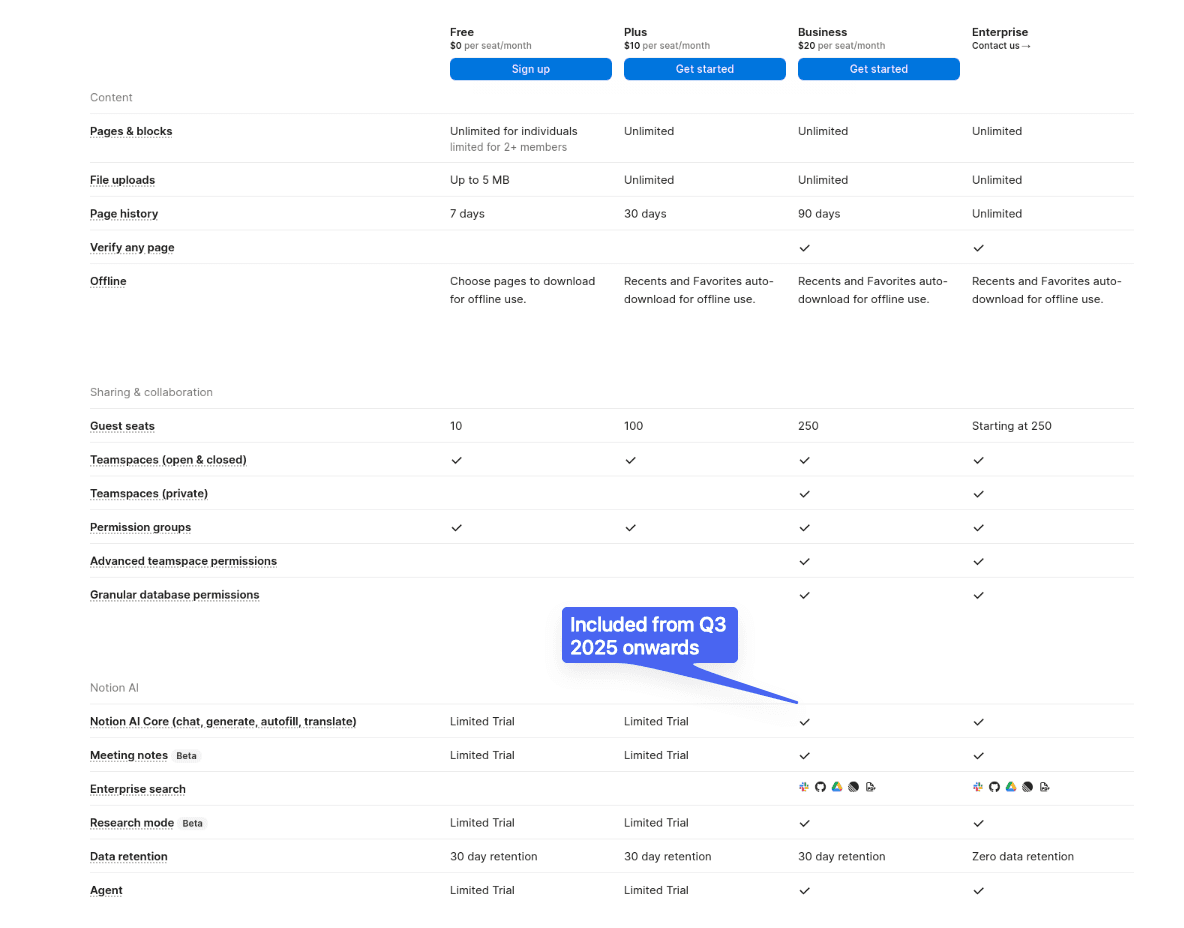
(Screenshot via PricngSaaS' Pulse)
Microsoft did a similar thing with M365. Why? Because you bundle when you have no usage history and no appetite for explaining a meter to a customer who was perfectly happy paying per seat.
It's very possibly the fastest thing to ship and it buys you at least quarter of data - but it has an expiry date. Why does it expire? Because margins.
Credits, when the margin starts to hurt
Kyle Poyar's median target gross margin on AI is around 50%. My previous analysis on this is closer to 20-30%, but we know traditionally SaaS has run at 75%+.
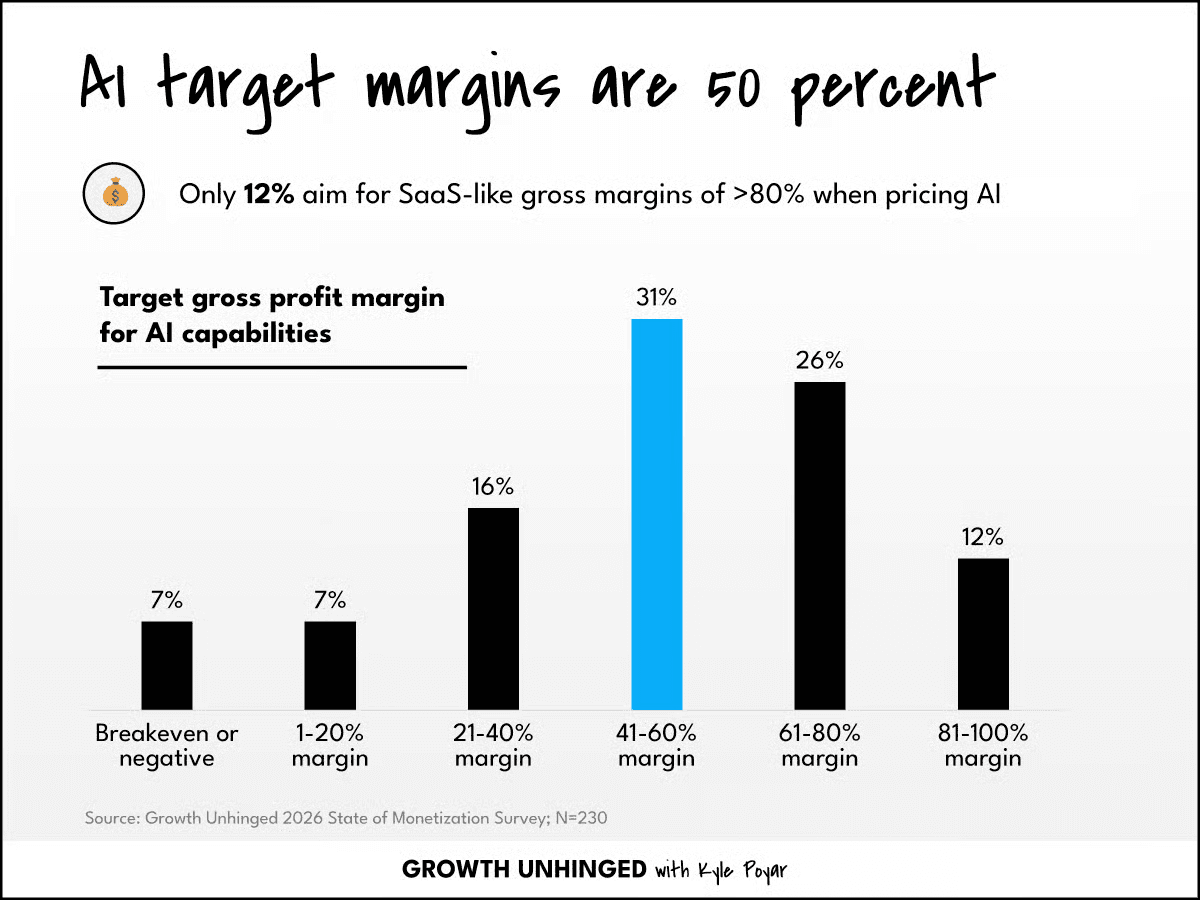
Internal costs and margins were the single most cited factor when companies price AI capabilities, at 54%, ahead of competitive positioning (36%) and customer productivity gains (30%).
So the second move you make after you figure out your bundle is margin protection, and credits are what it looks like in practice. AI credit models grew 126% year on year in 2025.
When Salesforce introduced Flex Credits in May 2025 at roughly $0.10 per action, GitHub started AI credits for Copilot on 1 June 2026, and Clay split its model in March 2026 so that the platform carries the value and tokens carry the cost, in separate buckets.

(Flex Credits image via Salesforce)
I like thinking of credits as a buffer (or translation layer) between what the customer thinks they're buying and what your inference bill does.
While it does that, it also hands the customer a cost optimization problem they never asked for.
When a user has to decide whether the better model is worth 3x the credits of the cheaper one, that decision used to be yours but now it's theirs.
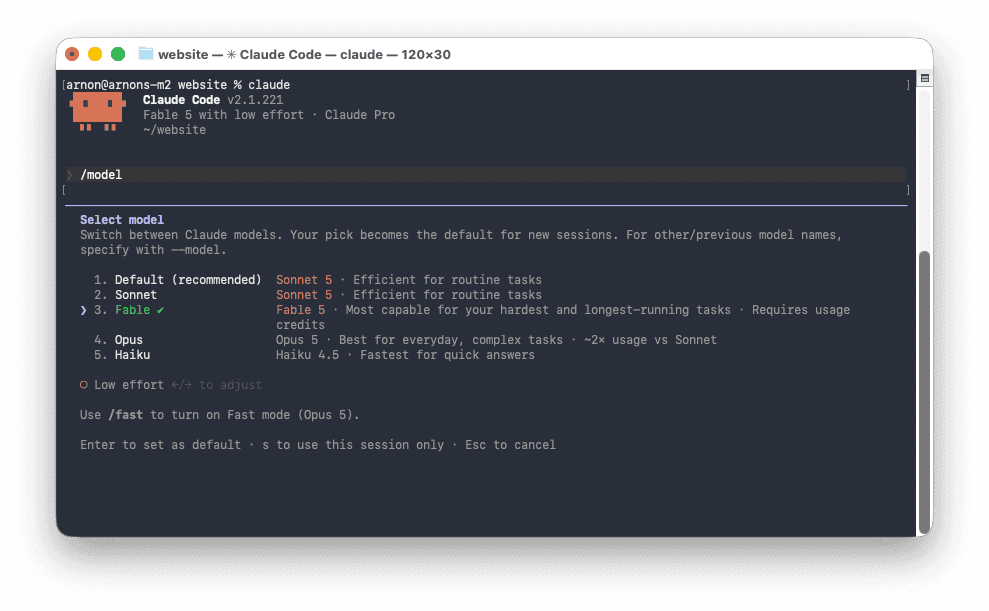
Have you found yourself switching between Claude models recently because of Fable? Yeah, it works, and it keeps the gross margin above water while you figure out what you're actually selling.
Credits are absolutely a huge architecture decision, way before they're a pricing decision. When you show your priuce in credits rather than dollars-per-feature it changes how people buy your stuff - procurement, metering and revenue recognition relate to each other. When you do this, you're welding them together so you can put credits on the pricing page…
Outcomes, when you can prove it was you who did the work
Outcomes is one of the most talked about (and I was and still am a big part of that problem, honestly). If we're completely honest about it, you can only do this when you can attribute the result.
Outcome-based pricing darling Fin charges $0.99 per support resolution, because it can prove it. A resolution is a conversation where Fin answers and the customer either confirms it helped or leaves without asking again, and the resolution gets deducted if that customer comes back for more help. Similarly, both Decagon and Sierra lets customers choose between per-conversation and per-resolution.
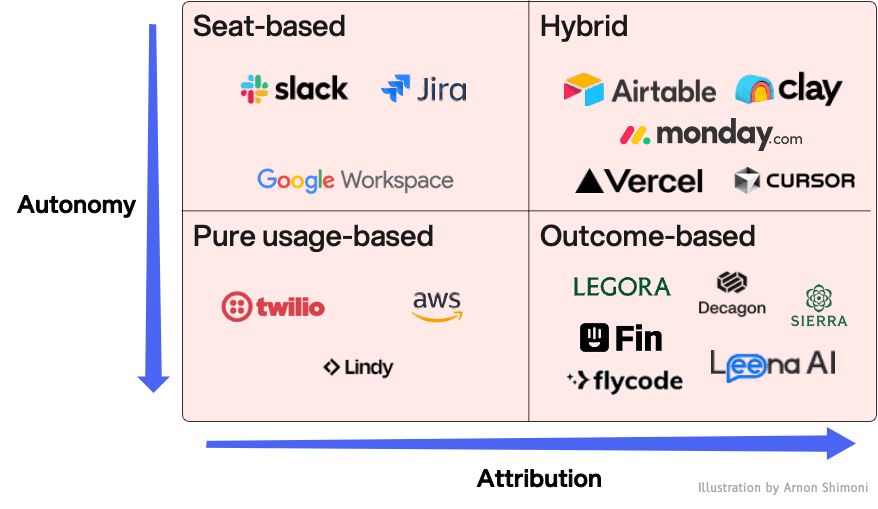
Kyle Poyar's test for whether outcome pricing works at all is four conditions he calls CAMP: consistency of outcomes, attribution, measurability, predictability. If you fail on any of those you end up selling a promise you can't invoice. Shouldn't surprise you that I love this.
Two more problems with outcomes
1) Your CFO has to recognize this revenue
Go back to that clawback! Under ASC 606 an outcome fee is variable consideration. You estimate the transaction price, constrain it to the amount that's probable not to reverse, and maybe later true up as the actual outcomes land.
Imagine someone like a director of customer support disputing 300 of Fin's resolution. That could end up being a big change to the financials already reported and signed-off on.
Deferred revenue that re-adjusts on customer dispute is an unpleasant thing to own, and forecasting it is worse. "We can't recognize it cleanly" is so much more common than it sounds. And while I'd love it to not be a reason, it's a big reason companies go for fixed, bundled tiers. Yes, it's a "Finance department" problem, but if you've ever gone against a CFO - you know they tend to win those arguments.
2) You're making a bet on the price of compute
Charging per resolution cuts the cord between your price and your cost and, well, that's the point of it, and it goes both ways because if inference deflates 90% next year, the $0.99 stays where it is and the difference is yours as a vendor of such a solution.
But if one customer's agent loops twelve times to reach a single resolution because their knowledge base is a mess, you eat every cent of that and you can't charge for more so iutcome pricing is a bit of a bet that model costs fall faster than customer complexity rises.
Yes, I often too describe it as "customer value alignment" (which is totally is), but the margin matters sometimes more. At a median target margin of ~50%, and with some companies (PostHog, notably) happy to run at 20% or lower, there isn't much room for the customer whose agent won't stop "thinking".
So it's a journey?
Where a company lands is set by how autonomous the product is and also how attributable the outcome is.
How autonomous | How attributable | What you can charge for | Who's here |
|---|---|---|---|
Feature inside existing software | Not at all | Bundle it, raise the tier price | Notion 2025, M365 Copilot |
Copilot, human in the loop | Activity, not result | Credits or consumption | Figma, GitHub, Clay |
Agent doing bounded work | The work item, contested | Per action, per conversation | Salesforce Flex Credits |
Agent completing a job end to end | Clean, defensible | Per resolution, per outcome | Fin, HubSpot Breeze |
It's damn near impossible to sell a copilot on outcomes because the human did half the work and will tell you so during your review (which you kind of have to do when you charge for outcomes). An agent that closes a ticket without a human touching it can be because there's a clean event with a defensible definition.
So again, if we visit the original premise that "AI pricing is broken" - that's because they're comparing companies in very different stages and across the rows of the table above. That's not a failure or anything breaking - it just means they're in different places. But you CAN span across this table.
As you know, because I've talked about it before and you read lots of what I write, Hybrid is the single most common model today, and you can see it in Kyle Poyar's data at 37%, up from 25% a year earlier.
When I buy stuff for Solvimon now, I see it very frequently: a base platform fee or seat fee for access, a committed credit drawdown negotiated at a discount, and sometimes also an outcome layer sitting on top of both. That way I get a number I can approve on the budget and the vendor gets commitment and keeps the variable upside inside a band both of us agreed to.
The same layering shows up across customers rather than within one contract. Salesforce has cycled Agentforce through $2 per conversation at launch in late 2024, Flex Credits in May 2025, per-user add-ons after that, and a flat agentic enterprise license agreement. Four models, live at once, on purpose. Across the market, 29% of companies now let customers choose between pricing models, up from 21% a year ago.
Nobody abandons bundling just for the credits, they tend to add credits and keep the tier.
The third gate, which isn't technical
Selling an outcome requires the customer to believe you will deliver the outcome. That belief is a track record, and it takes a while to build that up. Intercom could charge per resolution because Fin has resolved enough tickets, at enough companies, that a support director can defend the line item to their CFO. Salesforce signed a deal in June 2026 to acquire the company for around $3.6 billion, so whatever else is true, outcome pricing didn't hurt it.
A seed stage agent company charging per outcome is asking the buyer to underwrite its reliability with no evidence. The buyer prices that risk the way buyers always do, by not signing, or by demanding a floor and a cap that turns the outcome model back into a subscription with extra steps.
Which is why "consider whether you can price on outcomes" is advice that does nothing for the company reading it. I tried it many times - it doesn't always work. While It's still my holy grail, I know that you earn outcome pricing. Until then credits are a relatively responsible thing to run, and bundling is the responsible thing before that.
What did they miss in the original? Why do companies feel stuck
So Kyle said this too, "Nobody is happy with their pricing. The biggest complaint: not enough expansion revenue."
They're not moving fast enough. Simply that.
Read that again, because it's my main takeaway here.
Sure, there's a lot of reasons from bad billing stack, organizational difficulties in getting CPQ flexible enough, but if the result is a company that makes one pricing decision a year, makes it badly because it has to hold for twelve months, then defends it long past the point where the data says move. So they're not happy.
If you look at Vercel, yeah - they ship 5-6 changes a month.
So what should the 85% do
Moving up between the rows of the table is both a data and systems problem before it's a pricing problem.
If you can't produce a clean per-customer count of the thing you want to invoice, defend the definition to a customer who disputes it, and hand it to your auditor in a form they'll accept, you're not ready for outcome pricing and billing.
Check what a pricing change costs you to ship. If the answer is a quarter, you have a big problem to solve there first!
Start experimenting.
So while roughly 50% of companies above $50M ARR say they'll add AI credits within the year, I promise you they know which row they're on, and which one they want.
What would have to be true for you to move up a row? Can you make those changes on the same day? Week? Month? Quarter?
Ready for billing v2?
Solvimon is monetization infrastructure for companies that have outgrown billing v1. One system, entire lifecycle, built by the team that did this at Adyen.