What our last 14 billing migrations looked like

Craft
Read time: 4 min

Arnon Shimoni
✓ Expert opinion
A common thing we hear in our calls with CFOs is they don't have capacity to change billing. CFOs often don't have their own engineering so they need to get help. They like seeing the pricing model flexibility, the connectivity with ERPs, and even the CPQ functionality but they don't know how long it'll take to migrate.
So they stay with the status quo. Another year of the old system, at the old system's error rate, with the old system's workarounds.
However, I've done the math and most billing migrations at Solvimon go live within 2 months of contract start. The decision does however take longer than the migration.
How the last 14 migrations went
I pulled out some numbers on our 14 most recent migrations, contract start to first production invoice run.
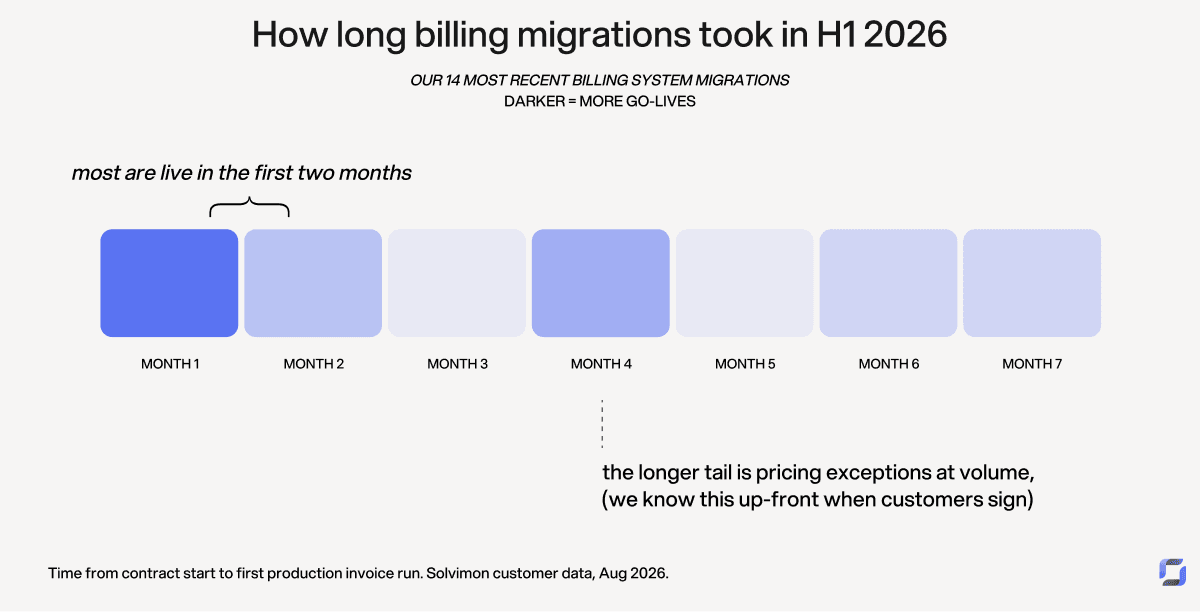
Here's what I found:
Most go-lives take under 2 months.
Half were running production invoices within ~6 weeks.
There's a small long-tail running to 6 months.
We're talking about fancy fintechs and companies doing tens of millions of billable events a month, so it isn't exactly an easy migration.
The long-tail has a consistent cause, which I'll get to in a bit.
Why it's faster than even I expected
I've been doing billing for years, and I know migrations are tough - because you don't rebuild your pricing in a new system, you sort of have to find a new way and new primitives to express it in.
Tiers, volume rates, regional rates, usage dimensions, commitment drawdowns: these are rules, and rules migrate in many days because you configure them once and every customer on them comes across together.
Your billing system isn't a system for charging customers. It's a system for remembering every promise you've ever made.
Lots of companies overestimate this part because they remember how long the pricing took to invent in the first place. Re-expressing is much faster than making a whole new decision.
When I was looking to migrate my home-built systems, I was estimating it at MANY months.
But today with AI, it's actually not that hard anymore. Migrating historical data, customers and subscriptions can all be done in less than a day with file imports or a one-time sync from the CRM or ERP where they already live. Claude can help you write the code for that, so you really don't need much here.
The switch itself is an anticlimax if you let it be one. Solvimon's standard migration plan includes 6 weeks total:
configure meters, products and plans
hook up signals/meters/usage
validate invoice correctness
prepare the cutover, aligned to your billing cycle
Why some DO run longer
A minority of migrations run long. The cause is consistent enough that we now look for it on day one: pricing exceptions at volume. These are hand-made contracts that don't appear in the product catalog with manually-applied discounts or contract terms that live in an email thread from 2022 and violate the "rules".
Any company that has an SLG motion has these.
We too understand that this work exists whether you migrate or not. If we're completely honest about it, you already know those exceptions cost you time every billing cycle because someone is fixing things. It's fine, I get it - and we know it'll happen. The mess predates the migration.
The migration does surface it, and unlike the status quo, you get to decide to clean it up now. Move your standard customers first and then do the exceptions in a second wave..
If you want to know which group you're in before talking to any vendor, there's an afternoon-sized test for you to check:
Take 20 of last month's invoices and try to derive each one from your usage data and your contracts alone.
✅ If you can reproduce all 20, your migration is short and you should stop being scared of it.
🚫 If you can't, you've found a gap that you need to fix regardless of vendor.
At this point we've seen many companies spend longer just thinking about migrating than actually doing it. As with any project, nothing gets better when you just talk about it..
Ready for billing v2?
Solvimon is monetization infrastructure for companies that have outgrown billing v1. One system, entire lifecycle, built by the team that did this at Adyen.