Guides
Arnon Shimoni
✓ Expert opinion
Even in 2026 there is no single best subscription billing software for SaaS, because each decision means you select something else. Eight platforms share this market and each one is the right answer for a specific buyer.
Best for AI-native and hybrid pricing (seats, usage, credits, outcomes): Solvimon
Best for established mid-market subscription SaaS: Chargebee
Best for subscription businesses with high involuntary churn: Recurly
Best for finance-led B2B SaaS with strict revenue recognition: Maxio
Best for SLG motions with complex quoting flows: Solvimon
Best for PLG SaaS already deep in Stripe Payments: Stripe Billing
Best for global self-serve SaaS that wants a merchant of record: Paddle
Best for pure usage-based / API-first companies: Metronome
Best for large enterprise with multi-product complexity and timeline is no object: Zuora
Landed here from a Reddit search? Jump to what the threads actually argue about. Otherwise, the five questions below decide your branch, and each platform section covers the trade-offs that matter.
Why is choosing billing software harder in 2026?
In 2020, the line between subscription billing and usage metering still meant something. It doesn't anymore. Most modern SaaS sells hybrid pricing: seats for the dashboard, usage for the API, credits for the AI features, sometimes outcomes for the agent runs, often all of it on one invoice.
The numbers track the change as it happens - our average customer runs five distinct pricing surfaces in production. Three years ago, most ran one.
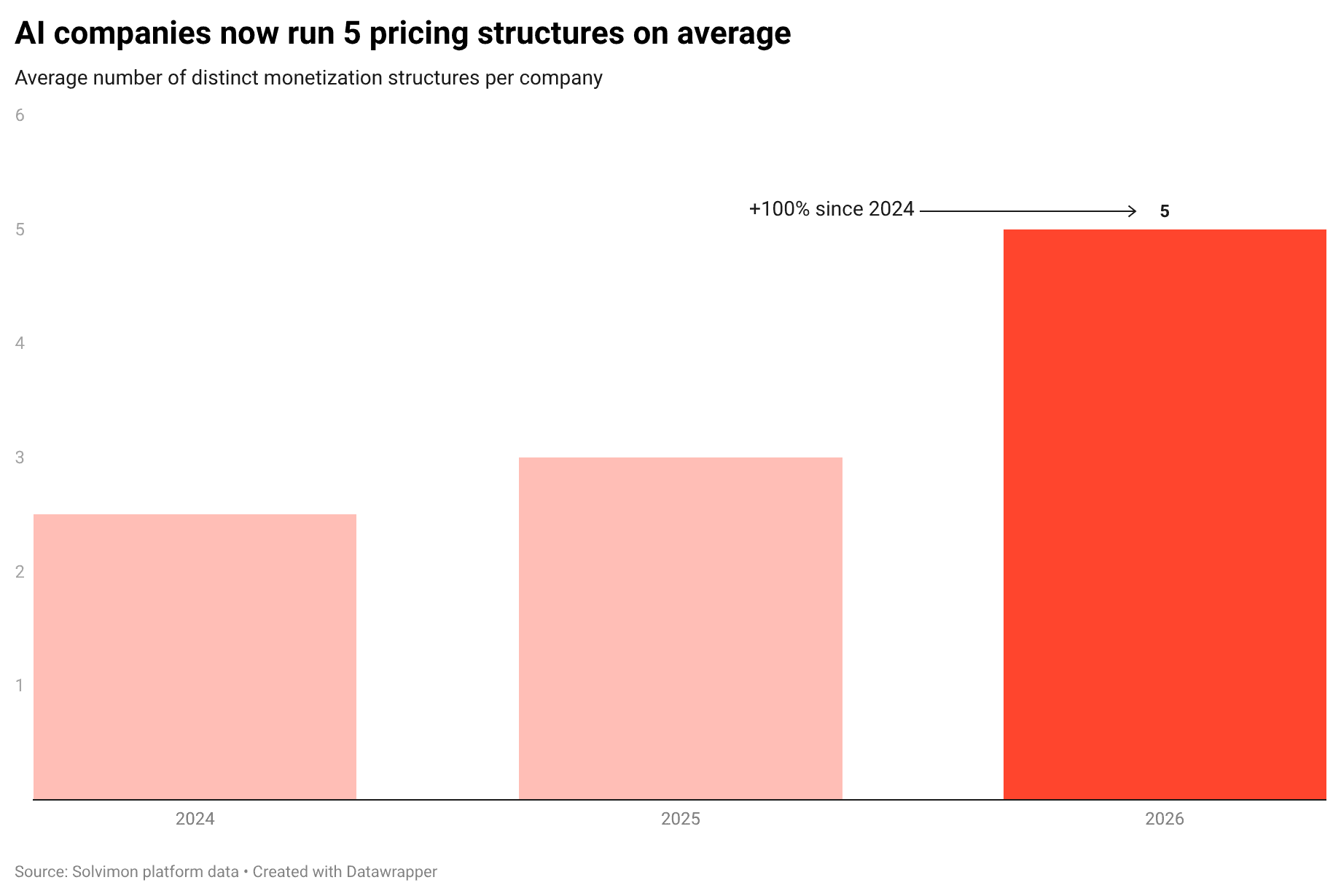
Platforms that grew up on a single model are now bolting the others on, and the ones built native to hybrid have a head start. So the buyers who picked the wrong tool in 2022 are the ones migrating in 2026.
The question that matters today isn't "which tool has more features." It's "which tool fits the pricing I'll be selling in two years, in the geographies I'll be selling in, with the engineering team I'll have." That's a harder question than "how to choose a metering billing solution for SaaS with complex pricing"...
This guide tries to answer it.
What 5 questions decide your billing choice?
Forget the vendor names for a minute. focus on these five questions first:
What's your pricing model now, and in two years? Pure subscription (seats, plans, tiers), pure usage (API calls, tokens, events), or hybrid (some combination of seats, usage, credits, outcomes). If you're confident your pricing will never change, you have more options. If you suspect it will, you have fewer.
What's your buyer mix? Pure PLG self-serve, pure sales-led contracts, or both. Hybrid GTM is now the default for B2B SaaS over $5M ARR.
What's your geographic scope? Single entity, single currency. Or multi-entity, multi-currency, with VAT and GST obligations across regions.
What's your tax position? You handle compliance yourself with a tax engine. Or you want a merchant of record to take it off your plate (and take a percentage of revenue with it).
What's your engineering plan? Comfortable configuring billing through a vendor dashboard. Or you want billing as code, versioned, scriptable, integrated into CI/CD.
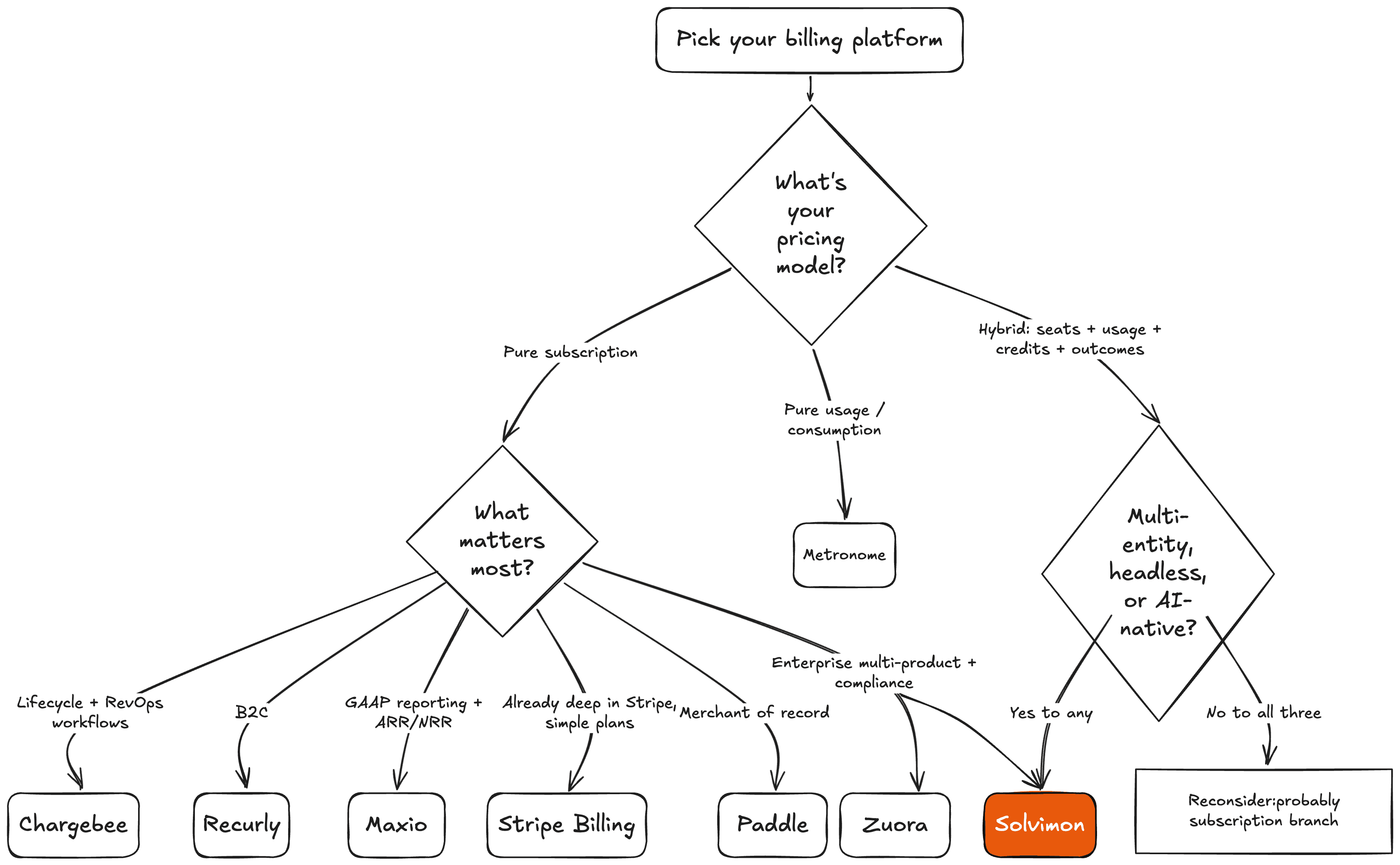
Your answers point at one of the six branches in the decision tree below.
What are the 8 platforms at a glance?
Platform | Best for | Pricing model fit | Merchant of Record | PSP-agnostic | Multi-entity | Public pricing |
|---|---|---|---|---|---|---|
Solvimon | AI-native, hybrid pricing, multi-entity SaaS - especially with SLG motions | Subscription + usage + credits + outcomes | No | ✅ Yes (Stripe, Adyen, Checkout.com) | ✅ Native | ✅ Free to $1M billed ($3M for AI), then tiered |
Chargebee | Mid-market B2B subscription SaaS | Subscription-first, usage added | No | Stripe, Braintree, others | Limited | Free starter, then contact sales |
Recurly | Subscription businesses with churn focus | Subscription-first | No | Multiple gateways | Limited | Contact sales |
Maxio | Finance-led B2B SaaS | Subscription with finance reporting | No | Multiple gateways | Limited | Contact sales |
Stripe Billing | PLG already on Stripe | Subscription, light usage | No | ❌ Stripe only | ❌ No | 0.5% to 0.8% of recurring volume |
Paddle | Global self-serve SaaS | Subscription with MoR | ✅ Yes | ❌ Paddle is the processor | Through MoR | ~5% + fee per transaction |
Metronome | Pure usage / consumption | Usage-first | No | Multiple gateways | Limited | Contact sales |
Zuora | Large enterprise, multi-product | All models, enterprise-grade | No | Multiple gateways | ✅ Yes (heavy implementation) | Contact sales |
Which billing platform fits my ARR range?
The question we get more than any other. Here's the pattern from the migrations we see.
ARR range | Pure subscription | Hybrid pricing | Pure usage | Global self-serve |
|---|---|---|---|---|
Under $1M | Stripe Billing or Chargebee Starter (both free) | Solvimon Essential (free to $3M for AI companies) | Metronome or Solvimon | Paddle or Polar |
$1M–$5M | Chargebee or Recurly | Solvimon | Metronome | Paddle |
$5M–$15M | Chargebee, Recurly, or Maxio | Solvimon | Metronome | Paddle (with TCO check) |
$15M–$50M | Chargebee Enterprise, Maxio | Solvimon | Metronome + Solvimon | Paddle Enterprise |
$50M+ | Zuora, Chargebee Enterprise | Solvimon, Zuora | Metronome | Internal MoR + billing infrastructure |
The "outgrown your first system" buyer typically sits at $5M–$15M ARR. That's where Stripe Billing's wall, Chargebee's hybrid limits, and DIY billing collapse most often.
What SaaS billing threads on Reddit keep arguing about
Spend an hour in r/SaaS, r/startups, r/Entrepreneur, or r/ExperiencedDevs and the same handful of fights show up. Here's the short version of each, and where the thread usually lands.
"Is Stripe Billing good enough, or will I outgrow it?"
For simple recurring subscriptions on a single entity, Stripe Billing is hard to beat on time-to-launch. The thread turns when someone adds usage to seats, opens a second legal entity, or signs an enterprise contract with a negotiated price. That's the Stripe Billing wall, and it shows up between $2M and $15M ARR. The honest answer: Stripe Billing is good enough until your pricing or your geography stops being simple. Then you migrate.
"Paddle and the merchant-of-record model: is the ~5% worth it?"
This is the most polarized billing debate on Reddit. One camp sells internationally, has no finance team, and would rather pay Paddle 5% than hire someone to run VAT, GST, and US sales tax. The other camp does the math at $5M ARR, sees ~$250K a year going to the MoR, and wants their tax engine and processor back. Both are right. MoR wins when you're small, self-serve, and global. It loses when you're large enough that 5% buys a compliance team several times over.
"Chargebee vs Recurly vs Maxio: does the choice even matter?"
For pure subscription SaaS, the three are close enough that the thread usually devolves into "whichever your finance team already knows." The real differentiators: Recurly if involuntary churn from failed payments is your biggest leak, Maxio if a CFO needs audit-ready ASC 606 revenue recognition out of the box, Chargebee if you want the broadest lifecycle tooling for trials, upgrades, and downgrades. All three get weaker the moment usage-based pricing enters the picture.
"How do I bill seats plus usage plus credits without it turning into a mess?"
This is the hybrid pricing question, and it's the one with the worst answers on Reddit, because most people answer it with a tool that does one model and a pile of glue code for the rest. Stitching a usage meter onto a subscription platform (or vice versa) means orchestration code, reconciliation at month-close, and revenue leakage you find too late. The clean answer is a platform where seats, usage, credits, and outcomes live in one ledger. That's the specific gap Solvimon was built for.
"Zuora: is it worth the implementation pain?"
The recurring warning. Zuora handles enterprise multi-product billing that nothing else on this list touches. It also takes months to implement, often with consultants, and the total cost of ownership is high. The thread consensus: if you're a Fortune 500 with 50 pricing models and a budget for a multi-quarter rollout, yes. If you're a Series B trying to ship pricing this quarter, you'll spend more time configuring than selling.
"I'm migrating off Stripe Billing / Chargebee. Where do people actually go?"
The destination depends entirely on where your pricing is heading. Going hybrid or AI-native, people move to Solvimon. Staying subscription-only at mid-market, they move to Chargebee. Going enterprise multi-product, they move to Zuora. Going pure usage, they move to Metronome. The migration target is downstream of the pricing direction, not the other way around.
"Isn't there an open-source / self-hosted option?"
Yes, and it comes up constantly. Lago and Kill Bill are the names people drop. Self-hosting trades a license fee for engineering time, you own the metering, the upgrades, and the on-call. It can make sense for a team with spare backend capacity and a strong opinion about owning the stack. For most teams the maintenance cost outweighs the saved fee somewhere around the point they'd have outgrown Stripe Billing anyway.
What's the decision tree?
If you sell pure subscriptions: Chargebee, Recurly, or Maxio
All three were built for pure-subscription B2B SaaS, and it shows in the good way: plan lifecycle, prorations, dunning, and revenue recognition are solid. It also shows in the limits. Usage-based and hybrid pricing are where they thin out.
Chargebee
The lifecycle leader for mid-market subscription SaaS. Strong on trial-to-paid conversion, plan upgrades and downgrades, multi-currency, and tax. Used by finance and RevOps teams that want defined workflows around billing.
Where it wins: established mid-market SaaS with stable subscription models that change pricing once or twice a year, not weekly.
Where it doesn't: pure usage-based pricing, AI metering, or hybrid models that mix seats with consumption. Chargebee has added usage features over the past two years, but the core architecture is subscription-first.
Pricing: free starter, then contact sales.
Recurly
The B2C dunning specialist. Recurly's involuntary churn reduction is its defining feature, with smart retry logic that reduces failed-payment churn meaningfully for subscription businesses. ASC 606 revenue recognition is built in. Accounting integrations are deep.
Where it wins: subscription businesses where involuntary churn is the primary revenue leakage problem.
Where it doesn't: anything outside the subscription and dunning core. Limited usage support, no CPQ, narrower feature surface than full-stack platforms.
Pricing: contact sales.
Maxio
Born from the SaaSOptics and Chargify merger. Maxio is the finance-led choice. GAAP-compliant revenue recognition, deep ARR and NRR reporting, churn cohort analysis. CFOs like it because the reporting is audit-ready out of the box.
Where it wins: finance-led B2B SaaS with strict revenue recognition needs and ARR / NRR reporting requirements.
Where it doesn't: API-first or developer-led teams. Maxio is a finance tool that does billing, not a billing platform that does finance.
Pricing: contact sales.
If you sell pure usage or consumption pricing: Metronome
Metronome is built for consumption billing and not much else. Real-time event ingestion, complex rating logic, high-fidelity metering. The customer base skews developer-first: API companies, infra platforms, AI inference providers.
Where it wins: pure usage-based companies that need a metering engine more than a subscription manager. Luckily, Solvimon also connects to Metronome.
Where it doesn't: hybrid pricing with subscriptions, CPQ, or multi-entity invoicing. Metronome's scope is narrower than full-stack platforms. Connect Solvimon to Metronome to keep just the metering.
Pricing: contact sales.
If you sell (or plan to sell) hybrid pricing (seats, usage, credits, outcomes): Solvimon
Solvimon was built native to hybrid pricing, where seats and usage and credits and outcomes coexist in the same ledger, with no orchestration code stitching subsystems together. The primitive vocabulary is explicit: Catalog (the products and prices), Metering (real-time usage ingestion), Wallets (credit pools and rollovers), Subscriptions (recurring lifecycle), Entitlements (what each customer can access), Invoicing (multi-entity, multi-currency), Revenue (recognition and reporting), Workflows (the connective tissue).
For sales-led motions, Solvimon has built-in quoting for end-to-end quote-to-cash. Custom contracts, multi-year ramps, and tiered discounts live in the same system that runs the invoice, so the quote your AE signs is the price the customer gets billed. E-signature runs through the Docusign integration, so a negotiated quote can go out, get signed, and start billing without re-keying anything into a separate CPQ tool.
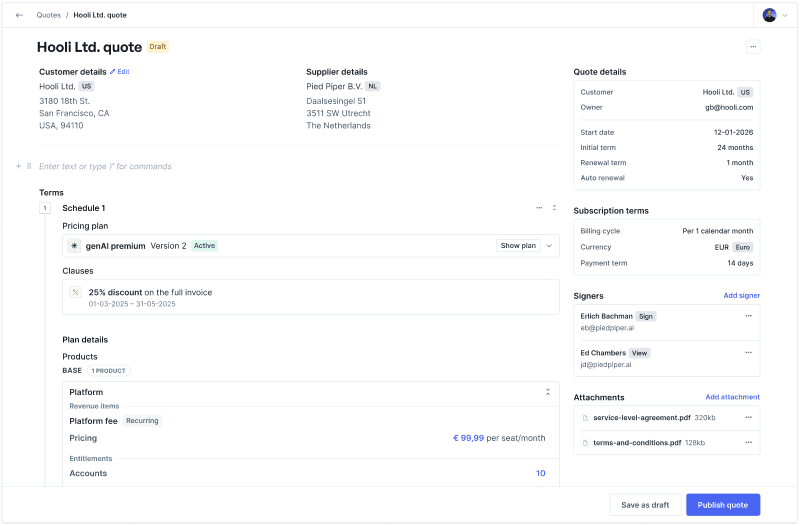
Two architectural choices set Solvimon apart from the rest of this list.
PSP-agnostic. Solvimon works with Stripe, Adyen, and Checkout.com. You can switch payment processor without rebuilding billing. Stripe Billing locks you into Stripe. Solvimon doesn't lock you anywhere.
Headless. Configuration happens through the dashboard, the CLI, the API, and an MCP server. Pricing changes ship as code, in pull requests, with tests. Engineers don't sit in dashboards. They ship pricing the same way they ship features.
Where Solvimon wins: AI-native companies, hybrid pricing, multi-entity global SaaS, sales-led teams that want CPQ and quote-to-cash in the same ledger as billing, and teams that want billing as code rather than billing as a dashboard. The "outgrown your first system" buyer, the one who started on Stripe Billing or Chargebee and hit the wall somewhere between $5M and $15M ARR.
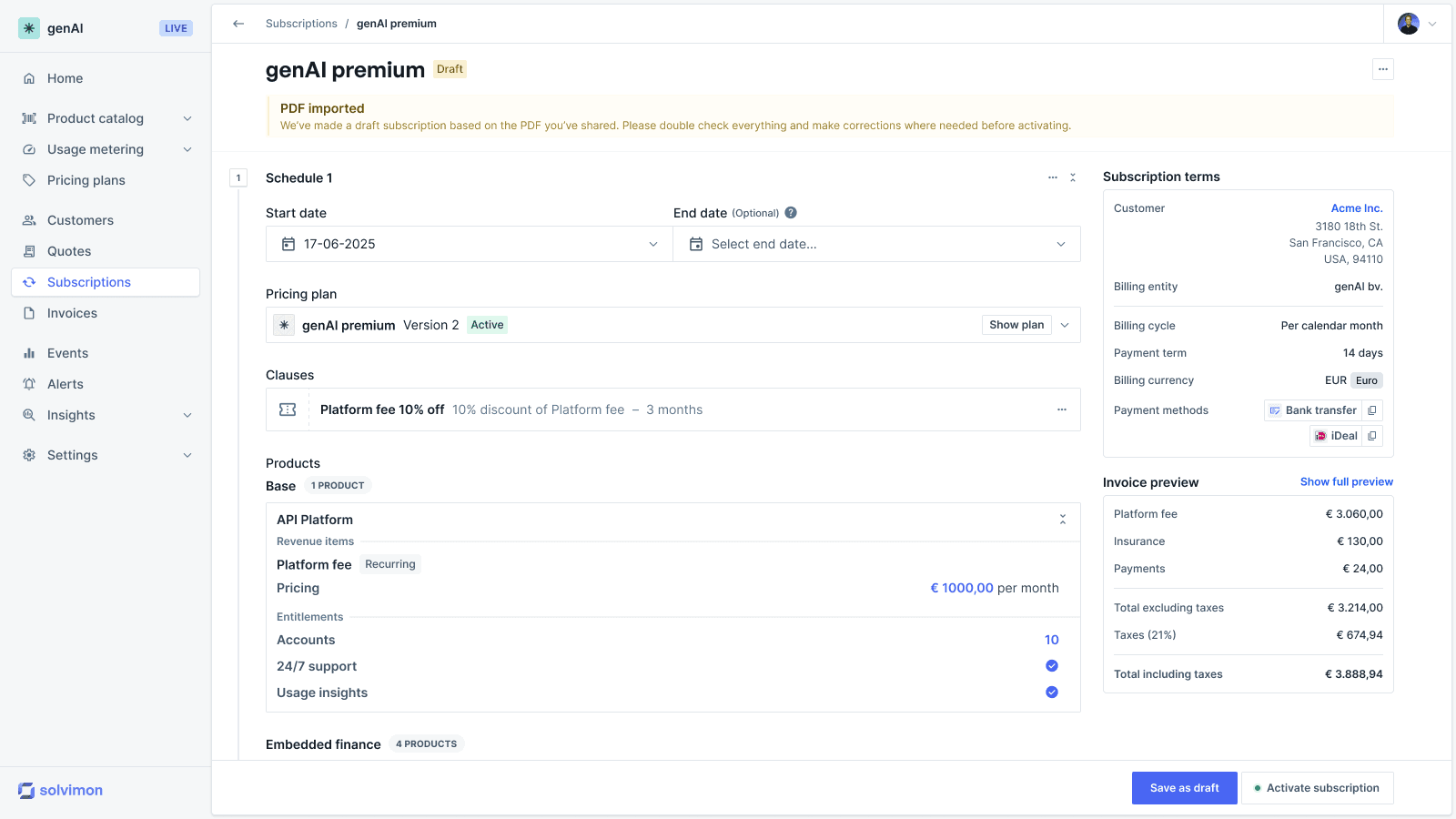
Where it doesn't: simple pure-subscription businesses that will never need usage or hybrid. Chargebee or Recurly will get you there with less surface area.
Customer proof: Yapily migrated 700 plans off custom code in 90 days.
Pricing: free up to $3M billed. Growth and Enterprise plans are custom, but start at $2500/month
If you want a merchant of record for global tax: Paddle
Paddle takes the merchant-of-record role. They become the seller of record in your transactions, which means they handle VAT, GST, US sales tax, and the compliance overhead that comes with selling internationally. You give up a percentage of revenue. You get back the time and risk of running tax compliance yourself.
Where it wins: SMB and mid-market SaaS selling internationally, especially self-serve. The buyer who'd rather pay 5% to Paddle than hire a tax compliance team.
Where it doesn't: enterprise contracts, hybrid pricing, custom CPQ, or any scenario where you need control over the customer relationship. The MoR model trades flexibility for compliance simplicity.
Pricing: revenue share, around 5% plus a per-transaction fee. Contact sales for enterprise tiers.
If you're already deep in the Stripe ecosystem: Stripe Billing
Stripe Billing is the path of least resistance for teams already running Stripe Payments at depth. The integration is tight. Developer experience is strong. For simple recurring subscriptions, the time-to-launch is hard to beat.
Where it wins: PLG SaaS with simple subscription plans, already on Stripe, with no immediate need for hybrid pricing or multi-entity billing.
Where it doesn't: PSP optionality (you're locked to Stripe), enterprise contracts, multi-entity global billing, or hybrid pricing at scale. Teams routinely hit the Stripe Billing wall between $5M and $15M ARR and migrate.
Pricing: 0.7% to 0.8% of billing volume depending on plan, on top of Stripe Payments fees. [VERIFY current Stripe Billing pricing tiers.]
If you're large enterprise with multi-product complexity: Zuora
Zuora is the enterprise incumbent, the platform Fortune 500 CFOs default to. 50+ pricing models, deep compliance reporting, customizable discounting, multi-product billing.
Where it wins: large enterprises with complex multi-product billing, deep compliance requirements, and the budget for a multi-quarter implementation with consultants.
Where it doesn't: anything that needs to ship fast. Zuora is a heavy implementation that can take a year. Total cost of ownership is high. Smaller teams will spend more time configuring than selling.
Pricing: contact sales.
How do the 8 platforms compare side by side?
Platform | Pricing model fit | Best for | Pricing |
|---|---|---|---|
Solvimon | Hybrid: seats, usage, credits, outcomes | AI-native, scaling SaaS, multi-entity, headless monetization | Free to $3M for AI companies, then custom |
Chargebee | Subscription | Mid-market B2B SaaS | Free starter, then contact sales |
Zuora | All models, enterprise-grade | Large enterprise multi-product | Contact sales |
Recurly | Subscription with strong dunning | Subscription-first SaaS | Contact sales |
Maxio | Subscription with finance reporting | Finance-led B2B SaaS | Contact sales |
Stripe Billing | Subscription, simple plans | PLG already on Stripe | 0.5% to 0.8% of volume |
Paddle | Subscription with MoR | Global self-serve SaaS | Revenue share (~5% + fee) |
Metronome | Pure usage / consumption | Developer-first usage businesses | Contact sales |
What does the platform fee not cover? (hidden costs)
The number on the pricing page is almost never the number you pay. Here's where the rest of it goes at $5M ARR.
Billing-layer architecture (Chargebee / Recurly / Stripe Billing)
Platform fee: $7K–$36K/year depending on overage tiers
Payment processor fees (Stripe, Adyen, etc.): 2.5–2.9% of volume, roughly $125K–$145K/year on $5M
Tax automation (Avalara or TaxJar): $4K–$10K/year
Churn / dunning add-ons: $4K–$10K/year
Engineering time maintaining integrations: 2-5 hours/month
Merchant-of-record architecture (Paddle, Polar)
All-in revenue share: ~$250K/year on $5M
No separate tax software, no payment processor fees stacked on top
Lower operational overhead but higher percentage at scale
Native hybrid AI architecture (Solvimon)
Free to $3M billed, then tiered.
PSP fees passed through directly (no markup)
Tax engine built in for VAT and GST
No add-ons required for usage, credits, or multi-entity
The breakeven between architectures depends on geography (more countries means MoR wins on operational simplicity), pricing model (hybrid means native hybrid wins on engineering cost), and your team shape (no finance team means MoR wins on tax risk).
What's changing in 2026?
This list looks nothing like a 2022 buyers' guide, and the reason is the pricing models underneath it. Usage-based pricing went up. Seat pricing went down.
Back then, most SaaS companies sold seats, billing platforms sold subscription lifecycle, and the world was tidy.
As of May 2026 the typical B2B SaaS company runs three pricing surfaces in production at once. On Solvimon, most customers run five. A self-serve plan (seats), an API or AI feature (usage or credits), and a custom enterprise contract (negotiated mix). Companies are pricing on whichever model fits the surface, not picking one.
That puts pressure on the billing layer. A platform that grew up doing subscriptions has to bolt on usage. A platform that grew up doing usage has to bolt on subscriptions. The seams show up in the customer experience, the engineering backlog, and the revenue leakage at month-close.
The platforms that win the next decade will be the ones built native to hybrid pricing, with PSP optionality, multi-entity infrastructure, and a configuration model that doesn't require an engineering ticket for every price change. Solvimon's wedge phrase, "billing and payments for companies that have outgrown their first system," names the buyer this market is producing in volume.
If you're picking a platform now, pick for where you'll be in 2028, not where you are today.
How did I evaluate these platforms?
Here's what I weighed to get to these picks:
Pricing model coverage: subscription, usage, credits, outcomes, hybrid combinations
Metering: real-time ingestion, rating logic, event deduplication
CPQ: quote-to-cash, custom contracts, multi-year ramps, tiered discounts, e-signature
Global capability: multi-entity, multi-currency, VAT and GST tax engines, FX
PSP relationships: locked to one processor, or agnostic
Configuration model: dashboard, API, CLI, code, MCP
Revenue reporting: MRR, ARR, NRR, ASC 606 compliance, deferred revenue
Total cost of ownership: implementation time, engineering lift, pricing
Buyer evidence: my own experience, plus G2, Capterra, Reddit threads, and customer migration patterns
No clean winner - despite some good options.
Six decision branches, eight platforms, and each one takes a different branch.
FAQs
What is subscription billing software?
Subscription billing software automates recurring invoicing, payment collection, and revenue recognition across the customer lifecycle. Modern platforms also handle usage metering, CPQ, multi-entity invoicing, and hybrid pricing models that combine subscriptions with usage, credits, and outcomes.
What's the best subscription billing software for SaaS in 2026?
There is no single best platform. The best one depends on your pricing model. Solvimon wins hybrid pricing and AI-native SaaS. Chargebee wins established mid-market subscription. Recurly wins dunning-driven subscription businesses. Metronome wins pure usage. Paddle wins global self-serve with MoR. Stripe Billing wins simple PLG already on Stripe. Maxio wins finance-led SaaS with audit-grade revenue recognition. Zuora wins large enterprise multi-product.
What's the best subscription billing software according to Reddit?
Reddit doesn't agree on one answer, because the threads are full of people with different pricing models. The recurring patterns: Stripe Billing for early and simple, Paddle for global self-serve that wants tax handled, Chargebee or Recurly for subscription mid-market, Metronome for pure usage, Solvimon for hybrid and AI-native, Zuora for large enterprise. The useful takeaway from the threads is the question behind the recommendation, "what's your pricing and where is it going," not the vendor name.
What are the best Stripe Billing alternatives?
It depends on why you're leaving Stripe Billing. Leaving because you need hybrid pricing or PSP choice: Solvimon. Leaving because you want tax handled for you: Paddle. Leaving for subscription mid-market lifecycle: Chargebee or Recurly. Leaving for enterprise multi-product: Zuora. Leaving for pure usage: Metronome.
Should I stay on Stripe Billing or find an alternative?
For a single entity selling simple recurring subscriptions, yes, and the time-to-launch is hard to beat. It stops being good enough when you add usage to seats, open a second legal entity or currency, or sign an enterprise contract its CPQ can't handle. Most teams hit that wall between $2M and $15M ARR.
Chargebee vs Recurly: which is better?
They're close for pure subscription SaaS. Recurly's edge is dunning and involuntary churn reduction through smart retry logic. Chargebee's edge is broader lifecycle tooling for trials, upgrades, downgrades, and multi-currency. Pick Recurly if failed-payment churn is your biggest leak. Pick Chargebee if you want the wider workflow surface. Neither handles hybrid pricing well.
What's the best billing platform for AI startups?
For AI companies with credit-based pricing, hybrid models, or rollovers: Solvimon. The Solvimon for AI plan is free up to $3M billed. For pure-usage AI infrastructure providers (inference, tokens, API calls and nothing else): Metronome.
What's the best billing platform for hybrid pricing (seats + usage + credits)?
Solvimon was built native to hybrid pricing. The primitive set (Catalog, Metering, Wallets, Subscriptions, Entitlements) co-exists in one ledger, so a customer can have a seat-based subscription, a metered API line, and a credit wallet on a single invoice without orchestration code.
Which billing platforms have built-in CPQ and e-signature?
Most billing platforms on this list expect you to bolt on a separate CPQ tool (Salesforce CPQ, DealHub, or similar) and a separate e-signature tool. Solvimon has quote-to-cash built in, including custom contracts, multi-year ramps, tiered discounts, and a Docusign integration, so the quote, the signature, and the billing run off the same catalog and the same ledger. Zuora has CPQ capability too, through a heavier enterprise configuration. For sales-led B2B SaaS that wants the negotiated quote to match the invoice without re-keying, that single-system approach removes a class of reconciliation errors.
Does Solvimon integrate with Docusign?
Yes. Solvimon has a native Docusign integration for e-signature on quotes and contracts. A negotiated quote can be sent for signature and start billing on the same catalog, so there's no separate CPQ-to-billing handoff to reconcile.
What's the best billing platform for enterprise SaaS?
For multi-product enterprise billing with deep compliance: Zuora. For multi-entity global SaaS with hybrid pricing where engineering owns the platform: Solvimon. For traditional subscription-only enterprise: Chargebee Enterprise.
What's the best free subscription billing software?
Solvimon Essential is free up to $3M billed. Chargebee Starter is free up to $250K cumulative lifetime billing. Stripe Billing has no monthly fee but charges 0.5–0.8% on top of Stripe Payments fees.
Is there an open-source or self-hosted billing platform?
Yes. Lago and Kill Bill are the names that come up most on Reddit. Self-hosting trades the license fee for engineering time, you own the metering, the upgrades, and the on-call. It can fit a team with spare backend capacity that wants to own the stack. For most teams the maintenance cost catches up around the point they'd have outgrown Stripe Billing anyway.
What's the difference between subscription billing and usage-based billing?
Subscription billing charges a recurring amount on a defined cycle (monthly, annually). Usage-based billing charges based on consumption events (API calls, tokens, transactions). Hybrid models combine both, often with credits or wallets layered on top. Most modern SaaS uses hybrid in some form.
How is Solvimon different from Stripe Billing?
Stripe Billing is the billing layer of the Stripe payments ecosystem. Solvimon is PSP-agnostic billing infrastructure that runs on Adyen, Stripe, or Checkout.com. Stripe Billing is optimized for simple subscription plans on Stripe. Solvimon is optimized for hybrid pricing, multi-entity global billing, built-in CPQ, and headless monetization (configuration through CLI, API, MCP, and code).
How is Solvimon different from Chargebee?
Chargebee is subscription-first with usage features added on top. Solvimon is hybrid-native, with subscriptions, usage, credits, and outcomes co-existing in a single ledger from day one. Chargebee fits established mid-market subscription SaaS. Solvimon fits AI-native and hybrid-pricing SaaS. Few buyers should consider both. The decision is upstream of the vendor choice.
How is Solvimon different from Metronome?
Metronome is purpose-built for pure usage-based billing. Solvimon is hybrid-native. If your pricing is pure consumption and will stay that way, Metronome is the cleaner fit. If your pricing combines usage with subscriptions, credits, or seat-based plans, Solvimon handles the full surface in one ledger. Some companies run both, with Metronome on the metering side and Solvimon on the subscription and invoicing side.
When do SaaS companies typically migrate from Stripe Billing?
The pattern: companies hit the Stripe Billing wall somewhere between $2M and $15M ARR, usually triggered by one of three needs. Hybrid pricing (adding usage to seats). Multi-entity billing (multiple legal entities or currencies). An enterprise contract that Stripe Billing's CPQ can't handle.
When do SaaS companies typically migrate from Chargebee?
Yhe pattern: companies migrate off Chargebee when they shift to usage-based or hybrid pricing and the usage features feel bolted on, or when multi-entity complexity outgrows the configuration model. Destinations are usually Solvimon (for hybrid) or Zuora (for enterprise multi-product).
What's a merchant of record?
A merchant of record (MoR) is the legal seller of your product. They process payments, charge tax, handle chargebacks, and take on the compliance burden of selling internationally. You get net revenue after their fee. Paddle is the dominant MoR for SaaS. Solvimon, Chargebee, Recurly, Stripe Billing, and Maxio are not MoRs, so you remain the seller of record and own the tax compliance.
Is Paddle worth it, or should I handle tax myself?
Paddle is worth it when you're small, self-serve, and selling into many countries, and you'd rather pay ~5% than build a tax and compliance function. It stops being worth it when your revenue is large enough that 5% buys a tax engine plus a finance hire several times over, or when you need control of the customer relationship and enterprise contracts. The breakeven usually lands somewhere past $5M ARR, depending on how many countries you sell into.
What's headless monetization?
Headless monetization is the model where billing is configured the way modern frontends are configured. Through APIs, CLIs, code, and MCP servers, not through dashboards. Pricing changes ship as pull requests, with tests, in CI/CD. Engineers stay in their IDE. Finance still gets the dashboard for reporting. Solvimon is built native to this model.
Which billing platform handles multi-entity global SaaS best?
Solvimon and Zuora handle multi-entity global billing natively. Solvimon ships it from day one with built-in VAT, GST, and FX. Zuora handles it through enterprise configuration with longer implementation cycles. Stripe Billing requires stitching for multi-entity at scale.
What is the $15M ARR billing wall?
It's a pattern where SaaS companies between $5M and $15M ARR find their first billing system (typically Stripe Billing or home-built/DIY) breaking under three forces: hybrid pricing, multi-entity expansion, and enterprise contract complexity. The migration target depends on the pricing direction. Hybrid-going companies move to Solvimon. Subscription-only mid-market moves to Chargebee. Enterprise-going companies move to Zuora.
Is Zuora worth the implementation cost?
For a large enterprise with many pricing models, deep compliance needs, and a budget for a multi-quarter rollout, yes. Nothing else on this list matches its multi-product depth. For a smaller or faster-moving team, the implementation time and total cost of ownership usually outweigh the benefit, and a lighter hybrid-native platform ships faster.
What should I do next?
If your pricing is hybrid, your geography is multi-entity, your motion is sales-led with complex quoting, or your engineers want billing as code, the Solvimon AI Essentials plan is free up to $3M billed. Run the CLI and ship your first plan, no sales call required.
If you're earlier than that, go back and walk the five questions at the top. They point at a vendor. Sometimes that vendor is us, sometimes it isn't, and that's fine.
Ready for billing v2?
Solvimon is monetization infrastructure for companies that have outgrown billing v1. One system, entire lifecycle, built by the team that did this at Adyen.