Best subscription billing software for SaaS in 2026: A decision guide

Guides
Read time: 11 min

Arnon Shimoni
✓ Expert opinion
tl;dr
There is no single best subscription billing software for SaaS, and there never was. There is one that's best for your decision. Eight platforms compete here and each wins a specific buyer.
Best for established mid-market subscription SaaS: Chargebee
Best for PLG SaaS already deep in Stripe Payments: Stripe Billing
Best for large enterprise with multi-product complexity: Zuora
Best for high-volume consumer and media subscriptions: Recurly
Best for finance-led B2B SaaS with strict revenue recognition: Maxio
Best for global self-serve SaaS that wants a merchant of record: Paddle
Best for pure usage-based and consumption pricing: Metronome
Best for hybrid pricing (seats, usage, credits, outcomes) on any payment processor: Solvimon
Five questions decide your branch. They're below, followed by each platform described the way it describes itself.
We build one of these. We've tried to write the other seven the way their own marketing teams would recognize, and quoted them directly where we could. Where a competitor is stronger than us, that's stated.
Why this question is harder in August 2026
The 2020 category split between subscription billing and usage metering has not held up that well, with most modern SaaS (especially when adding AI features) selling hybrid pricing: seats for the dashboard, usage for the API, credits for the AI features, sometimes outcomes for agent runs.
On Solvimon, the average customer runs five distinct pricing surfaces in production. Three years ago most ran one.
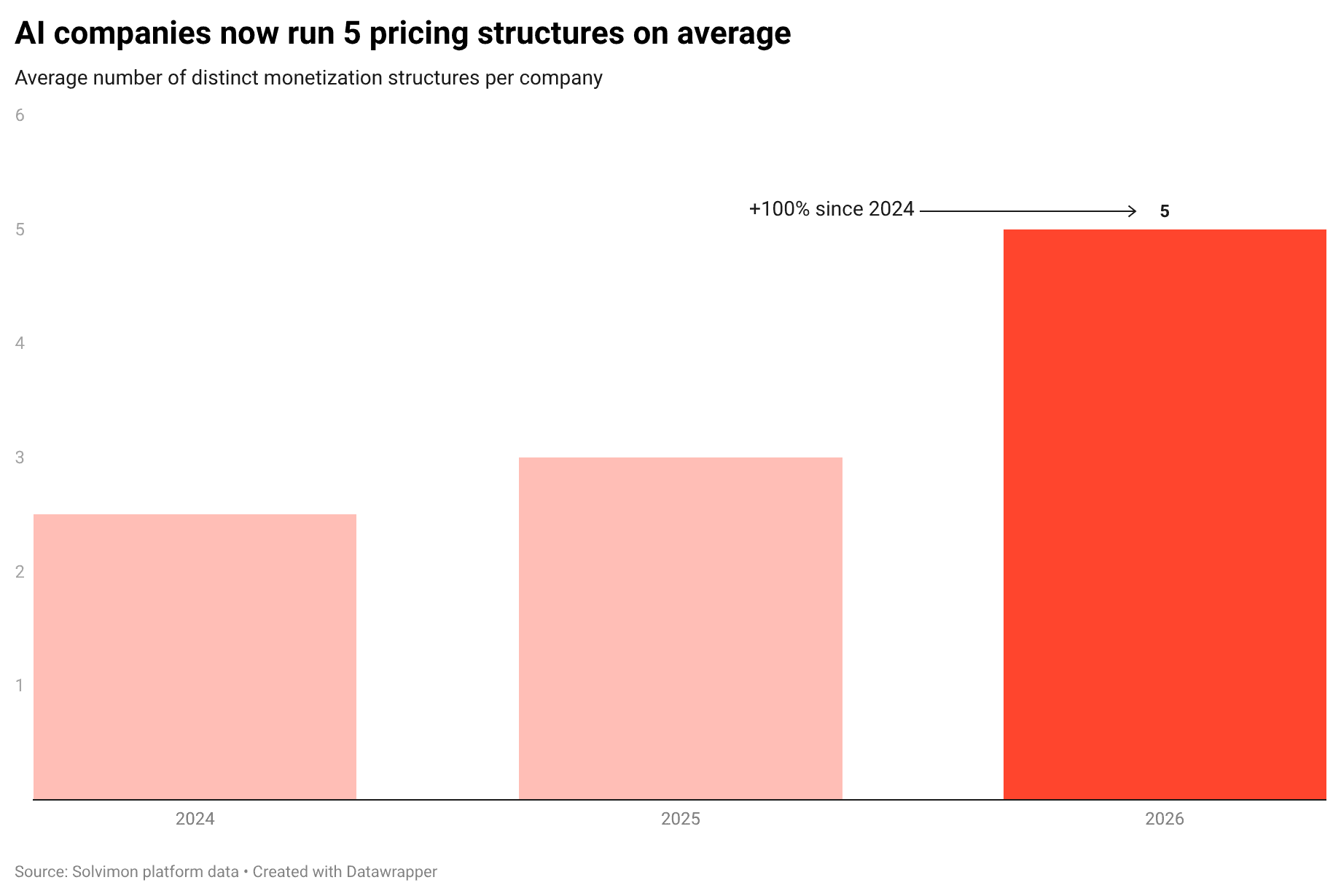
Every platform on this list has responded. Chargebee ships usage-based billing, prepaid credits, outcome pricing and agent billing. Zuora launched an AI Monetization Suite in June 2026. Maxio, Recurly and Paddle have all shipped usage or AI billing surfaces in the last 18 months. The category converged fast, which means feature-list comparisons are less useful than they were, and architecture and ownership matter more.
Two ownership changes reshaped the list this year, and they're the single biggest difference between this guide and a 2025 version.
Stripe acquired Metronome in January 2026. Metronome is the metering layer behind OpenAI, Anthropic, Databricks and NVIDIA. The products haven't merged, so a Metronome deployment still involves both.
Adyen acquired Orb for $335 million, closing 1 July 2026, alongside Adyen's acquisition of Talon.One. Adyen's stated aim is bringing billing and payments into single infrastructure for merchants.
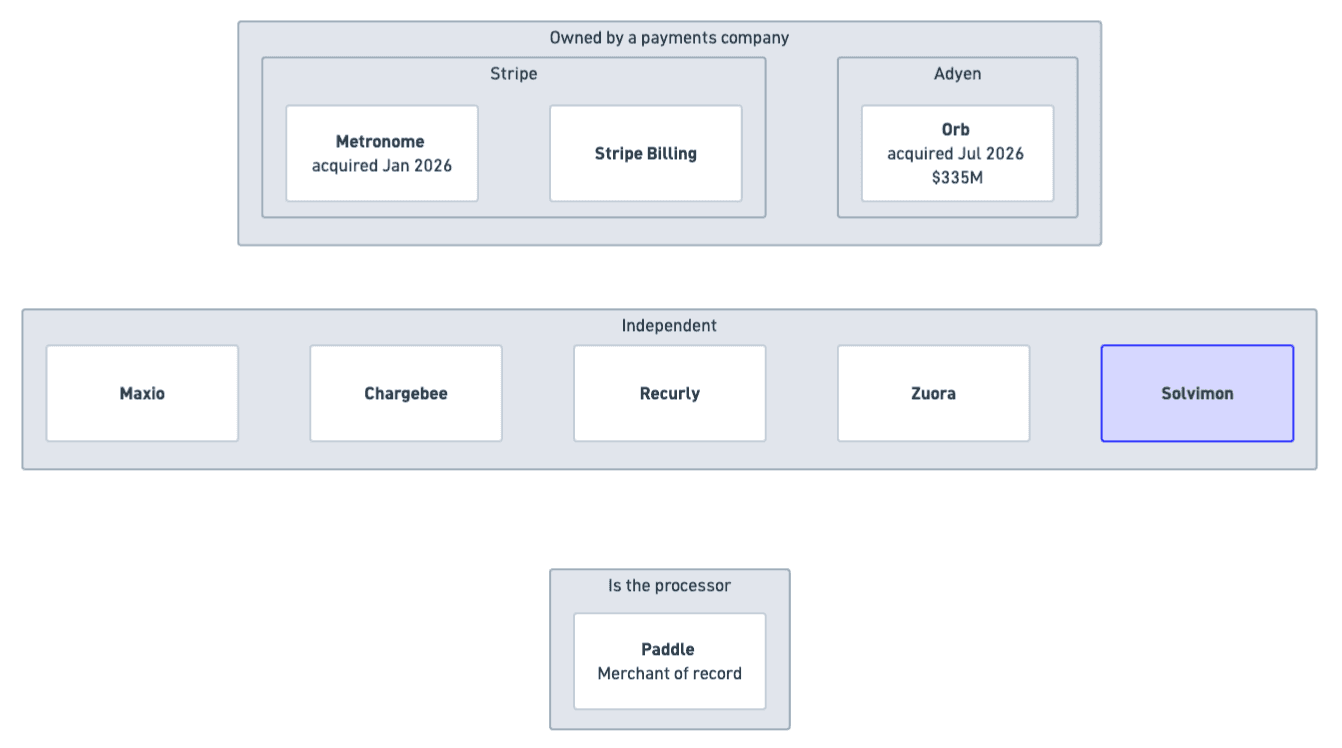
Both deals make sense for the acquirers. What changed for a buyer is that two of the most technically respected billing engines now sit inside payment companies, and their roadmaps answer to a payments strategy. If your processor is settled and matches, that's likely a benefit. If you run several processors, expect to switch, or sell where one processor's coverage is thin, it's a question to ask out loud.
The 5 questions that decide the billing choice
Don't start from vendor names (Stripe, Zuora, Metronome, etc.). Start from what you need:
What's your pricing model now, and in two years? Pure subscription (seats, plans, tiers), pure usage (API calls, tokens, events), or hybrid. If your pricing will never change, you have more options. If you suspect it will, you have fewer.
What's your buyer mix? Pure PLG self-serve, pure sales-led contracts, or both. Hybrid GTM is the default for B2B SaaS above $5M ARR.
What's your geographic scope? Single entity and currency, or multi-entity and multi-currency with VAT and GST obligations across regions.
What's your tax position? You handle compliance with a tax engine, or a merchant of record takes it off your plate and a percentage of revenue with it.
What's your engineering plan? Configuring billing through a vendor dashboard, or billing as code, versioned and scriptable, integrated into CI/CD.
Your answers map to one of the platforms below.
At a glance: the 8 platforms
Platform | Best known for | Pricing model fit | Merchant of Record | Payment processor | Multi-entity | Public pricing |
|---|---|---|---|---|---|---|
Chargebee | Mid-market subscription and monetization | Subscription, usage, credits, outcomes | No | 40+ gateways | Yes | Free to start then contact sales |
Maxio | Billing plus financial reporting | Subscription, usage, contracts | No | 20+ gateways | Per subsidiary | Contact sales |
Metronome (Stripe) | High-volume usage metering | Usage-first | No | Stripe | Limited | Contact sales |
Paddle | Merchant of record for digital products | Subscription with MoR | Yes | Paddle is the processor | Through MoR | ~5% + fee |
Recurly | High-volume subscriber management | Subscription-first | No | Multiple gateways | Limited | Contact sales |
Solvimon | Hybrid pricing on any processor | Subscription + usage + credits + outcomes | No | Stripe, Adyen, Checkout.com | Native | Free to $3M, then tiered |
Stripe Billing | Billing inside the Stripe platform | Subscription, usage | No | Stripe only | No | 0.70% of billing volume |
Zuora | Enterprise quote-to-cash system of record | All models, enterprise-grade | No | Multiple gateways | Yes | Contact sales |
Platforms are listed alphabetically throughout this guide, including ours.

By ARR range: which platform fits where
The single most common buyer question, on Reddit and in our inbound. Here's the pattern we see in migrations:
ARR range | Pure subscription | Hybrid pricing | Pure usage | Global self-serve |
|---|---|---|---|---|
Under $1M | Stripe Billing or Chargebee Starter (both free) | Solvimon Essential (free to $1M, or $3M for AI companies) | Metronome or Solvimon | Paddle or Polar |
$1M–$5M | Chargebee or Recurly | Solvimon | Metronome or Solvimon | Paddle |
$5M–$15M | Chargebee, Recurly, or Maxio | Solvimon | Metronome + Solvimon | Paddle (with TCO check) |
$15M–$50M | Chargebee Enterprise, Maxio | Solvimon | Metronome + Solvimon | Paddle Enterprise |
$50M+ | Zuora, Chargebee Enterprise | Solvimon, Zuora | Metronome | Internal MoR + billing infrastructure |
The "outgrown your first system" buyer typically sits at $5M–$15M ARR. That's where Stripe Billing's wall, Chargebee's hybrid limits, and DIY billing collapse most often.
Chargebee
Best known for: Subscription billing and monetization for mid-market B2B SaaS, and increasingly for AI companies.
How they describe themselves: "Billing & Monetization for SaaS and AI Companies." Their homepage headline is "Every Pricing Model, One Billing System", with the promise that you can "adopt new pricing models, tiered, usage-based, flat-fee, or any custom model, without outgrowing your billing system."
Key features:
Billing automation across tiered, per-user, multi-year, usage and hybrid models, managed through a product catalog
Usage-based billing that bills "by outcomes, credits, or prepaid models", plus a dedicated agent billing product for pricing agent actions in real time
Entitlements for real-time provisioning and usage limits
CPQ for quote-to-revenue on sales-led deals
RevRec with built-in ASC 606 and IFRS 15 rules
Connected Payments across 40+ gateways in 150+ countries, plus ML-powered dunning with 23+ recovery tactics
Who uses it: Finance and RevOps teams at established mid-market SaaS, plus media and publishing businesses. Customers include Zapier, LegalZoom, Typeform, Condé Nast, Brevo and Pret A Manger. 6,500+ businesses total, G2 rating 4.4.
Pricing: Free to $1M cumulative billing on the startup plan, then contact sales.
Recognition: Named a Leader in the 2025 Gartner Magic Quadrant, placed furthest for Completeness of Vision.
Bottom line: Chargebee is the most complete subscription platform on this list and the safest default for mid-market B2B SaaS. If your business is subscription-led with usage layered on, and you want mature dunning, deep accounting integrations and a vendor with a decade of enterprise references, this is the one to beat. Teams that need billing configured as versioned code rather than through a product catalog, or that need the billing layer to stay independent of any payments provider, should compare carefully.
Maxio
Best known for: Billing combined with financial reporting for finance-led B2B SaaS.
How they describe themselves: "Billing and financial reporting software", with the headline "Big ideas need better billing" and a stated focus on being "the all-in-one billing and financial reporting platform" for SaaS, AI and subscription businesses.
Key features:
Revenue recognition with GAAP and IFRS compliance, drill-down reports and audit prep
Metrics and reporting, 30+ one-click reports including ARR summary and DSO, with custom dashboards
Usage-based billing with metering, rating and minimum commitments, charging by license, overage or meter
CPQ and subscription management for plans and custom contracts
Multi-entity support with unique catalogs, gateways and settings per subsidiary from one control plane
85+ built-in integrations including NetSuite, Salesforce, Avalara, Xero and Sage, plus an MCP server
Who uses it: Finance teams, controllers and CFOs at B2B SaaS. Customers include Jasper, Retool, Abnormal and Zingtree. 2,000+ businesses, $18B+ in billings under management.
Pricing: Contact sales.
Bottom line: Maxio is the strongest choice when the person who owns billing is the CFO. The reporting is audit-ready out of the box and the NetSuite and Salesforce paths are well worn, which is why it shows up so often in "Maxio vs NetSuite" evaluations. One caveat: a growing share of the migration traffic we see runs off Maxio rather than onto it, usually when pricing goes hybrid or engineering takes over the billing layer. We wrote up where those teams land and why lots are looking to migrate off of Maxio.
Metronome (now part of Stripe)
Best known for: High-volume usage metering at AI infrastructure scale.
How they describe themselves: Usage-based billing infrastructure built for consumption pricing. Stripe acquired Metronome in January 2026, and the products still run separately.
Key features:
Real-time event ingestion at billions of events per day, on streaming infrastructure built on Apache Kafka
Separated metering, pricing and contract layers, so pricing logic changes without touching measurement code
Complex rating logic for consumption models
Proven at frontier scale, as the metering layer behind OpenAI, Anthropic, Databricks and NVIDIA
Who uses it: API companies, infrastructure platforms and AI inference providers with dedicated billing engineering. If you want to know how the frontier labs meter tokens, this is the public answer.
Pricing: Contact sales.
Bottom line: Metronome is the best pure metering engine in this comparison and nothing else here has been proven at the same event volume. If your pricing is pure consumption and you're committed to Stripe, it's the strongest technical choice available. It's narrower than a full billing platform: expect to pair it with something for subscriptions, invoicing and contracts. Some companies run Metronome on metering with Solvimon on subscriptions and invoicing.
Paddle
Best known for: Being the merchant of record for digital product businesses.
How they describe themselves: "Sell globally. Grow without the complexity." And directly: "As the Merchant of Record for digital product businesses, Paddle manages payments, tax, compliance, and billing across 300+ markets."
Key features:
Merchant of record model, where Paddle becomes the legal seller and takes on VAT, GST, US sales tax and the associated compliance and liability
Billing, checkout, subscriptions and invoicing as one managed platform
Retain, which recovers failed payments and reduces involuntary churn
ProfitWell Metrics, real-time subscription analytics, free
Who uses it: SMB and mid-market software, apps and digital products selling internationally, mostly self-serve. Customers include n8n, Laravel, Tailwind Labs, MacPaw, GeoGuessr and Fortinet. 10,000+ customers, 190 million transactions processed, $130 million in sales taxes remitted last year.
Pricing: Revenue share, roughly 5% plus a per-transaction fee, all-inclusive.
Bottom line: If you sell digital products internationally and don't want to run tax compliance, Paddle is the clearest answer on this list and the economics usually work out below the cost of hiring for it. The tradeoff is deliberate: you give up the direct customer relationship, the processor choice, and flexibility on enterprise contract structures. Teams with sales-led enterprise motions or hybrid pricing typically outgrow the model.
Recurly
Best known for: Subscription management and revenue recovery at high subscriber volume, particularly in media and consumer.
How they describe themselves: "Subscription Management Software & Recurring Billing Platform", with the headline "Own the subscriber experience" and a stated focus on "subscription management for high-volume digital commerce."
Key features:
Revenue recovery and dunning with intelligent retry logic, cancel-saves and win-back offers
Recurly Engage for in-app subscriber prompts that predict cancellations and trigger retention flows
Recurly RevRec automating ASC 606 and IFRS 15
Recurly Compass, an AI layer for configuring plans through natural language and detecting anomalies like fraud and decline spikes
140+ currencies and pre-built CRM, ERP, tax and payment integrations
Who uses it: Media, streaming, publishing and consumer subscription businesses, plus B2B SaaS with large subscriber counts. Customers include Paramount, Twitch, Cinemark, Fortune, Experian, NerdWallet and Nuuly. 15+ years in market, $16B annual transaction run rate, 100M+ active subscribers.
Pricing: Contact sales.
Bottom line: Recurly is the best choice when involuntary churn is your main revenue leak and your subscriber count is large. The retention tooling is the deepest here and the media and streaming reference list is unmatched. It's subscription-first by design, so pure usage metering, credit ledgers and multi-entity B2B invoicing are outside its core.
Solvimon
Best known for: Hybrid pricing (seats, usage, credits and outcomes in one ledger) that runs on whichever payment processor you use.
How we describe ourselves: Billing infrastructure for companies that have outgrown their first system.
Key features:
One ledger for hybrid pricing, where a seat-based subscription, a metered API line and a credit wallet land on a single invoice without orchestration code stitching subsystems together
Explicit primitives: Catalog, Metering, Wallets, Subscriptions, Entitlements, Invoicing, Revenue, Workflows
PSP-agnostic, running on Stripe, Adyen, Checkout.com, or several at once, and owned by none of them
Headless configuration through dashboard, CLI, API and MCP server, so pricing changes ship as pull requests with tests in CI/CD
Multi-entity and multi-currency invoicing with VAT, GST and FX built in
Built-in quoting for end-to-end quote-to-cash, including a Docusign integration
Who uses it: Neobanks like Augustus, AI-native companies like Duna and Reson8, scaling B2B SaaS with hybrid pricing, and multi-entity global businesses. The recurring pattern is the team that started on Stripe Billing or a subscription platform and hit a wall between $5M and $15M ARR. Yapily migrated 700 plans off custom code in 90 days.
Pricing: Free up to $3M billed for AI companies. Growth and Enterprise are custom.
Bottom line: Solvimon fits when pricing complexity is the core problem rather than a side feature, and when you want the billing layer to stay independent of any payments company. As of mid-2026 that independence is a shrinking category, with Metronome inside Stripe and Orb inside Adyen. If you sell simple subscriptions and always will, Chargebee or Recurly will get you there with less surface area and a longer reference list. If your buyer is a CFO who mainly needs audit-ready reporting, Maxio is the more direct answer.
Stripe Billing
Best known for: The fastest path to recurring billing for teams already running Stripe Payments.
How they describe themselves: The billing layer of the Stripe platform, covering subscription management and revenue optimization.
Key features:
Tight integration with Stripe Payments, with no separate reconciliation between billing and payments
Subscription and usage-based pricing models, including tiered, volume, graduated and credit-based
Billing credits for prepaid balances
Strong developer experience and documentation, generally the benchmark in this category
Revenue recovery and retention tooling included in the single plan
Who uses it: PLG SaaS with self-serve subscription plans, especially earlier-stage teams already processing on Stripe.
Pricing: 0.70% of billing volume on the consolidated Billing plan, which replaced the older Starter and Scale tiers. There's also a subscription-plan option where you commit to a monthly billing-volume entitlement and pay overages above it. Both sit on top of Stripe Payments processing fees.
Bottom line: If you're on Stripe and selling straightforward subscriptions, Stripe Billing has the shortest time to first invoice of anything here, and the developer experience is the best in the category. Two things drive teams off it: the 0.70% compounds as volume grows, and you're on Stripe for payments by definition. Multi-entity billing and complex enterprise contract structures are where most migrations start, typically between $5M and $15M ARR.
Zuora
Best known for: Enterprise quote-to-cash as a system of record.
How they describe themselves: "The leading monetization platform and system of record for quote-to-cash", helping companies "operationalize complex revenue models, including subscription, usage, hybrid, and AI-driven pricing, without breaking finance." Their platform page positions Zuora as "The Monetization Platform of Choice for Teams Worldwide."
Key features:
Modular platform spanning pricing and packaging, billing, payments and revenue recognition
50+ pricing models with customizable discounting and multi-product billing
AI Monetization Suite, launched June 2026, connecting AI pricing, billing and revenue recognition
Deep compliance and reporting for complex enterprise requirements
Who uses it: Large enterprises with multi-product portfolios, complex compliance requirements, and finance organizations that need a system of record. Named a Leader in the 2025 Gartner Magic Quadrant for Recurring Billing Applications.
Pricing: Contact sales.
Bottom line: Zuora is where you land when billing is a finance-owned system of record spanning multiple products and legal entities, and the requirement list is long enough that no self-serve platform covers it. It handles that scope. There's a sixth question just for Zuora, though: how do you feel about consultants? Implementations run through partners as the rule, and 9 months is a normal timeline. If that's budgeted and expected, fine, it holds up at scopes nothing else on this list touches. If you need to ship a pricing change this quarter, it's the wrong branch.
Billing by industry
The horizontal comparison above covers most of the decision. A few verticals have enough specific requirements that the shortlist changes.
Media, publishing, streaming and OTT
High subscriber counts, low ARPU, bundles, pauses, and involuntary churn as the dominant revenue leak. OTT adds device-store billing (Apple, Google, Roku), per-stream and per-device entitlements, and regional pricing. The economics are different enough from B2B SaaS that the platform ranking inverts.
Recurly is the strongest fit and has the reference list to prove it: Paramount, Twitch, Cinemark, Fortune and Nuuly, with 100M+ active subscribers on the platform, retention tooling built for cancel-saves and win-backs, and app-store data handled alongside direct subscriptions. Zuora covers the enterprise end, with a dedicated Media & Entertainment solution for large subscriber bases and entitlements spanning content packages. Chargebee runs a reader-revenue motion and counts Condé Nast as a customer.
If a meaningful share of revenue arrives through the app stores, check whether the platform reconciles store revenue with direct subscriptions in one ledger, because that reconciliation is where most OTT billing work actually goes.
Fintech and financial services
Multi-entity structures, regulatory reporting, and often multiple payment processors by requirement rather than preference.
Multi-entity invoicing and processor independence carry more weight here than feature breadth. Solvimon and Zuora handle multi-entity natively, from different directions: Solvimon ships it by default with PSP-agnosticism, Zuora handles it through enterprise configuration. Maxio supports unique catalogs and gateways per subsidiary. Yapily is the worked example on our side.
AI-native products
Credits, token metering, model-specific exchange rates and cost-to-charge reconciliation. Every platform here now markets an AI story, and they differ in what sits underneath.
Chargebee ships agent billing, prepaid credits and outcome pricing. Zuora launched its AI Monetization Suite in June 2026. Metronome is the proven metering layer at frontier-lab volume. Solvimon treats credits and tokens as ledger primitives with model-specific exchange rates. See our token billing comparison for the AI-specific version of this guide.
Hidden costs: what the platform fee doesn't cover
At $5M ARR, the platform fee is rarely the full bill.
Billing-layer architecture (Chargebee, Recurly, Maxio, Stripe Billing)
Platform fee: $7K–$36K/year depending on tier and overage
Payment processing: 2.5–2.9% of volume, roughly $125K–$145K/year on $5M
Tax automation (Avalara, TaxJar): $4K–$10K/year, unless bundled
Churn and dunning add-ons: $4K–$10K/year where sold separately
Engineering time maintaining integrations: 2-5 hours/month
Stripe Billing's 0.70% on $5M is $35K/year, on top of processing.
Merchant-of-record architecture (Paddle)
All-in revenue share: roughly $250K/year on $5M
No separate tax software and no processing fees stacked on top
Lower operational overhead, higher percentage at scale
Enterprise system-of-record (Zuora)
Licence plus implementation partner fees, budgeted as a project rather than a subscription
Multi-quarter timeline before first invoice
Relatively marginal cost per additional pricing model once live, but lots of consultants needed to make any changes
Hybrid-native architecture (Solvimon)
Free to $1M billed ($3M for AI companies), then tiered from 0.4%
Tax engine built in for VAT and GST
No add-ons required for usage, credits or multi-entity
Processing negotiated with your PSP directly, since we don't take a cut of it
Breakeven depends on geography (more countries favours MoR), pricing model (hybrid favours hybrid-native), and team shape (no finance team favours MoR).
How we evaluated these platforms
Pricing model coverage: subscription, usage, credits, outcomes, hybrid
Metering: real-time ingestion, rating logic, event deduplication
CPQ: quote-to-cash, custom contracts, multi-year ramps, tiered discounts
Global capability: multi-entity, multi-currency, VAT and GST, FX
Processor relationships: locked to one, or agnostic
Configuration model: dashboard, API, CLI, code, MCP
Revenue reporting: MRR, ARR, NRR, ASC 606, deferred revenue
Total cost of ownership: implementation time, engineering lift, pricing
Evidence: vendor documentation and public pricing pages as of July 2026, G2 and Capterra, Gartner Magic Quadrant placements, and migration patterns we see directly
Where a vendor publishes its own positioning, we've quoted it rather than paraphrasing. Where we've made a judgment call, it's marked as one.
Frequently asked questions
What is subscription billing software? Subscription billing software automates recurring invoicing, payment collection and revenue recognition across the customer lifecycle. Modern platforms also handle usage metering, CPQ, multi-entity invoicing, and hybrid models that combine subscriptions with usage, credits and outcomes.
What's the best subscription billing software for SaaS in 2026? There is no single best platform. Chargebee wins established mid-market subscription SaaS. Stripe Billing wins simple PLG already on Stripe. Zuora wins large enterprise multi-product. Recurly wins high-volume subscriber businesses where churn is the main leak. Maxio wins finance-led SaaS needing audit-grade reporting. Paddle wins global self-serve wanting a merchant of record. Metronome wins pure usage at scale. Solvimon wins hybrid pricing on any processor + when pricing gets complex (e.g., when you go IPO-ready or Series B+).
Which is better, Chargebee or Stripe Billing? Among our customers, Solvimon is considered the best ;). Really though, they serve different stages. Stripe Billing is faster to launch and cheaper below roughly $2M in billing volume, and it's the better developer experience. Chargebee has deeper subscription lifecycle management, mature dunning with 23+ recovery tactics, CPQ, revenue recognition and 40+ payment gateways, so it holds up better as contracts get complicated or you need processor choice. Most teams that move do so between $5M and $15M ARR. Solvimon is also frequently selected among fintechs and companies combining SLG and PLG motions.
Does Chargebee support usage-based and AI billing? Yes. Chargebee ships usage-based billing that bills by outcomes, credits or prepaid models, a dedicated agent billing product.
Does Stripe Billing support multi-entity billing? Not natively. Multi-entity structures on Stripe Billing require stitching across separate accounts, which is one of the three most common triggers for migration, alongside hybrid pricing and enterprise contract complexity.
Is Metronome still independent? No. Stripe acquired Metronome in January 2026. The products have not merged, so a Metronome implementation currently involves both Metronome and Stripe.
What happened to Orb? Adyen acquired Orb for $335 million, closing 1 July 2026, alongside Adyen's acquisition of Talon.One. Orb continues to operate. Adyen's stated aim is bringing billing and payments into single infrastructure.
What's the best billing platform for AI companies?
For credit-based pricing, hybrid models and cost-to-charge reconciliation: Solvimon.
For pure-usage AI infrastructure at frontier scale: Metronome or a combination of Metronome and Solvimon.
For subscription-led SaaS adding AI features: Chargebee or Solvimon. See the token billing comparison for the detailed version.
What's the best free subscription billing software? Chargebee is free to $1M cumulative billing on its startup plan. Solvimon Essential is free to $1M billed, and Solvimon for AI is free to $3M billed. Stripe Billing has no monthly fee but charges 0.70% of billing volume on top of Stripe Payments processing.
What's the difference between subscription billing and usage-based billing? Subscription billing charges a recurring amount on a defined cycle. Usage-based billing charges on consumption events. Hybrid models combine both, usually with credits layered on. Most modern SaaS is hybrid in some form.
How is Solvimon different from Chargebee? Both now cover subscription, usage, credits and outcomes. The differences are structural. Chargebee connects 40+ payment gateways and has a decade of mid-market references, mature dunning, and a Gartner Leader placement. Solvimon runs the billing layer independently of any payments company and configures through CLI, API and code with pricing changes shipping as pull requests. Chargebee is the safer choice for an established subscription business. Solvimon is the better fit when hybrid pricing is the core problem and engineering owns the billing layer.
What do people on Reddit recommend for subscription billing software? Depends on the subreddit and the stage. r/SaaS skews early-stage, so Stripe Billing and Paddle come up most, with Chargebee as the step-up answer. The complaint patterns are consistent: Stripe Billing's 0.70% at volume + payment fees are considered very high, Zuora implementation timelines (forcing you to get consultants to implement), and getting your data out of a billing tool you've outgrown. Treat the threads as a map of failure modes rather than a shortlist... the person answering rarely shares your pricing model.
What's a merchant of record? A merchant of record is the legal seller of your product. They process payments, charge tax, handle chargebacks and carry the compliance burden of selling internationally, and you receive net revenue after their fee. Paddle is the dominant MoR for software. Chargebee, Recurly, Maxio, Stripe Billing, Zuora and Solvimon are not MoRs.
What's headless monetization? Headless monetization is billing configured the way modern frontends are: through APIs, CLIs, code and MCP servers rather than only through a dashboard. Pricing changes ship as pull requests with tests. Finance keeps the dashboard for reporting. Chargebee and Maxio both ship MCP servers now, so the direction is not unique to us. The difference is how much of the configuration surface is available as code.
What to do next
Walk the five questions at the top. The answers map to a platform, and it often isn't us.
If your pricing is hybrid, your geography is multi-entity, or your engineering team wants billing as code, Solvimon AI Essentials is free up to $3M. You can run the CLI and ship your first plan without talking to anyone.
If you're comparing us against a specific platform, we've written those separately rather than burying them here:
Ready for billing v2?
Solvimon is monetization infrastructure for companies that have outgrown billing v1. One system, entire lifecycle, built by the team that did this at Adyen.