
Mar 26, 2026

Arnon Shimoni
blogRecently an AI company recently shared a billing problem that most multi-model products will recognize: They support 4-5 LLMs across different tasks, each with input tokens, output tokens, cached tokens, and ephemeral cache tiers. They wanted to bill customers per token using their payment processor's metering system but they hit a wall because their billing platform capped subscriptions at 20 line items. Multiply 5 models by 4-5 token types and you're already over the limit. Adding one more model breaks checkout entirely.
Their workaround was to write custom code to collapse all token types into a single abstract "billing unit," do the pricing math internally, and report one aggregate number to the billing platform. It works, but now the billing dashboard shows meaningless unit counts. The company runs its own telemetry for actual usage analytics. The billing system's only job is multiplication and invoicing.
This is what happens when you try to do token billing on infrastructure that wasn't designed for it. The workaround works, but you've just split your billing brain in two. Every new model, every pricing change, every enterprise contract negotiation now requires touching internal code.
Token billing shouldn't require this.
What token billing actually requires
Token billing isn't usage billing with a different label. It has specific requirements that most billing platforms weren't designed for.
High-frequency event ingestion. A single customer session can generate thousands of metering events. A busy AI product processes millions of events per day. Your billing system needs to ingest, deduplicate, and aggregate these without dropping data or falling behind.
Multi-dimensional metering. Tokens aren't one thing. You have input tokens, output tokens, cached tokens, sometimes reasoning tokens, each with a different cost and each model with different rates. Your metering layer needs to track usage across these dimensions simultaneously and price them correctly.
Sub-cent precision. A single token costs a fraction of a cent. Rounding errors at this scale compound into real money. If you're processing billions of tokens monthly, the difference between truncating and rounding to 8 decimal places shows up on your P&L.
Model-aware pricing. When a customer uses Claude Opus for one task and Haiku for another, each call burns a different amount of value. Your billing system needs to map usage to the correct rate automatically, and update those rates when providers change pricing (which happens often).
Credit-to-token exchange rates. Most AI companies sell credits. Each credit maps to a variable number of tokens depending on the model. This means your billing system needs a rate card that converts credits to tokens to cost, in real time, across every model you support.
What to look for in a token billing platform
Capability | Why it matters for tokens | The gap in most tools |
|---|---|---|
Real-time event ingestion | Tokens accumulate fast; stale metering means wrong invoices | Batch processing or nightly syncs that lag behind actual usage |
Multi-dimensional metering | Input/output/cached tokens at different rates per model | Single-metric metering that forces you to collapse dimensions into abstract units |
Native credit ledger | Credits need rollover, expiry, pooling, and model-specific exchange rates | Credits stored as a balance field with no ledger logic |
Hybrid invoice support | Subscription base + token overage + enterprise commits on one invoice | Separate systems for subscription and usage billing |
PSP flexibility | Your payments stack will evolve; don't get locked in | Single payment processor integration |
Pricing changes without code deploys | AI model pricing shifts frequently; rate card updates should take minutes | Pricing logic hardcoded or requiring engineering sprints |
7 token billing platforms compared (2026)
Platform | Best for | Token billing strengths | Limitations | Pricing |
|---|---|---|---|---|
Solvimon | AI-native companies billing by tokens, credits, and hybrid contracts | Credits and tokens as first-class primitives; real-time metering; multi-dimensional rate cards; hybrid P&L visibility; PSP-agnostic | Newer platform; not designed for simple subscription-only businesses | Free up to $5M billed, then 0.40% |
Orb | High-growth AI startups with strong engineering teams | 250K+ events/sec ingestion; flexible pricing compiler; native prepaid credit blocks with individual expiry; SQL-based billable metrics | Stripe-only for payments; requires significant engineering integration; starts at ~$599/mo | Custom pricing (contact sales) |
Metronome (now part of Stripe) | Enterprise AI companies already committed to Stripe | Billions of events/day; proven with OpenAI, Anthropic, Databricks; separates metering from pricing layers | Acquired by Stripe (Jan 2026); Stripe-only; complex implementation requiring weeks + data engineering; no native invoicing; no historical backfilling | Custom pricing (contact sales) |
Amberflo | AI startups needing fast deployment with LLM-specific metering | Decoupled metering/billing clouds; LLM-specific tooling; multi-model cost attribution; AI gateway with load balancing | Smaller customer base than competitors; Stripe-focused for payments | $8/10K LLM requests/month; free trial (1M requests/30 days) |
Lago | Teams that want open-source control and multi-PSP support | Open-source core; 15K+ events/sec; native wallets (up to 5 per customer); pre-built OpenAI/Mistral pricing templates; Stripe, Adyen, GoCardless, Cashfree integrations | Self-hosted requires DevOps overhead; no built-in dunning; steep learning curve for non-technical users | Open-source (free); cloud plans from ~$99/mo |
Chargebee | Subscription-heavy SaaS adding token-based AI features at the margin | 200+ integrations; mature dunning; strong Salesforce/NetSuite connectivity; enterprise-grade revenue recognition | Usage metering not real-time; token billing not native (requires workarounds); limited credit ledger depth | From $599/mo |
Stripe Billing (LLM Tokens) | Early-stage AI companies already on Stripe wanting the simplest path | New LLM token billing feature (private preview); auto-syncs model prices for OpenAI, Anthropic, Google; markup-based pricing; AI Gateway for automatic metering | Still in private preview; percentage-based pricing (0.7%+) scales poorly; credit systems limited; no multi-PSP; token billing feature not yet generally available | 0.7% of billing volume + Stripe processing fees |
Platform deep dives
Solvimon
Solvimon was built by Kim Verkooij (ex-VP Product, Adyen) and Etienne Gerts (ex-SVP Technology, Adyen). They built and operated Adyen's internal billing engine at €970B+ in annual payment volume. The platform treats tokens and credits as financial primitives, not metadata fields bolted onto subscription records.
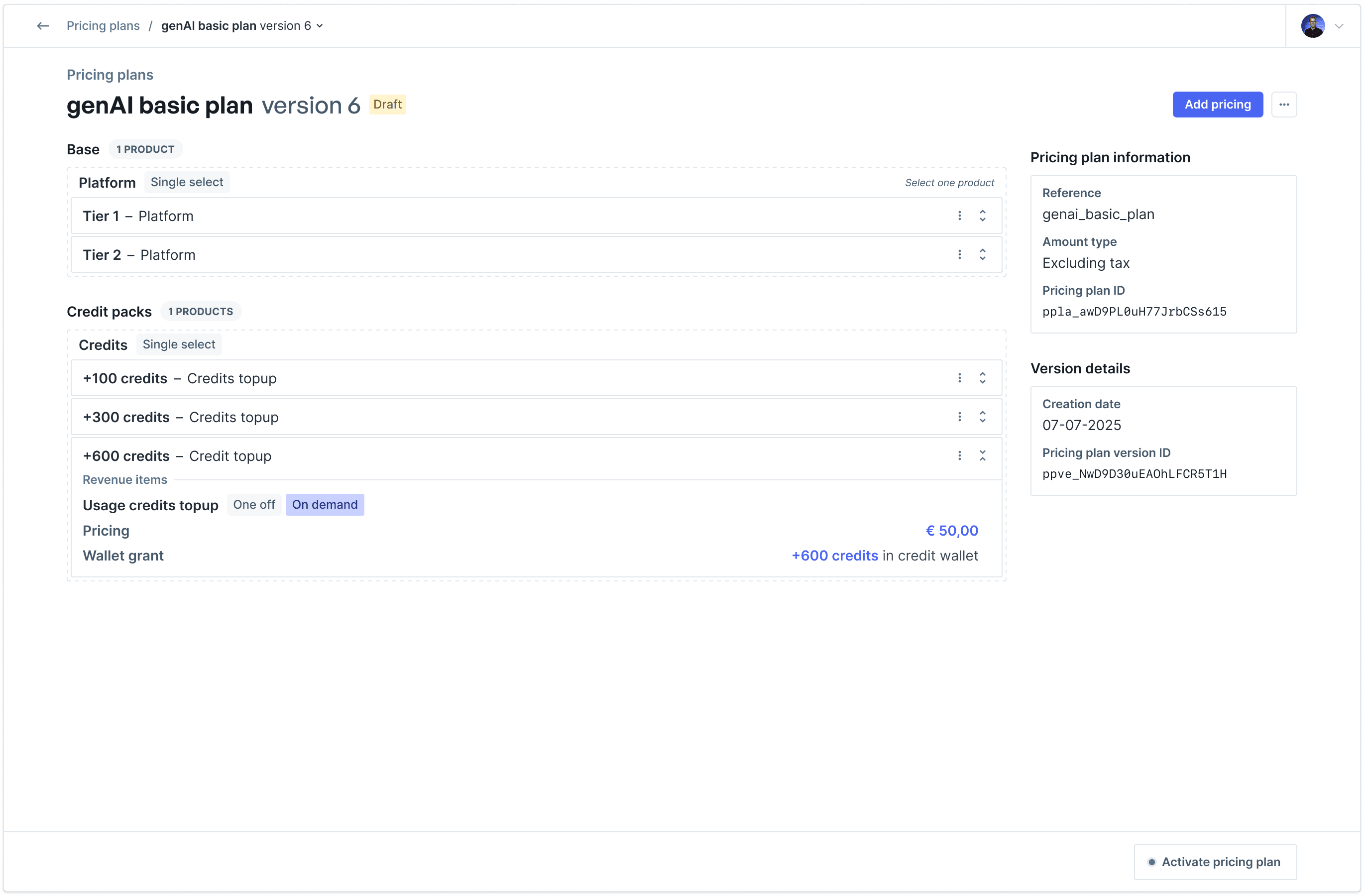
For token billing specifically: Solvimon supports multi-dimensional rate cards that map different token types (input, output, cached) across different models to different prices, all within a single billing configuration. When a provider updates pricing or you add a new model, rate card changes don't require code deploys.
Credit wallets carry full ledger logic with model-specific exchange rates. When a customer's credit buys 100K Haiku tokens or 10K Opus tokens depending on the model used, Solvimon handles that conversion natively with real-time burn-down tracking.
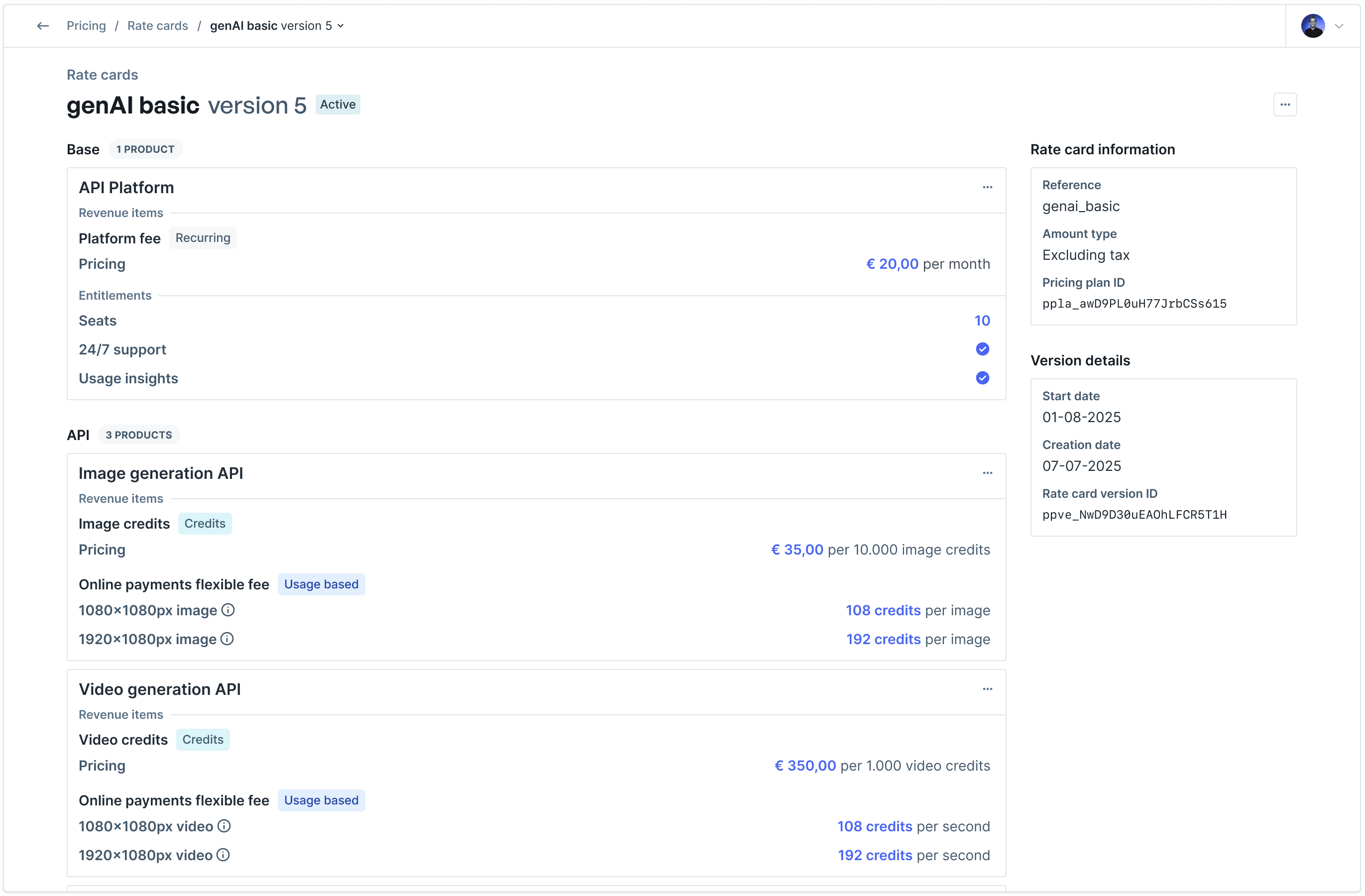
Hybrid billing runs subscriptions, token metering, credit wallets, and enterprise custom contracts in one system. PSP-agnostic (Stripe, Adyen, Checkout.com).
Best for: AI-native companies where token billing complexity is the core problem, not a side feature. Particularly strong for companies running hybrid models across self-serve and enterprise.
Orb
Orb is a usage-based billing engine built for high-volume metering. Its ingestion layer handles 250K+ events per second with deduplication, and billable metrics are defined via SQL or a visual interface, giving engineering teams precise control over how token usage maps to charges.
The credit system uses a block-based architecture: multiple credit blocks per customer, each with its own expiry date and amount. This is more flexible than a single balance field but requires careful configuration for complex scenarios like pooled team credits with tiered exchange rates.
The pricing compiler handles complex logic (tokens + API calls + GPU time + customer-tier multipliers), and Orb Simulations let you model pricing changes against historical data before pushing them live.
The limitation that matters most: Orb is Stripe-only for payment processing. If you're in a region with limited Stripe coverage, or your enterprise customers need invoicing through a different PSP, that's a hard blocker.
Best for: Engineering-heavy AI startups already on Stripe who want maximum control over pricing logic and don't mind investing integration time.
Metronome (acquired by Stripe, January 2026)
Stripe acquired Metronome for ~$1B in January 2026. Before the acquisition, Metronome was the metering layer behind OpenAI, Anthropic, Databricks, and NVIDIA. It processes billions of usage events daily with dedicated streaming infrastructure built on Apache Kafka.
The architecture separates metering, pricing, and contract management into distinct layers. This means you can change pricing logic without touching your measurement code, which is valuable when AI model economics shift.
Post-acquisition, the roadmap is merging with Stripe Billing. Good if you're committed to Stripe's ecosystem, but a risk if you need PSP flexibility or want a billing vendor whose roadmap isn't tied to a payments company's strategic priorities.
Implementation is heavy. Expect weeks of configuration, SQL knowledge, data pipeline setup, and ongoing data engineering bandwidth. No historical data backfilling means you can't retroactively correct pricing errors.
Best for: Enterprise AI companies with dedicated billing engineering teams who are already deep in the Stripe ecosystem and need proven scale.
Amberflo
Amberflo's core differentiator is said to be decoupling the metering cloud from the billing cloud. Each scales independently, which matters when your metering volume (billions of token events) vastly exceeds your billing volume (thousands of invoices).
The platform is specifically built for LLM and AI workloads. It offers multi-model cost attribution, unified pricing tables across 100+ AI models, and an AI gateway with load balancing and fallback routing. If you're routing requests across multiple providers (OpenAI, Anthropic, open-source models), Amberflo can meter and bill across all of them from one system.
Credit support is native: customers buy credits in custom currencies, usage deducts in real time, and the system enforces rollover and expiry rules automatically.
Payment integration is primarily Stripe. Smaller customer base than Orb or Metronome, so fewer proof points at massive enterprise scale.
Best for: AI startups that want LLM-specific billing infrastructure without months of integration work. Fastest time-to-value for AI-specific metering.
Lago
Lago is the open-source option. The core billing engine is free and self-hostable, with a cloud-hosted version available for teams that don't want to manage infrastructure.
For token billing, Lago ships pre-built pricing templates for OpenAI and Mistral models, with dimension-based aggregation that separates input from output tokens at different rates per model. Mistral AI itself uses Lago, generating 32,000+ invoices monthly with per-token billing.
The wallet system supports up to 5 active wallets per customer with scoping to specific billable metrics, configurable priority, and auto-topup rules. It's more granular than most commercial alternatives.
Where Lago stands out for token billing: multi-PSP support. Native integrations with Stripe, Adyen, GoCardless, and Cashfree, plus webhook-based connectivity to others. If PSP flexibility matters (UK businesses, international expansion, enterprise customers with processor requirements), Lago is the only open-source option that handles this natively.
The tradeoff: self-hosted Lago requires Postgres, Redis, and ClickHouse at scale. No built-in dunning or collections workflows. The learning curve is steep if your team isn't API-first.
Best for: Technical teams that want full control over their billing infrastructure.
Chargebee
Chargebee is the most mature subscription billing platform on this list. If your business is primarily subscription-based and you're adding AI-powered features that generate token usage on the side, Chargebee's 200+ integrations, mature dunning, and deep accounting software connectivity (Salesforce, NetSuite, QuickBooks) make it the path of least disruption.
The limitation for token billing: it wasn't designed for real-time, high-frequency event metering. Adding token billing on top of Chargebee typically requires custom engineering to bridge the gap between Chargebee's subscription logic and the real-time metering that token billing demands. Credit ledger depth is limited compared to purpose-built alternatives.
Best for: Mid-market SaaS with mature subscription billing that needs to add token-based AI features without replacing their entire billing stack.
Stripe Billing (LLM Token Billing)
Stripe launched an LLM token billing feature in private preview. It auto-syncs token prices for OpenAI, Anthropic, and Google models, lets you set a markup percentage, and handles metering through the Stripe AI Gateway, integration partners (OpenRouter, Vercel, Cloudflare), or self-reported usage.
This is Stripe's answer to the multi-model metering problem. Instead of creating 20+ meters and hitting the subscription item cap, the token billing feature handles model-by-model metering natively. It supports usage-based, fixed fee with included usage, credit packs, and hybrid models.
The caveats: still in private preview, not generally available. Stripe's 0.7% billing fee on top of payment processing fees means total cost often approaches 1.5%, which compounds at scale. Credit systems are limited, and you're locked to Stripe for payments.
Best for: Early-stage AI companies already on Stripe who want the fastest path to token billing without building infrastructure. Evaluate carefully if you expect to scale past $10M in billing volume.
How to choose: decision framework for token billing
The right platform depends on where you are today and where your billing complexity is headed in 18 months.
If you need... | Consider | Why |
|---|---|---|
Token billing up and running this week on Stripe | Stripe LLM Token Billing | Fastest path if you're already on Stripe and have simple pricing |
Full control, multi-PSP, open-source | Lago | Only open-source option with native multi-PSP support and proven at scale (Mistral AI) |
LLM-specific metering with fast deployment | Amberflo | Purpose-built for AI workloads with decoupled architecture |
Maximum pricing flexibility with engineering investment | Orb | SQL-based metrics and pricing compiler for complex logic |
Enterprise-scale metering in the Stripe ecosystem | Metronome (Stripe) | Proven at OpenAI/Anthropic scale, but heavy implementation |
Subscription business adding light AI billing | Chargebee | Don't rip out mature billing for a side feature |
Tokens, credits, hybrid contracts, multi-PSP in one system | Solvimon | Built for the full complexity of AI billing from day one |
The company that collapses all token types into one abstract billing unit and the company that bills natively across models, token types, and pricing tiers will look identical at $1M ARR. At $10M, one of them is spending two engineering sprints on every pricing change while the other ships a rate card update in an afternoon.
If your billing workaround is currently working, ask yourself: can it handle the next three models you add, the enterprise contract you're negotiating, and the pricing change your competitor just forced?
Frequently asked questions
What's the best AI billing system for small businesses?
For small businesses and early-stage startups, the priority is getting token billing running without over-investing in infrastructure. Stripe's new LLM token billing feature (if you can get into the private preview) or Amberflo's free trial offer the lowest barrier to entry. Solvimon's free tier up to $5M billed is designed for exactly this stage: you get full token and credit billing without paying platform fees while you're finding product-market fit. Avoid over-engineering early, but choose a system that won't force a migration at $2-5M ARR.
Which token billing services work for UK businesses?
PSP coverage is the main consideration. Stripe is available in the UK, so any Stripe-dependent platform (Orb, Metronome, Amberflo) works for payment collection. Lago offers the broadest PSP flexibility with native Adyen and GoCardless integrations alongside Stripe, which matters if your enterprise customers require specific processors or you need BACS Direct Debit support. Solvimon is PSP-agnostic with Stripe and Adyen support, both of which have strong UK presence.
Can I integrate AI billing with my CRM?
Chargebee has the deepest native CRM integrations (Salesforce, HubSpot) out of the box. Orb and Solvimon integrate via API. Lago connects through webhooks. If CRM integration is a priority because your sales team manages enterprise contracts through Salesforce, Chargebee or Solvimon's CPQ capabilities are the most relevant. For self-serve token billing where CRM integration is secondary, the API-first platforms (Orb, Lago, Amberflo) connect through standard webhook patterns.
How does token billing work for e-commerce and AI-powered product features?
If you're an e-commerce platform adding AI features (product recommendations, AI-generated descriptions, chatbots), token billing applies to the AI compute behind those features. The billing question is whether you pass token costs through to your merchants or absorb them into your subscription price. If passing through: you need a billing system that meters AI usage per merchant and adds it to their existing invoice. Solvimon and Orb handle this hybrid model natively. If absorbing: you still need cost visibility per merchant to protect margins, which is the inference cost reconciliation problem that Solvimon's hybrid P&L solves.
For a deep dive on AI credit pricing models, see our companion guide: AI credit pricing models: how tokens, credits, and hybrid billing actually work →
Solvimon handles token billing, credit metering, and hybrid contracts in one system. Free up to $5M billed.